


Close Menu
HitechubHitechub
    What's Hot
    Science

    US Surgeon Contracts Ebola: Family Flown to Germany for Treatment and Monitoring

    Science

    Did Dinosaurs Face Extinction Before the Asteroid Impact? Insights from Cyworthy

    Technology

    Challenges of Space Travel: Why Journeying to Space is So Difficult

    Important Pages:
    • About Us
    • Privacy Policy
    • Terms & Conditions
    Facebook X (Twitter) Instagram Pinterest
    Facebook X (Twitter) Instagram
    HitechubHitechub
    Tuesday, June 23
    • Technology
      1. AI
      2. Gadgets
      3. View All

      This is the most popular CEO in the world

      Sectors in which “Chat-GPT” is most often used

      AI Pioneer Expresses Concern About Potential for AI to Surpass Humanity

      Artificial intelligence has begun to “swallow” professions

      What’s new in Android 14

      Europeans have about 700 million old mobile phones in their drawers

      Here’s how you can tell if your phone is being tapped

      “Sneaker X” – computer case in the shape of a sneaker

      Russian Gamers Unite to Prevent Nuclear War: Join the Fight Online

      Challenges of Space Travel: Why Journeying to Space is So Difficult

      NASA Astronaut Casts Historic Vote from Space

      Discover the Future of Comfort: What If You Could Wear a Chair?

    • Science
      1. Space
      2. Wheels
      3. View All

      Galaxies in the universe are growing more slowly than they should

      “Espace” presented the new lander “Apex 1.0”

      The largest asteroid sample ever collected has arrived on Earth

      (VIDEO) Incredible flight of the Parker Solar Probe

      Toyota wants to make a new generation battery with a range of up to 1,200 km

      Meet Toyota’s lunar “baby” that could make exploring the Moon easier

      Microlino – Is this the perfect city car?

      Alfa Romeo 4C gets an electric successor

      Transformative Brain Changes: What Happens from Your 20s to 40s

      Could Promising Natural Technologies for CO2 Removal Have Unintended Consequences?

      Fusive Neurosurgery Restores Mobility in Paralyzed Pigs – Could Humans Be Next?

      New Research Challenges Long-Standing Beliefs About Human Ancestors’ Growth Trends

    HitechubHitechub
    Home » New Research Challenges Long-Standing Beliefs About Human Ancestors’ Growth Trends
    Science

    New Research Challenges Long-Standing Beliefs About Human Ancestors’ Growth Trends

    Share Facebook Twitter Pinterest WhatsApp
    Share
    Facebook Twitter LinkedIn Pinterest WhatsApp

    For decades, paleoanthropologists have posited that hominins, the ancestors of modern humans, evolved gradually over millions of years. However, new research from the University of Reading significantly complicates this narrative. The most substantial change in body size appears to have occurred between 2 million and 2.5 million years ago, with species like Homo rudolfensis and Homo erectus/ergaster. Meanwhile, smaller species such as Homo floresiensis and Homo naledi, along with early humans like Australopithecus, averaged only 40 kg in weight and reached heights similar to that of a child. In contrast, Homo erectus/ergaster marked the first humans to exceed an average weight of 60 kg, aligning more closely with many modern humans.

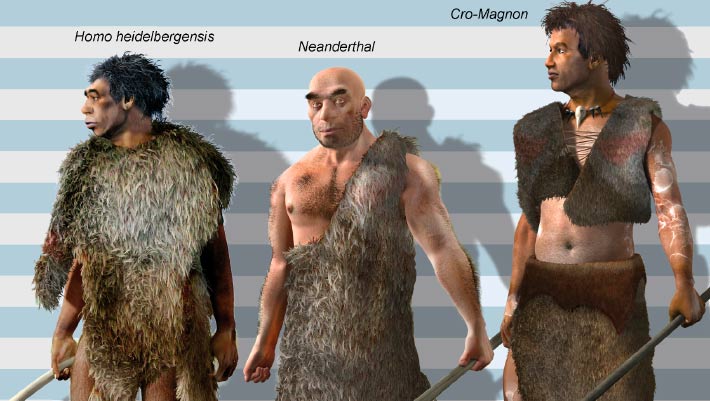
    Homo heidelbergensis, Neanderthal, Cro-Magnon. Image credit: SINC / Jose Antonio Peñas.

    An illustration of Homo heidelbergensis, alongside Neanderthals and Cro-Magnons. Image credit: SINC / Jose Antonio Peñas.

    Body size plays a crucial role in organismal biology, impacting aspects like ecology, life history, physiology, and neuroanatomy.

    Within the framework of hominin evolution, an increase in body size correlates with larger brains, enhanced bipedalism, and a broader range of movement.

    Despite its significance, there remains a lack of consensus on whether hominin body size consistently increased over time.

    Recent studies present conflicting perspectives, with some challenging the general trend of evolutionary size increase, while others advocate for overall growth in weight and height.

    Notably, the small-bodied species, such as Homo floresiensis and Homo naledi, are often cited as exceptions to the general trend.

    Moreover, some researchers propose that increases in size may be species-specific or occur following certain evolutionary milestones within the genus Homo.

    However, tests assessing lineage-specific size fluctuations alongside broader trends have not yet been implemented within a single model.

    “Throughout the years, a variety of studies have produced divergent conclusions regarding whether our ancestors consistently grew in size or experienced rapid growth at critical junctures,” stated lead author Dr. Jacob Gardner from the University of Reading.

    “The variation arises because researchers have been focusing on distinct aspects of a much larger narrative.”

    “By synthesizing all available fossil evidence, evaluating multiple competing theories, and elucidating species relationships, a more coherent picture has emerged. It’s likely that the reality encompasses a blend of these theories.”

    “The narrative of human evolution isn’t solely one of unbroken growth, but also of significant transformations within our genus, while other branches of our family tree, including some surprisingly diminutive relatives, followed their own unique trajectories.”

    In the recent study, Dr. Gardner and colleagues analyzed estimated body weights from 386 fossil specimens encompassing 21 human species, from ancient australopiths to modern Homo sapiens.

    Employing advanced statistical models to clarify evolutionary connections between species, researchers determined that the narrative of human body size is considerably more intricate than a straightforward upward trend.

    The data highlights a distinct increase in size, particularly among later members of the genus Homo — roughly following Homo habilis — as opposed to a consistent rise throughout human history.

    Species such as Homo ergaster and Homo erectus appear to exemplify a genuine leap in size, coinciding with pivotal evolutionary shifts, including improved bipedalism and carnivorous adaptations.

    A more generalized and gradual increase in body size across all hominins garners only moderate support, heavily influenced by the fossil datasets and estimation techniques employed, which often leads to disagreements in the field.

    Two notable exceptions are the species Homo floresiensis from Indonesia and Homo naledi, both of which fall significantly below their average body weight expectations for that era.

    “Our findings indicate that the evolution of human body size is not merely a tale of gradual growth,” remarked co-author Dr. Thomas Pushell from the University of Oxford.

    “While weight has generally escalated throughout our evolutionary journey, the most impactful changes transpired later within the genus Homo.”

    “Such changes align with significant modifications in how our ancestors navigated their environments and exploited available resources, underscoring the tight interplay between body size and major ecological as well as behavioral developments.”

    These findings are published in the latest issue of Proceedings of the National Academy of Sciences.

    _____

    Jacob D. Gardner et al. 2026. Competing models of human body size evolution. PNAS 123 (27): e2521732123; doi: 10.1073/pnas.2521732123

    Source: www.sci.news

    Share. Facebook Twitter Pinterest LinkedIn WhatsApp
    Previous ArticleDiscover the Simple Method to Slow Brain Decline That Most Haven’t Tried
    Next Article Fusive Neurosurgery Restores Mobility in Paralyzed Pigs – Could Humans Be Next?

    Related Posts

    Science

    Transformative Brain Changes: What Happens from Your 20s to 40s

    Science

    Could Promising Natural Technologies for CO2 Removal Have Unintended Consequences?

    Science

    Fusive Neurosurgery Restores Mobility in Paralyzed Pigs – Could Humans Be Next?

    Science

    Discover the Simple Method to Slow Brain Decline That Most Haven’t Tried

    Science

    How Menopause Transforms Brain Function and What to Expect Post-Menopause

    Science

    New Discoveries Indicate Interstellar Comet 3I/ATLAS Originated 12 Billion Years Ago

    Science

    Breakthrough: Woman with Alzheimer’s Disease Begins Speaking Again After Psilocybin Treatment

    Science

    Discover How Pollen Could Unlock the Longevity Secrets of Heliconius Butterflies

    Add A Comment
    Leave A Reply Cancel Reply

    Stay In Touch
    • Facebook
    • Twitter
    • Instagram
    • Pinterest
    Top Picks
    Science

    Webb Discovers Most Distant Inactive Black Hole Ever Detected

    A supermassive black hole, six billion times the mass of the Sun, has been identified…

    Will We See a Practical, Error-Free Quantum Computer Within Two Years?

    Discovering the Universe: How the Electromagnetic Spectrum Expanded Our Understanding

    Astronomers Discover the Missing Black Hole Wind in the Milky Way Galaxy

    Overlooked Pollutants Account for 15% of Global Warming: What You Need to Know

    Most Popular
    Science

    Fishing Restrictions Lifted in Western Reservoirs Facing Drought-Related Drying

    AI

    AI created opening credits for the series “Friends”

    Categories
    • AI (13)
    • Gadgets (10)
    • Science (322)
    • Space (9)
    • Technology (37)
    • Wheels (9)
    Our Picks
    Science

    BBC Science Focus Crossword Solution #434: Complete Guide and Answers

    Science

    7 Common Autism Myths Experts Urge You to Stop Believing

    © 2026 Hitechub.
    • Home
    • About Us
    • Privacy Policy
    • Terms & Conditions

    Type above and press Enter to search. Press Esc to cancel.

    We are using cookies to give you the best experience on our website.

    You can find out more about which cookies we are using or switch them off in .

    Ad Blocker Enabled!
    Ad Blocker Enabled!
    Our website is made possible by displaying online advertisements to our visitors. Please support us by disabling your Ad Blocker.
    Hitechub
    Powered by  GDPR Cookie Compliance
    Privacy Overview

    This website uses cookies so that we can provide you with the best user experience possible. Cookie information is stored in your browser and performs functions such as recognising you when you return to our website and helping our team to understand which sections of the website you find most interesting and useful.

    Strictly Necessary Cookies

    Strictly Necessary Cookie should be enabled at all times so that we can save your preferences for cookie settings.