


Close Menu
HitechubHitechub
    What's Hot
    Science

    Will We See a Practical, Error-Free Quantum Computer Within Two Years?

    Wheels

    Microlino – Is this the perfect city car?

    Science

    El Niño Has Arrived: What You Need to Know About Its Potential Impact

    Important Pages:
    • About Us
    • Privacy Policy
    • Terms & Conditions
    Facebook X (Twitter) Instagram Pinterest
    Facebook X (Twitter) Instagram
    HitechubHitechub
    Wednesday, June 24
    • Technology
      1. AI
      2. Gadgets
      3. View All

      This is the most popular CEO in the world

      Sectors in which “Chat-GPT” is most often used

      AI Pioneer Expresses Concern About Potential for AI to Surpass Humanity

      Artificial intelligence has begun to “swallow” professions

      What’s new in Android 14

      Europeans have about 700 million old mobile phones in their drawers

      Here’s how you can tell if your phone is being tapped

      “Sneaker X” – computer case in the shape of a sneaker

      Russian Gamers Unite to Prevent Nuclear War: Join the Fight Online

      Challenges of Space Travel: Why Journeying to Space is So Difficult

      NASA Astronaut Casts Historic Vote from Space

      Discover the Future of Comfort: What If You Could Wear a Chair?

    • Science
      1. Space
      2. Wheels
      3. View All

      Galaxies in the universe are growing more slowly than they should

      “Espace” presented the new lander “Apex 1.0”

      The largest asteroid sample ever collected has arrived on Earth

      (VIDEO) Incredible flight of the Parker Solar Probe

      Toyota wants to make a new generation battery with a range of up to 1,200 km

      Meet Toyota’s lunar “baby” that could make exploring the Moon easier

      Microlino – Is this the perfect city car?

      Alfa Romeo 4C gets an electric successor

      How Parenting Boosts Brain Health for Moms and Dads: Long-Term Benefits

      New Feathered Dinosaur from China Discovered with Stunning Peacock-Like Tail

      Mayan Elite Buried Their Teeth in Caves: Unearthing Ancient Rituals Beyond Graves

      Exploring the Timeless and Universal Bond Between Humans and Dogs: Findings from Recent Study

    HitechubHitechub
    Home » Discovering the Universe: How the Electromagnetic Spectrum Expanded Our Understanding
    Science

    Discovering the Universe: How the Electromagnetic Spectrum Expanded Our Understanding

    Share Facebook Twitter Pinterest WhatsApp
    Share
    Facebook Twitter LinkedIn Pinterest WhatsApp

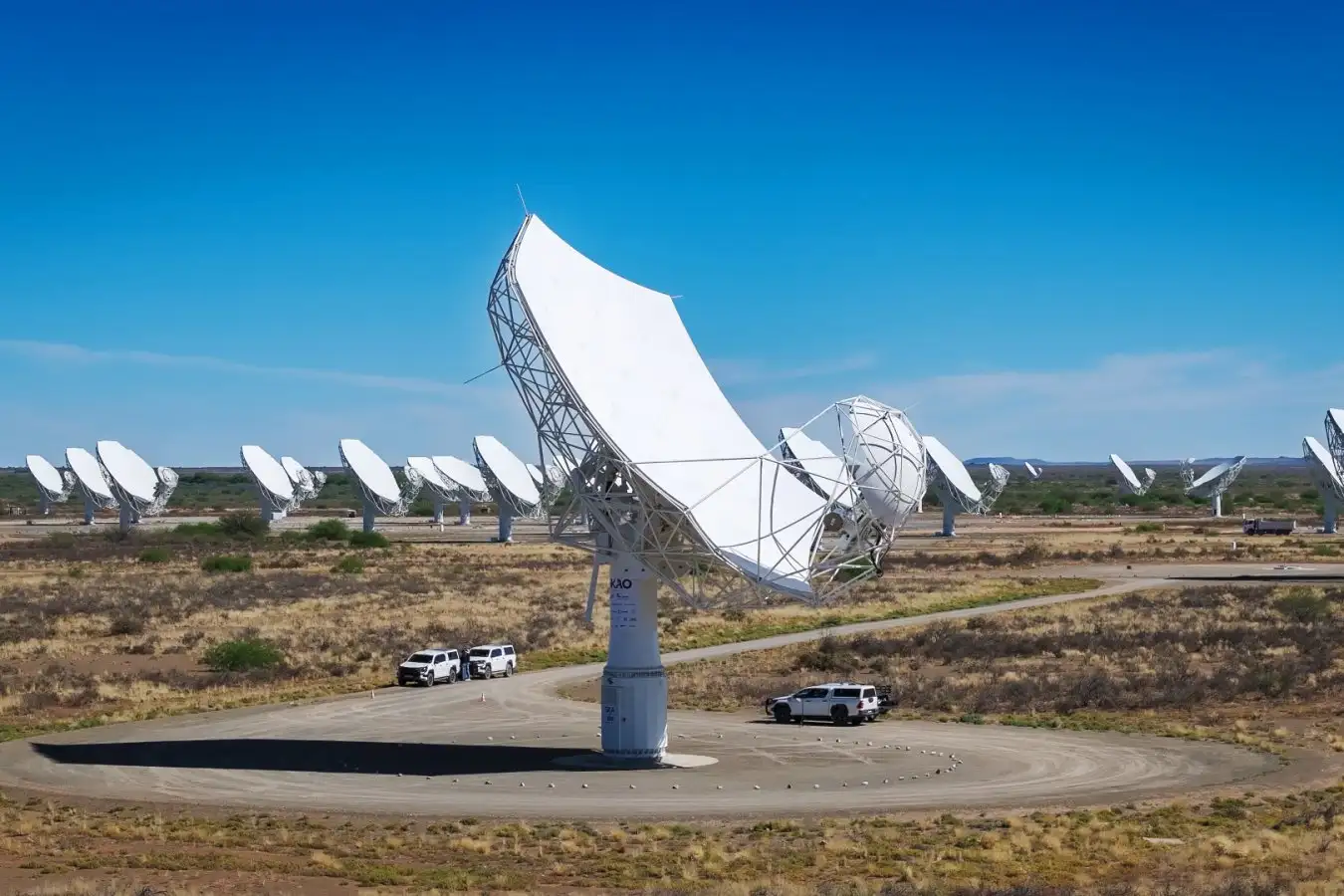
    Square Kilometer Array Telescope

    SKAO

    Welcome to our “Lost in Time and Space” newsletter! Each month, we explore captivating concepts from around the globe. Sign up for the “Lost in Time and Space” newsletter here.

    My fascination with invisible light began in childhood, reminiscent of magic. Radios echoed through my home, each room filled with static as I searched for music and conversations hidden within. It wasn’t until later that I grasped my child’s wonder at the invisible world around us, connected through the electromagnetic spectrum.

    The human eye has evolved to perceive a narrow range of light, sufficient for navigating terrain and spotting threats. However, the universe radiates a vast spectrum, from gamma rays to radio waves. Each wavelength interacts differently with matter, revealing diverse aspects of our world. In our everyday lives, we regularly witness these interactions. For instance, microwaves excite water molecules, making them excellent for reheating meals, while X-rays penetrate soft tissues but are absorbed by bones, crucial for medical imaging.

    Radio waves, with their long wavelengths and low energy, travel great distances with minimal interruption, effortlessly passing through Earth’s atmosphere. As experienced during my childhood, radio waves serve as vital communication tools on Earth and messengers from the cosmos. Eventually, this passion led me to cosmology and the use of radio telescopes to explore the universe’s early stars and galaxies.

    The electromagnetic spectrum, as we know it today, is the culmination of centuries of scientific inquiry. It began with a prism in 1665, when Isaac Newton demonstrated that white light could be divided into a spectrum of colors from red to violet. By 1800, astronomer William Herschel discovered infrared light through a prism, noticing temperature increases beyond red light. The 19th century brought the revelation of radio waves, microwaves, X-rays, and gamma rays, forming our contemporary understanding of the spectrum.

    Unveiling the Invisible

    Optical astronomy is as ancient as civilization itself, emerging from humanity’s natural ability to perceive sunlight and starlight. Other wavelengths require specialized tools—antennas for radio waves and microwaves, detectors for X-rays and infrared radiation. Each wavelength can be likened to a different language. To decipher the universe, we must translate these wavelengths into forms we comprehend, whether through light for our eyes or sound for our ears, revealing a complete narrative of hidden histories.

    To illuminate the universe fully, we need the entire spectrum. For example, ultraviolet light reveals water plumes erupting from Europa, one of Jupiter’s moons. The giant planet’s magnetic field interacts with the moon’s atmosphere, producing vivid auroras at ultraviolet wavelengths. Observing these changes helps astronomers deduce the presence of water ejected from an ocean beneath Europa’s icy crust.

    Composite Images of Europa

    Composite Image of a Suspected Water Plume from Europa

    NASA, ESA, W. Sparks (STScI), and USGS Astrogeology Science Center

    The James Webb Space Telescope (JWST), located 1.5 million kilometers from Earth, has transformed our understanding of early star and galaxy formation. With its expansive, shaded lens akin to a tennis court, it grants us the clearest view yet into the universe.

    As the universe expands, light from ancient galaxies shifts to infrared wavelengths, a phenomenon known as redshift, efficiently observed by JWST. By labeling infrared wavelengths with optical colors, we can observe galaxies dating back just hundreds of millions of years post-Big Bang. However, some present with unexpected sizes, challenging prior assumptions about star formation and galaxy development.

    Astronomers collect older light shifted to radio wavelengths, utilizing the Square Kilometer Array (SKA) comprising over 100,000 antennas across Western Australia. This immense radio observatory captures faint signals dating back to shortly after the Big Bang, interpreting messages from early stars and black holes. Beyond this, it facilitates diverse observations, including the mapping of the Milky Way and potential signs of extraterrestrial life.

    The Search for Extraterrestrial Intelligence (SETI) particularly captivates me, showcasing how various wavelengths complement each other to deepen our understanding of the universe. Using optical telescopes, like the Transiting Exoplanet Survey Satellite (TESS), astronomers catalog thousands of exoplanets by observing changes in star brightness as these planets transit. Subsequently, IR telescopes like JWST analyze exoplanet atmospheres to gauge habitability. Finally, radio telescopes target likely life-supporting planets, listening for potential signals—be it transmissions or unintentional radio waves like television broadcasts.

    While our innate language is limited to one form of light, the universe speaks many dialects. The electromagnetic spectrum serves as a Rosetta Stone, helping us interpret invisible tales penned in the cosmos. Together, we can tune into a richer universe far beyond the capabilities of our unaided sight.

    Emma Chapman is an astrophysicist at the University of Nottingham, UK, and author of Radio Universe: How to Explore Space Without Leaving Earth (John Murray, 2026).

    Topics:

    Source: www.newscientist.com

    Share. Facebook Twitter Pinterest LinkedIn WhatsApp
    Previous ArticleBoost Your Brainpower: Essential Tips for Strengthening Your Cognitive Health in Middle Age
    Next Article Roborace Car Makes Historic Street Circuit Debut in Marrakech

    Related Posts

    Science

    How Parenting Boosts Brain Health for Moms and Dads: Long-Term Benefits

    Science

    New Feathered Dinosaur from China Discovered with Stunning Peacock-Like Tail

    Science

    Mayan Elite Buried Their Teeth in Caves: Unearthing Ancient Rituals Beyond Graves

    Science

    Exploring the Timeless and Universal Bond Between Humans and Dogs: Findings from Recent Study

    Science

    How Hot Is Too Hot? When to Turn Off Your Fan for Optimal Comfort

    Science

    New Research Shows Domestic Cats Age Similar to Humans: What You Need to Know

    Science

    SpaceX’s Innovative Strategy for Earth Cargo Delivery from Space

    Science

    The Great Zoo Escape: What Happened After the Largest Animal Escape in History?

    Add A Comment
    Leave A Reply Cancel Reply

    Stay In Touch
    • Facebook
    • Twitter
    • Instagram
    • Pinterest
    Top Picks
    Science

    Tropical Storm Arthur: First Named Storm of the Season with Flash Flooding Threat

    The Southeastern United States is bracing for significant flash flooding and extended flooding as Tropical…

    What has Tesla’s Optimus robot learned so far?

    How Pursuing Big Dreams Can Lead to Exhaustion and Emotional Strain

    Severe Weather Disrupts U.S. Travel: Storms, Floods, and Heatwaves Coincide with World Cup and Holiday Rush

    Challenges of Space Travel: Why Journeying to Space is So Difficult

    Most Popular
    Science

    NASA’s Stunning New Image Reveals the Incredible Power of a Supermassive Black Hole

    Science

    Structural changes in the women’s brain during the menstrual cycle?

    Categories
    • AI (13)
    • Gadgets (10)
    • Science (334)
    • Space (9)
    • Technology (37)
    • Wheels (9)
    Our Picks
    Science

    Boost Your Mood Daily with a Glass of Fruit Juice: Study Insights

    Technology

    Challenges of Space Travel: Why Journeying to Space is So Difficult

    © 2026 Hitechub.
    • Home
    • About Us
    • Privacy Policy
    • Terms & Conditions

    Type above and press Enter to search. Press Esc to cancel.

    We are using cookies to give you the best experience on our website.

    You can find out more about which cookies we are using or switch them off in .

    Ad Blocker Enabled!
    Ad Blocker Enabled!
    Our website is made possible by displaying online advertisements to our visitors. Please support us by disabling your Ad Blocker.
    Go to mobile version
    Hitechub
    Powered by  GDPR Cookie Compliance
    Privacy Overview

    This website uses cookies so that we can provide you with the best user experience possible. Cookie information is stored in your browser and performs functions such as recognising you when you return to our website and helping our team to understand which sections of the website you find most interesting and useful.

    Strictly Necessary Cookies

    Strictly Necessary Cookie should be enabled at all times so that we can save your preferences for cookie settings.