


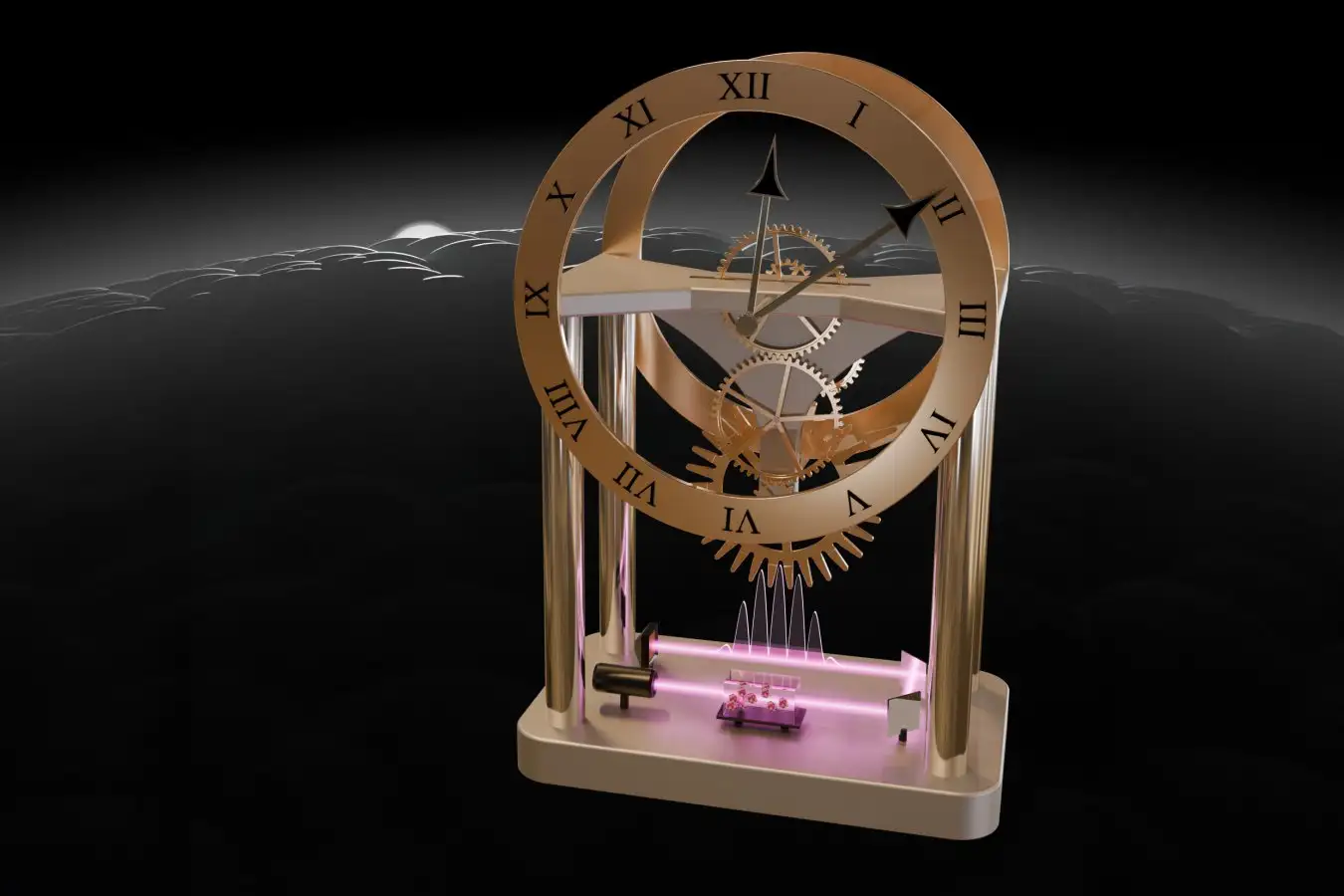
Innovative Concept of a Nuclear Clock
Credit: Oliver Diekmann, Vienna University of Technology
Researchers have successfully created the world’s first operational nuclear clock, harnessing the vibrations of atomic nuclei for precise time measurement. This breakthrough, two decades in the making, could revolutionize accurate timekeeping and open avenues for groundbreaking physics experiments.
Current state-of-the-art atomic clocks utilize electrons to keep time, relying on their movements between various energy levels or orbitals around an atom’s nucleus. By exciting electrons with specific frequencies of light, researchers can measure time much like the classic ticking of a grandfather clock.
These atomic clocks employ laser technology tuned to electron-exciting nuclear frequencies to stimulate atom collections. Deviations from the correct frequency lead to fewer electrons jumping between energy levels, prompting the system to adjust the frequency for maximum accuracy. Such atomic clocks can maintain an error margin of just seconds over a billion years.
Nuclear clocks might eventually surpass this accuracy due to their reliance on the more stable energy transitions of atomic nuclei. These nuclei have higher energy requirements for excitation, suggesting they could function accurately over vast timescales far exceeding the universe’s age.
Nonetheless, the development of effective nuclear clocks has faced challenges since the majority of atomic nuclei need more energy for excitation than the most powerful lasers can provide. Fortunately, radioactive thorium stands out as a prime candidate for nuclear clocks, requiring relatively lower energy for excitation.
Recent developments by Torsten Schumm and his team at Vienna University of Technology have yielded a thorium-based clock that hints at potential in identifying dark matter particles. “This achievement sums up over 15 to 20 years of research,” Schumm notes. “It’s remarkable to see dreams come to fruition for many researchers.”
While prior attempts demonstrated that thorium’s nuclear frequencies could be excited with appropriate lasers, they lacked a reliable tuning mechanism. As Harry Morgan from the University of Manchester puts it, “If there’s ever been a moment of breakthrough, this is it.”
The newly developed clock works by embedding thorium within a calcium fluoride crystal and illuminating it with an ultraviolet laser. This laser functions as the clock’s hands, oscillating between two frequencies around thorium’s nuclear frequency. If both frequencies are equally absorbed by thorium, the laser is correctly tuned; discrepancies prompt adjustments.
Though current nuclear clocks lack the precision of the best atomic clocks, losing tens of seconds every billion years, Schumm’s team believes this prototype demonstrates potential for improvement.
Team members are encouraged by the surprising performance of this prototype, as Ekkehard Peik from the German National Metrology Institute comments, “What impressed me most was the system’s ability to run continuously for 24 hours without user intervention, something no other optical clock has managed this quickly.”
Despite the current limitations, nuclear clocks offer advantages over atomic clocks. The atomic nucleus is shielded from the chaotic electromagnetic environments of surrounding electrons, allowing for measurements of physical influences sensitive to very precise transitions. This unique feature makes them potentially more accurate for fundamental physics measurements.
Additionally, nuclear clocks can operate at room temperature without the need for extreme cooling or vacuum conditions common in atomic clocks. “This simplicity is groundbreaking,” Schumm adds.
This characteristic may pave the way for these clocks to be miniaturized for diverse applications, like satellite experiments testing the theory of relativity. “Current capabilities are below the state-of-the-art, but we anticipate significant advancements shortly,” asserts Eric Hudson from UCLA.
By leveraging the high-energy transitions of thorium nuclei, the team was able to investigate potential dark matter particles. If dark matter behaves like an electromagnetic force permeating the universe, it should subtly modify nuclear energy transitions, affecting the clock’s operating frequency due to thorium’s elevated nuclear characteristics. As Schumm explains, “It’s akin to measuring length variations in a metal when temperature changes impact its dimensions.”
Topic:
Source: www.newscientist.com