


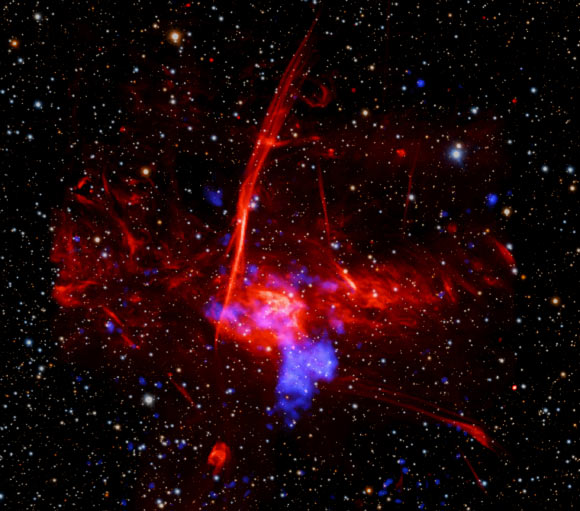
Astronomers, utilizing NASA’s Chandra X-ray Observatory and ESA’s XMM-Newton satellite, have discovered potential remnants of an ancient supernova explosion located merely a few dozen light-years from Sagittarius A*, the supermassive black hole at the heart of the Milky Way galaxy.
This composite image includes X-rays from the Chandra and XMM-Newton missions (shown in blue), radio data from the MeerKAT telescope in South Africa (shown in red), and optical images (red, green, and blue) from the Pan-STARRS telescope in Hawaii. Image credits: NASA / CXC / UCLA / Zhu et al. / ESA / XMM-Newton / Pan-STARRS / MeerKAT / CSA / STScI / SAO / L. Frattare & P. Edmonds.
Recent findings indicate a new supernova remnant candidate approximately 26,000 light-years from Earth, derived from X-ray data collected by the Chandra and XMM-Newton missions.
The X-ray observations unveiled an unusual ‘clump’ of X-ray radiation, concealed within a vast cloud of expanding gas, possibly originating from the remains of a massive star that underwent a supernova explosion.
This structure exists within a bubble of gas (known as an HII region) surrounding a youthful, massive star, where hydrogen has lost its electrons.
This bubble is characterized as a prominent radio emitter known as Sagittarius C.
If verified as a supernova remnant, it is expanding at approximately 3.2 million kilometers per hour (2 million miles per hour) and is estimated to be at least 1,700 years old.
Prior observations from NASA’s SOFIA mission provided clues about a gas shell enveloping Sagittarius C, hinting at past stellar explosions in the vicinity.
The long filaments captured in radio images arise primarily from high-energy particles navigating magnetic fields that are oriented perpendicular to the galactic plane.
A star’s fusion process creates elements from hydrogen and helium, which were plentiful in the early universe.
When a star culminates its life cycle in a supernova explosion, the newly formed elements are dispersed into interstellar space, contributing to the next generation of stars and planets.
The researchers meticulously examined the X-ray data for signs indicating an increase in the abundances of essential elements within the debris, potentially propelled into space by the exploding star.
However, they found no enhancement, suggesting that the stellar debris may already be integrating with the surrounding gas.
Another hypothesis regarding the X-ray clump suggests it could originate from a cluster of massive stars in the region.
Yet, this alternative explanation appears improbable, as the X-ray emissions from this anomaly are over 10 times more intense than those from established clusters containing bright, massive stars, according to the scientists.
For further details, refer to their study published in the April 16th edition of the Astrophysical Journal.
_____
Zhu Zhenlin et al. 2026. Diffuse emission of X-rays in the Sagittarius C complex. APJ 1001, 197; doi: 10.3847/1538-4357/ae547c
Source: www.sci.news