


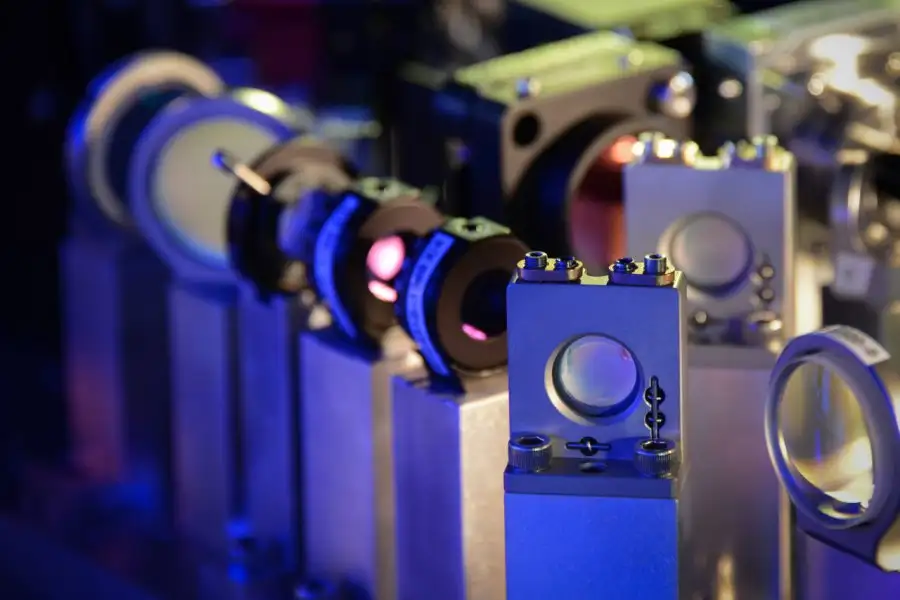

Exploring Optical Components in Atom Computing’s Quantum Computers
Credit: Atom Computing
The race for the first practical quantum computer is gaining momentum. A new quantum computer, utilizing ultra-cold atoms, has achieved significant milestones on its path to practical implementation, joining a select group of advanced machines.
Experts agree that a sufficiently powerful quantum computer could revolutionize material discovery, drug development, and cyber-security by breaking codes that underpin the Internet. However, various methodologies are competing to determine the optimal approach for building these devices. Industry leaders such as Google and IBM have invested over ten years in developing quantum computers based on superconducting circuits, currently viewed as the frontrunners in this domain.
In contrast, a novel approach utilizing electrically neutral ultracold atoms is gaining traction. Ben Bloom and his team at Atom Computing have constructed a neutral atomic quantum computer that meets critical requirements for error detection and correction, essentials for practical utility.
“This represents a major milestone for neutral atomic systems,” Bloom asserted. “Previously, we focused on incremental improvements; now our goal is to innovate faster, better, and cheaper.”
The focus of their research is on error correction—an essential ability for quantum computers to identify errors in calculations, discard faulty processes, and restart accurately. Quantum computers are notoriously prone to errors, making robust error correction one of the largest challenges to their practical application.
In error correction, information is shared across qubit clusters, with certain qubits designated as alerts when errors surface, enabling timely corrections.
Atom Computing’s researchers demonstrated that they could expand the size of error-correcting qubit groups from 16 to 32 without increasing error rates. Notably, larger qubit groupings correspond to lower error rates—a crucial factor for amplifying a quantum computer’s power.
In 2023, Google and researchers from the University of Science and Technology of China successfully increased both qubit counts and reduced error rates in superconducting quantum computers. Furthermore, in 2025, a Harvard University team showed similar advancements using another neutral atomic quantum computer. Bloom emphasized that their new experiment is groundbreaking, allowing continuous error checks and qubit evaluations up to 90 times in succession. “Ultimately, our aim is to achieve infinite error correction,” he stated.
Addressing industrial challenges necessitates not only vast qubit numbers but also continuous, reliable operation. The Atom Computing team claims their new findings demonstrate their capability to achieve both. “This is the first study to consolidate all functionalities required to construct a functioning neutral atomic quantum computer,” commented Jeff Thompson from Princeton University, noting that while the results are promising, further enhancements in error rates and computational speed are still needed.
Mark Safman, a leading researcher at the University of Wisconsin-Madison, believes this represents another stride towards establishing a neutral atomic quantum computer that can operate continuously, akin to conventional computers. However, he cautioned that even after 90 error checks, the quantum computer experienced additional error accumulation, which could diminish its efficacy.
Bloom and his colleagues are diligently working on addressing these errors and are optimistic about enhancing quantum computer performance. They view this new research, alongside contributions from other teams, as positioning neutral atomic quantum computers as formidable contenders against superconducting qubit systems.
“This research signifies that the barriers preventing neutral atoms from matching superconducting qubits are beginning to be resolved,” Bloom remarked. Thompson echoed this sentiment by stating, “We anticipate swift advancements throughout the industry.”
Topics:
Source: www.newscientist.com