


An asteroid or comet striking Earth could cause significant damage, although modern astronomy is improving both the detection of potentially hazardous objects and the ability to study planetary-defense strategies. The 1908 Tunguska event demonstrated the danger when a space rock, probably tens of meters wide, exploded over Siberia, leaving visible scars on the landscape even when scientists reached the site roughly 20 years later.
The Tunguska event remains one of the clearest examples of the damage a cosmic object can cause without striking the ground directly. The subject has also featured in Hollywood films, but the possibility of a future impact is a real scientific concern.
Apophis will make a close approach in 2029
Astronomers predict that the asteroid Apophis will pass close to Earth in mid-April 2029. The asteroid is about a quarter of a mile wide and is expected to pass within 19,000 miles of Earth—roughly 12 times closer than the Moon and closer than many satellites. It will become visible to the naked eye.
Over the past few decades, scientists have made major advances in predicting the movements of near-Earth objects. Space probes have improved knowledge of the Solar System’s small bodies, while astronomical observations now provide increasingly reliable and detailed data for identifying potentially dangerous asteroids.
Detecting a threat, however, is only part of the challenge. Planetary defense also requires technology capable of deflecting a dangerous object early enough to prevent an impact.
Changing an asteroid’s path
Science-fiction films often resolve an asteroid threat with a nuclear explosion. In reality, breaking a large cosmic object into smaller pieces would not necessarily eliminate the danger. A better approach could be to alter the asteroid’s orbit.
Objects in space are constantly moving, as is Earth, which travels at about 20 miles per second. If a threatening asteroid could be slowed slightly or otherwise redirected so that it reached the point of intersection a little later, it might miss Earth entirely.
NASA’s DART planetary-defense test
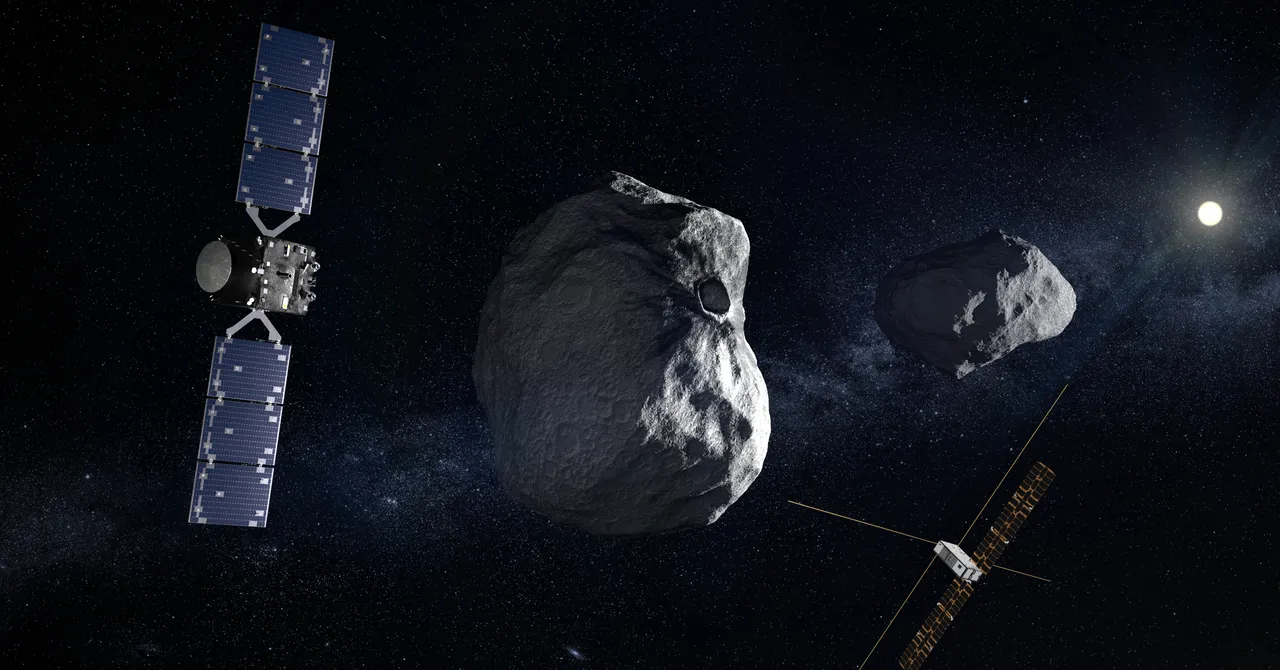
Four years ago, NASA tested this basic strategy on a pair of objects named Didymos and Dimorphos. Astronomers at Kitt Peak Observatory discovered the 780-meter-diameter asteroid Didymos 30 years ago. A few years later, Czech astronomer Petr Plavec observed that Didymos had a “satellite” orbiting it roughly every 12 hours.
The smaller object, about 151 meters in diameter, was named Dimorphos. Together, the two bodies provided a useful testing ground for studying how a planetary-defense system could deflect an asteroid.
To carry out the test, NASA launched the Double Asteroid Redirection Test (DART) in late 2021. Almost a year later, the DART spacecraft deliberately crashed into Dimorphos, testing whether a spacecraft impact could change the orbit of a small asteroid.
Source: www.wired.com