


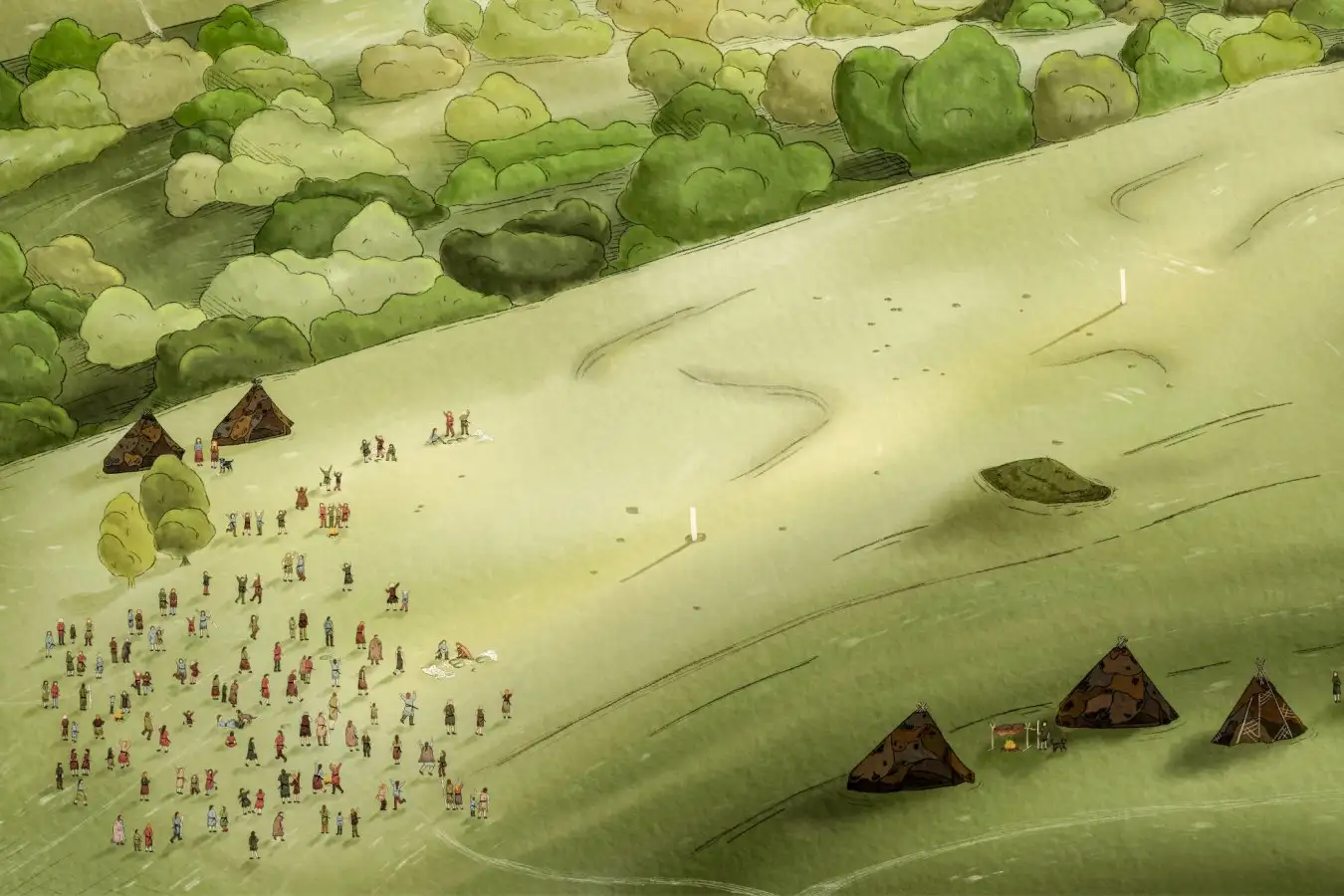

A reenactment of the summer solstice celebrations that might have taken place in Bulford, England, thousands of years ago
Credit: Marijane Porter, Wessex Archaeology
Archaeological discoveries reveal that Stone Age people in Britain constructed wooden monuments to mark the summer solstice 500 years prior to the establishment of the iconic stone circles at Stonehenge.
This ancient structure not only aligns with the summer solstice but may have also served as a precursor to Stonehenge, signifying one of the earliest instances of monuments dedicated to celestial events in Britain.
As Phil Harding from Wessex Archaeology noted, “What we have now is tangible evidence that these early Britons understood the sun’s movement.” This statement was made during a press briefing announcing the finding.
Stonehenge, built toward the latter part of the Stone Age during the Neolithic period, is located on Salisbury Plain, England. It features an outer ring composed of vertical sarsen stones topped with horizontal lintels and a smaller inner ring of vertical bluestones, all surrounded by earthworks. This oldest section was constructed around 3100 BC, with further modifications made until 1600 BC.
Notably, many of the standing stones are meticulously aligned to indicate sunrise on the summer solstice and sunset on the winter solstice. The associated bluestones were erected around 2500 BC.
During excavations in the vicinity, Harding and his team uncovered the remains of a 500-year-old monument near the village of Bulford, approximately five kilometers northeast of Stonehenge. This site was excavated by Wessex Archaeology between 2015 and 2017 due to a planned housing project by the British Ministry of Defense, which aimed to accommodate around 5,000 soldiers.
The research team found pits containing fluted pottery typical of late Neolithic eras, with radiocarbon dating indicating that these artifacts date back to around 2950 BC. Harding stated, “This site appears to have been occupied for a relatively brief period, roughly 10 years.”
Susan Greaney from the University of Exeter, who was not part of the research, emphasized the site’s significance, adding, “This represents a crucial Middle Neolithic settlement.”

Pottery unearthed in Bulford, England
Credit: Wessex Archaeology
Two pits at Bulford revealed unique shapes, tapering from 1.2 meters at the top to just 0.5 meters at the bottom, filled with chalk rubble instead of pottery. Researchers believe these were postholes that once held upright timber structures, supported by the rubble base, with one posthole containing rowan charcoal.
These postholes are located roughly 120 meters apart, with a line drawn between them pointing about 48.1 degrees northeast—aligning with the midsummer sunrise. “I was thrilled when I noticed this alignment,” Harding expressed.
Wessex Archaeology engaged Fabio Silva, a skyscape archaeologist, to study the alignment of these postholes. Using a 3D landscape reconstruction, Silva assessed the sun’s trajectory and found that the postholes corresponded well with ancient summer solstice sunrises.
Though the alignment was slightly off (by about one degree), Silva noted that this was understandable due to the potential width of the wooden pillars being up to 50 centimeters. “Considering that width, the alignment is quite accurate,” he clarified during a press conference. He concluded that the likelihood of this alignment being mere coincidence is under 0.5 percent.
“Rough alignment is probably adequate for the rituals intended at these sites,” remarked A. Cesar González Garcia from Spain’s National Research Council, who wasn’t involved in the research. “This indicates a profound understanding of celestial events.”
Evidence from ancient ruins in the vicinity also pointed to rituals linked to solar tracking, even if less precisely executed. “From the Neolithic period onward, these early communities in this landscape integrated solar events into their ceremonial structures,” stated Matt Leivers from Wessex Archaeology.
Greaney highlighted that many wooden monuments reveal such solar alignments, suggesting that the Bruford Monument could represent an earlier phase in this trend. Nearby, the Larkhill Neolithic enclosure, dated around 3700 BC, shows an entrance aligned northeast, enabling observers to see the sunrise on Sidbury Hill during midsummer.
Topics:
Source: www.newscientist.com