


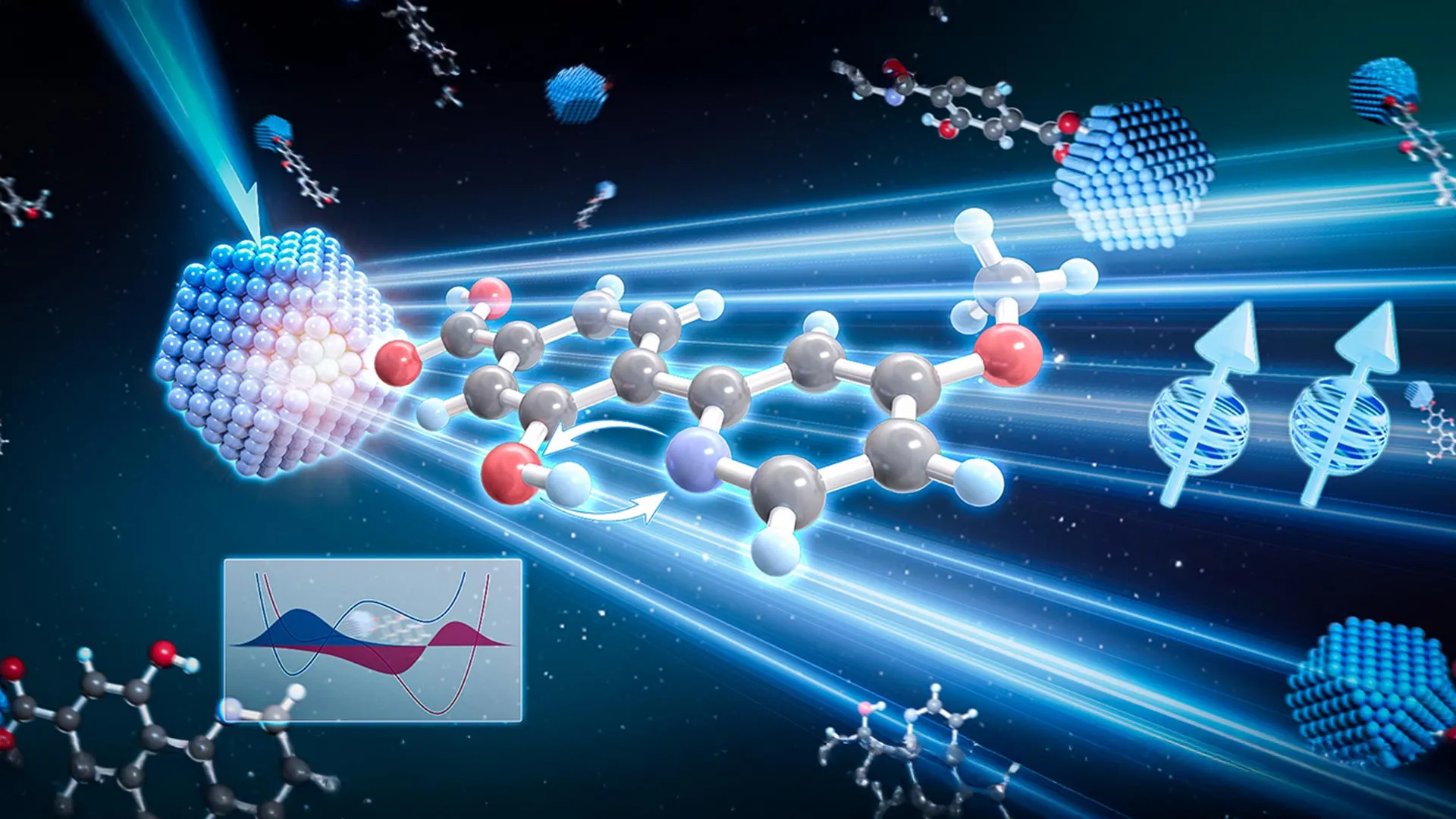
The interaction between electrons and protons is crucial in both biological systems and synthetic materials. A prime example of this synergy is proton-coupled electron transfer (PCET), which is integral to bioenergetics, cellular respiration, photosynthesis, and nitrogen fixation. Furthermore, PCET has inspired the development of engineered materials for energy conversion and storage. Recently, researchers have also discovered a related phenomenon known as proton-coupled singlet energy transfer (PCEnT).
A research team headed by Professor Kaifeng Wu from the Dalian Institute of Chemical Physics, Chinese Academy of Sciences, built upon foundational work in PCET and PCEnT to delve into another crucial yet underexplored mechanism: triplet energy transfer linked with proton transfer.
Triplet energy transfer serves as the primary mechanism for energy transfer in both natural and synthetic systems, functioning differently than singlet energy transfer. Gaining insights into how proton dynamics influence this transfer could unveil innovative pathways for controlling energy flow in advanced materials.
In a recent publication in Nature Materials, researchers unveiled a previously unidentified mechanism known as proton shuttle-assisted triplet energy transfer (PS-TET). This mechanism was identified during the energy transfer from a ZnSe-based colloidal quantum dot (QD) to a phenol-pyridine divalent acceptor affixed to its surface.
Mechanism of Proton Shuttle Energy Transfer
When ZnSe QDs absorb light, they transition to an excited state. Concurrently, a hole is transferred from ZnSe to phenol, while a proton migrates from phenol to pyridine.
Subsequently, electrons are transferred from ZnSe to the phenoxyl radical, with the proton returning to its original position from the pyridinium. Collectively, these sequential actions facilitate an effective spin triplet energy transfer from ZnSe QDs to the phenol-pyridine dyad.
Although the protons eventually return to their initial positions, their intermediate movement has substantial implications. This shuttle mechanism significantly enhances both the speed and efficiency of triplet energy transfer when compared to methylated analogs lacking a proton shuttle.
The researchers also found that incorporating a strong electron-withdrawing trifluoromethyl substituent onto pyridine alters the sequence of proton conjugation, electron, and hole transfer steps.
Quantum Tunneling at Room Temperature
The rate of PS-TET demonstrated minimal variation with temperature changes, suggesting that protons do not undergo conventional thermally driven motions. Instead, their movement appears to occur via quantum mechanical tunneling.
Calculations involving the overlap integrals of the proton’s vibrational wave functions supported this conclusion. These integrals assist in identifying the most favorable excited state relaxation pathway, thereby guiding the system toward efficient triplet energy transfer.
The findings indicate that quantum effects can effectively control charge and energy transfer in complex materials, even at room temperature.
Implications for Solar Cells, Lasers, and Catalysts
Professor Wu emphasized, “The discovery of the PS-TET mechanism holds significant promise for many contemporary molecular techniques that exploit the spin triplet excited states of molecules.”
Enhancing triplet production efficiency may advance photoredox and environmental catalysis. Conversely, certain applications may benefit from limiting triplet formation. Organic optoelectronic devices, such as solar cells and lasers, tend to perform better when unwanted triplet states are minimized.
This research suggests that scientists could fine-tune triplet production to match specific requirements—enhancing the process through proton shuttle creation or diminishing it by removing the shuttle.
Source: www.sciencedaily.com