


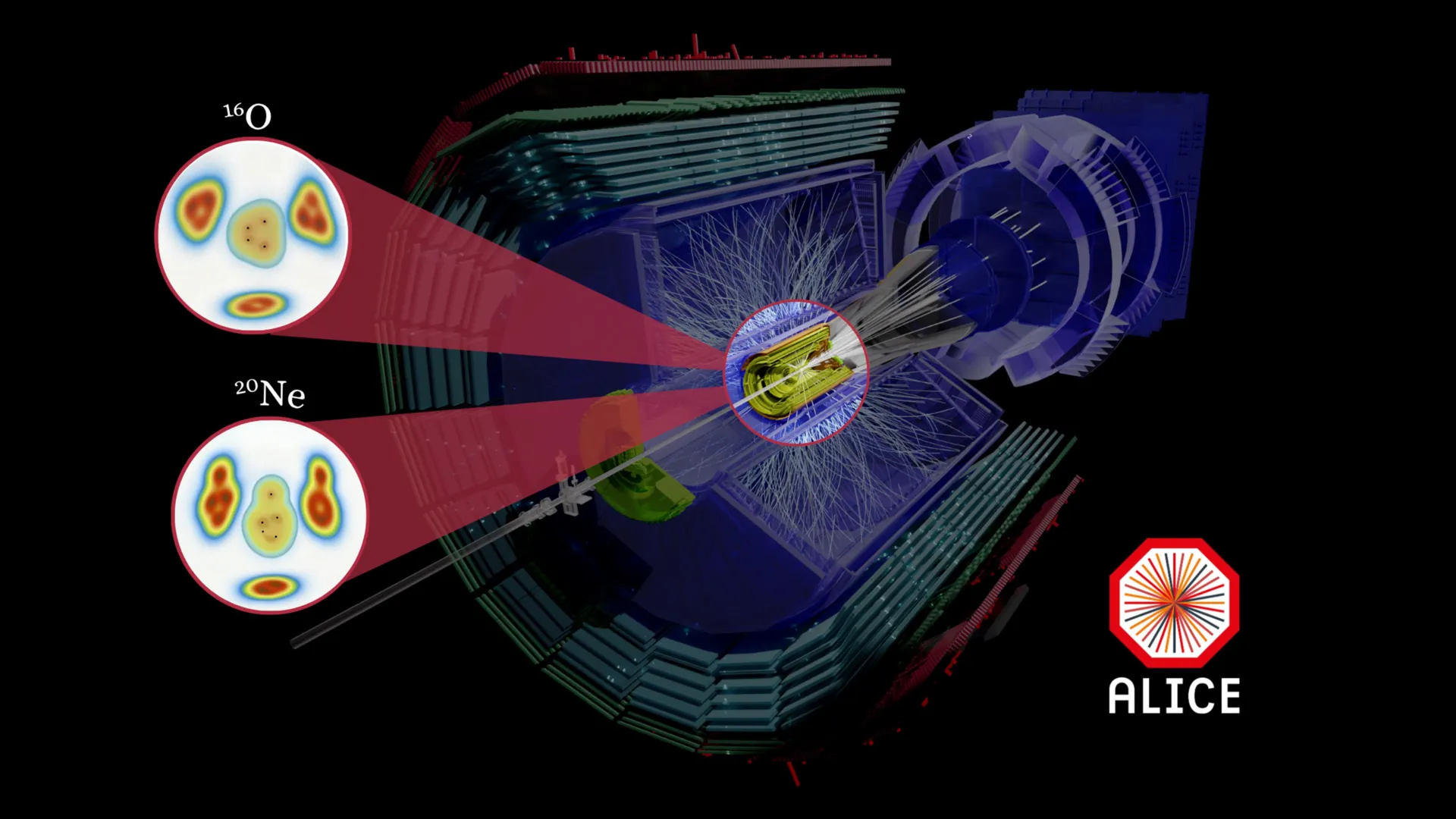
Researchers at the University of Copenhagen have recreated the primordial state of matter believed to have filled the universe moments after the Big Bang using atomic nuclei far smaller than previously considered possible. These miniature “Little Big Bangs” could help scientists investigate the origins of the universe while revealing new insights into nuclear physics and the structure of atomic nuclei.
What was the universe like before stars, planets, atoms, and all familiar forms of matter existed?
Physicists at CERN in Switzerland are working to answer this question by recreating the extreme conditions of the early universe. Scientists from the Niels Bohr Institute, together with researchers from the international ALICE collaboration, have now made an important breakthrough.
Recreating the primordial matter of the early universe
At CERN, atomic nuclei are accelerated to almost the speed of light before being collided and shattered. These high-energy collisions can create tiny droplets of quark-gluon plasma, an exotic state of matter believed to have filled the universe during the first millionth of a second after the Big Bang.
For decades, scientists believed that producing quark-gluon plasma required collisions between extremely heavy atomic nuclei, such as lead. However, new experiments show that much smaller nuclei can also recreate this primordial form of matter. Researchers produced it by colliding oxygen nuclei with neon nuclei.
“We have pushed the limits of how small an atomic nucleus can be while still recreating this primordial state of matter—a process we might call the Little Big Bang. We now have a much clearer understanding of the fundamental conditions required for matter to transition into this extreme state,” says You Zhou, an associate professor who led the experiment and recently worked at the Niels Bohr Institute at the University of Copenhagen.
He adds:
“We hope these findings will help us better understand how quark-gluon plasma behaved during the earliest moments of the universe and how it eventually evolved into the forms of matter that make up everything around us.”
The findings, produced as part of the international ALICE experiment, have been published in the prestigious journal Physical Review Letters.
A Little Big Bang with a bowling-pin signature
When atomic nuclei collide at enormous speeds, their individual constituents can transform into tiny droplets of quark-gluon plasma. These droplets exist for only a brief moment before expanding and forming other particles.
Because scientists cannot observe quark-gluon plasma directly, they study the particles created immediately after the collision and analyze how those particles move.
The new results show that these movement patterns preserve information about the original shape of the colliding nuclei. Collisions between two oxygen nuclei create a relatively round pattern, while collisions involving neon produce a distinctive bowling-pin-shaped pattern.
“The particles produced from primordial matter are directly influenced by the geometry of the colliding nuclei. When two spherical nuclei collide, they create one type of pattern. When a nucleus shaped like a bowling pin is involved, the pattern is different. By studying how particles move after a collision, we can gain information about nuclear shapes that is difficult to obtain through other methods,” explains Emil Gorm Dahlbeck-Nielsen, a postdoctoral researcher and co-author of the study at the Niels Bohr Institute.
He elaborates:
“It is similar to shining light on an object and observing its shadow. You cannot see the object directly, but its shadow reveals its shape. In the same way, the movement of particles reveals the geometry of the nucleus at the start of the collision.”
Studying nuclear structure through extreme collisions
For more than 70 years, physicists have worked to understand the shape and internal structure of atomic nuclei. This research is particularly significant for the Niels Bohr Institute, where Aage Bohr won the Nobel Prize in Physics in 1975 for his work on the structure of the atomic nucleus.
The shape of an atomic nucleus is more than a matter of geometry. It reflects how protons and neutrons are arranged and can provide important clues about the strong nuclear force, one of the four fundamental forces of nature. Scientists are still working to understand this force in its entirety.
Traditionally, researchers have studied nuclear structure through lower-energy experiments, including measurements of how atomic nuclei rotate and vibrate.
The new method takes a fundamentally different approach. Instead of gently probing atomic nuclei, scientists collide them at the highest available energies and reconstruct their shape from the patterns created by the resulting particles.
“By precisely understanding the structure of an atomic nucleus, we can learn more about the strong force. Rather than examining the nucleus only at low energies, we can now shatter it at the highest energies available and determine its shape from the traces it leaves behind,” You Zhou says.
Researchers believe this technique could transform the study of nuclear physics. With further development, it may provide a new way to investigate atomic nuclei whose internal structures remain poorly understood.
How small can the Little Big Bang become?
Scientists do not yet know the smallest collision system capable of producing quark-gluon plasma. Defining this limit is one of the team’s next major research goals.
The researchers are planning additional experiments using even lighter nuclei, including helium-4.
“What makes this research especially interesting is that the same experiment can help us study the structure of atomic nuclei and investigate what happened at the beginning of the universe. These two areas are much more closely connected than we once thought,” You Zhou concludes.
What is quark-gluon plasma?
Quark-gluon plasma is an extremely hot and dense state of matter that existed during the first millionth of a second after the Big Bang. Temperatures were so high during this period that protons and neutrons had not yet formed. Instead, their building blocks—quarks and gluons—moved freely in a hot, dense state often described as a particle “soup.”
As the universe expanded and cooled, quarks and gluons combined to form protons, neutrons, and other particles. These particles later became the building blocks of atomic nuclei and, ultimately, the ordinary matter found in stars, planets, and living organisms.
Source: www.sciencedaily.com