


Close Menu
HitechubHitechub
    What's Hot
    Technology

    Download Kids and Space Travel Agents: Learning AI

    Science

    New Evidence Reveals Spinosaurus Spent Most of Its Life Underwater

    Technology

    American Hybrid Cars Gain Popularity in the Used Car Market

    Important Pages:
    • About Us
    • Privacy Policy
    • Terms & Conditions
    Facebook X (Twitter) Instagram Pinterest
    Facebook X (Twitter) Instagram
    HitechubHitechub
    Friday, November 27
    • Shop
      • Fashion
        • Mens
        • Womens
        • Accessories
          • Handbags
          • Keychain
          • Masks
          • Money clicps
          • Neck Pillow
          • Rings
          • Towels
          • Wallets
        • Jewelry
        • Watches
        • T-shirts
        • Hawaiian shirts
        • Vests
        • Swim trunks
        • Swimsuits
      • Fun
        • Magic cubes
        • Magnifiers
        • Misc
        • Photo books
        • Puzzles
        • Toys
      • Home
        • Cleaning/Care
        • Mailbox covers
        • Mugs
        • Pot Holders
        • Spoon
      • Office and Electronics
        • Chairs
        • Office Supplies
        • IPad cases
        • Laptop stickers
        • Mouse pads
        • Notebooks
        • Pencil bags
        • Pens
        • Phone cases
      • Personalized
      • Pets
      • Sports
        • Cycling
          • Balaclava Mask
          • Bike Bell
          • Bike Computer
          • Bike Fender
          • Bike Grips
          • Bike Kickstand
          • Bike Light
          • Bike Locks
          • Bike Mitts
          • Bike Pumps
          • Bike Repair Stand
          • Bike Seat
          • Bike Trainer
          • Bike Wheels
          • BIKES
            • Folding Bikes
            • Road Bikes
          • Carbon Fiber Bike Products
          • Cycling Mask
          • Kid’ Bike Helmets
          • Inner Tube
          • Motorcycle Bag
          • Nylon Pedals
          • Adult Helmets
          • Photochromic Sunglasses
          • Soft Coolers
          • Suction Cup Bike Rack
          • Tool accessories
          • Winter Cloth
          • Heart Rate Monitor
        • Outdoors/Camping
          • Outdoor Bags
        • Sweatband
    • Technology
      1. AI
      2. Gadgets
      3. View All

      This is the most popular CEO in the world

      Sectors in which “Chat-GPT” is most often used

      Artificial intelligence has begun to “swallow” professions

      The unusual robot conductor of a concert in Seoul

      Here’s how you can tell if your phone is being tapped

      PlayStation 5 becomes a completely silent console and gets more space

      This is the first phone that can be used to park a car

      Best Gaming Laptops 2023: Powerful Portables for PC Games

      Iranian Hacker Group Discovers New Tactics to Launch Widespread Cyberattacks

      Volvo’s Big Battery Powers the New 2028 Plug-In Hybrid

      Nvidia Scandal: How Jensen Huang and Asia’s Big AI Bet Exposed Major Risks

      Lead Azide Explosion in Iowa Raises Concerns About Potential Health Risks

    • Science
      1. Space
      2. Wheels
      3. View All

      Space Perspective: A Journey to the Edge of Space

      5 Fascinating Facts About Space

      Space Exploration: Unveiling the Wonders of the Universe

      Toyota wants to make a new generation battery with a range of up to 1,200 km

      Meet Toyota’s lunar “baby” that could make exploring the Moon easier

      What does a night drive look like with one of the most beautiful cars in the world: the Rolls-Royce Ghost

      Extremophile Transgene Enhances Drought Resistance and Yield in Cereal Crops

      Black Friday 2026 Telescope Deals: Smart Telescopes and Binoculars

      NASA Science: Imbued with Sivrich

      Why Certainty Can Be a Failure in Science

    HitechubHitechub
    Home » Water and Dust Survive Near the Milky Way’s Central Black Hole
    Science

    Water and Dust Survive Near the Milky Way’s Central Black Hole

    Share Facebook Twitter Pinterest WhatsApp
    Share
    Facebook Twitter LinkedIn Pinterest WhatsApp

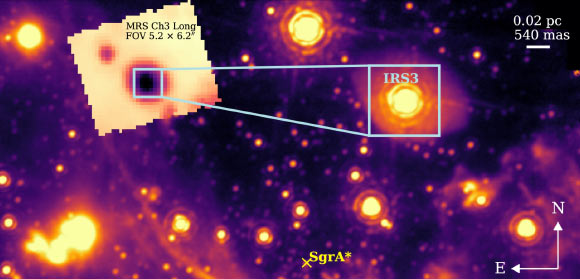
    Using NASA, ESA, and CSA James Webb Space Telescope observations, astronomers have discovered that IRS 3—a swollen giant star located just 0.55 light-years from the Milky Way’s central black hole, Sagittarius A*—continues to produce silicate dust and retain water molecules despite the extreme radiation environment at the galactic center.

    Mid-infrared images of the IRS 3 environment observed by VLT/NACO and the James Webb Space Telescope MIRI/MRS instruments. Image credit: Peißker et al., doi: 10.1051/0004-6361/202660243.

    At the heart of the Milky Way, the supermassive black hole Sagittarius A* dominates an exceptionally violent region filled with intense radiation, powerful stellar winds, and extreme gravitational forces.

    Astronomers have long questioned how fragile molecules and dust grains—the raw materials needed to form planets and potentially support life—can survive so close to such a destructive environment.

    “The galactic center is one of the most extreme environments, so understanding whether stars can continue to enrich their surroundings is an important question,” said Dr. Florian Peißker, an astronomer at the University of Cologne.

    “With Webb, we can directly observe how stars behave under these conditions and see that dust production remains surprisingly resilient.”

    IRS 3 is a red giant star approximately 72 million years old and about six times more massive than the Sun.

    The star is approaching the final stages of its evolution and is shedding gas and dust in a phase known as the asymptotic giant branch, or AGB.

    Dr. Peißker and his colleagues used the James Webb Space Telescope’s MIRI (Mid-Infrared Instrument) to obtain the most complete infrared spectrum yet recorded for IRS 3, helping resolve long-standing questions about the star’s chemistry.

    Earlier ground-based observations raised the possibility that IRS 3 could be carbon-rich. However, Webb’s new data reveal two distinct absorption signatures that can only be produced by oxygen-rich, silicate-based dust.

    These findings rule out a carbon-dominated composition and firmly identify IRS 3 as an oxygen-rich giant star.

    Even more remarkably, the researchers detected clear traces of water molecules in the material surrounding IRS 3.

    Water and other complex molecules are highly vulnerable to the ultraviolet and X-ray radiation generated near Sagittarius A*. The detection of intact water so close to the Milky Way’s central black hole suggests that IRS 3’s dense, dusty envelope provides effective protection from the harsh radiation.

    ESA astronomer Dr. Macarena García Marín said: “This discovery was made possible thanks to Webb’s sophisticated infrared instruments.”

    “This is the first time a continuous mid-infrared spectrum has been collected for this star, allowing us to detect features in the silicate dust and reveal the star’s true chemical identity.”

    To interpret the observations, the researchers used a radiation-transport code called Hyperion to create a computer model of the gas and dust shell surrounding IRS 3. They tested approximately 100,000 model variations before identifying the best-fitting solution.

    The model indicates that IRS 3 is about 60,000 times more luminous than the Sun. Its surrounding envelope consists of multiple concentric shells, each with different temperatures, densities, and dust compositions. Hot aluminum oxide near the star gradually gives way to cooler silicate grains farther away, with temperatures decreasing by approximately 1,000 K across the structure.

    “The detection of water is particularly exciting because it shows that molecular materials can survive in environments dominated by intense radiation,” said Dr. García Marín.

    “This shows that even near a supermassive black hole, a star can continue to return material to its surroundings.”

    The results appear in the journal Astronomy & Astrophysics.

    _____

    F. Peißker et al. 2026. Dust generation in harsh environments of Sgr A*: MIRI/JWST observation of O-rich asymptotic giant branch star IRS 3. A&A 712, A79; doi: 10.1051/0004-6361/202660243

    Source: www.sci.news

    Share. Facebook Twitter Pinterest LinkedIn WhatsApp
    Previous ArticleBest Movies to Stream in August 2026
    Next Article State Judge Orders Kalsi to Halt Sports Betting and Other Wagering Services

    Related Posts

    Science

    Extremophile Transgene Enhances Drought Resistance and Yield in Cereal Crops

    Science

    Black Friday 2026 Telescope Deals: Smart Telescopes and Binoculars

    Science

    NASA Science: Imbued with Sivrich

    Science

    Why Certainty Can Be a Failure in Science

    Science

    Chromosomal Glue May Improve Fertility by Stabilizing Aging Eggs

    Science

    Thanksgiving Storm Brings Flooding and Flight Delays Across the U.S.

    Science

    Iowans Face Thanksgiving Horror After Chemical Plant Explosion

    Science

    NASA Hubble Observes a Sea of Stars During Roman Space Telescope Construction

    Add A Comment
    Leave A Reply Cancel Reply

    Stay In Touch
    • Facebook
    • Twitter
    • Instagram
    • Pinterest
    Top Picks
    Technology

    Apple Mac mini M6 Review: $300 Price Increase Makes the Upgrade Hard to Justify

    Apple M6 Chip: CPU Cores, Cache, Clock Speeds and Memory Bandwidth Apple’s M6 chip introduces…

    WhatsApp Launches New Feature to Flag Potentially Fraudulent Messages

    Home Destroyed in South Los Angeles North Fire as Evacuation Orders Issued

    Voyager Technologies’ Griffin-1 Completes Environmental Testing at NASA JPL

    Best 2-in-1 Laptops in 2026: Top Microsoft, Lenovo, and iPad Picks

    Most Popular
    Technology

    Microsoft Outlook to Block MSIX Attachments Starting in November

    Science

    Stanford Scientists Discover Immune Cells That Explode Like Microscopic Bombs

    Categories
    • AI (9)
    • Gadgets (6)
    • Science (3,610)
    • Space (3)
    • Technology (3,041)
    • Wheels (3)
    Our Picks
    Science

    AI Agents Design and Run the Perfect Robotic Laboratory

    Science

    Half of Global Reservoirs at Risk of Soil Sedimentation by 2060: Impacts and Solutions

    © 2026 Hitechub.
    • Home
    • About Us
    • Privacy Policy
    • Terms & Conditions

    Type above and press Enter to search. Press Esc to cancel.

    GDPR Cookie Banner

    We are using cookies to give you the best experience on our website.

    You can find out more about which cookies we are using or switch them off in .

    Ad Blocker Enabled!
    Ad Blocker Enabled!
    Our website is made possible by displaying online advertisements to our visitors. Please support us by disabling your Ad Blocker.