


Tyrannosaurus rex Had a Body Temperature Similar to Humans, Study Finds
New analysis of Tyrannosaurus rex teeth suggests that this ancient predator maintained an average body temperature of approximately 36.3 degrees Celsius (97.3 degrees Fahrenheit)—similar to modern humans and close to the temperatures of Indian and African elephants.
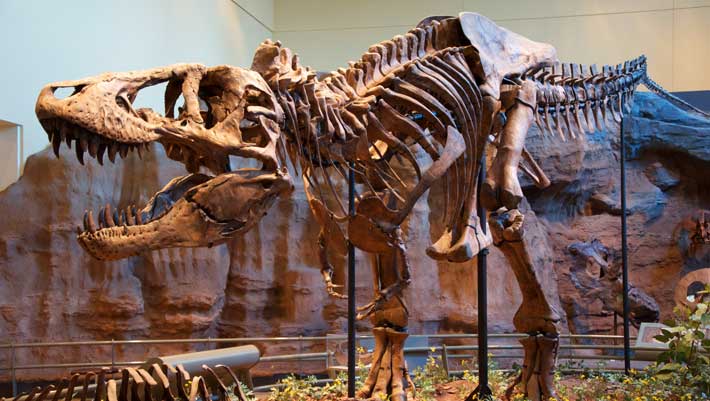
Tyrannosaurus rex holotype specimen at the Carnegie Museum of Natural History in Pittsburgh, USA. Image credit: Scott Robert Anselmo / CC BY-SA 3.0.
Measuring the body temperature of Tyrannosaurus rex
“The relatively well-sampled record makes Tyrannosaurus rex perhaps the most intensely studied dinosaur and has earned it the status of a typical creature commonly referenced in studies of vertebrate paleontology,” said geobiologist Robert Eagle of the University of California, Los Angeles, and his colleagues.
Researchers have found evidence that T. rex had an endothermic thermophysiology, including evidence related to locomotor costs, growth rates, and geographic distribution. However, reliable estimates of the dinosaur’s body temperature have been lacking.
The researchers analyzed three materials using a technique called aggregated isotope paleothermometry. The samples included T. rex teeth collected from the Late Cretaceous Hell Creek Formation southeast of Ekalaka in Carter County, Montana.
This method measures the bonding patterns of carbon and oxygen atoms in tooth enamel. These patterns can reveal the temperature at which the mineral formed.
T. rex was warmer than crocodiles in the same ecosystem
The results indicate that Tyrannosaurus rex had an average body temperature of about 36.3 degrees Celsius. That is comparable to the reported body temperatures of large modern mammals, including Indian elephants at approximately 36 degrees Celsius and African elephants at approximately 36.2 degrees Celsius.
“No one has been able to take body temperature measurements like this before,” Dr. Eagle said.
“We found the temperature of Tyrannosaurus rex was 36 degrees Celsius, about the same temperature as humans.”
“Its temperature is exactly what I expected: higher than reptiles and slow-footed mammals like sloths, but lower than birds.”
By contrast, teeth from crocodiles living in the same Late Cretaceous ecosystem showed much cooler average temperatures of approximately 30.9 degrees Celsius (87.6 degrees Fahrenheit). That result is consistent with the cold-blooded, sunbasking lifestyle of modern crocodiles.
The temperature difference between T. rex and the crocodiles suggests that the dinosaur maintained a body temperature significantly higher than its surroundings—a characteristic associated with warm-blooded physiology.
Warm-blooded physiology may have helped T. rex thrive
“Temperature-regulated Tyrannosaurus rex supports the theory that Tyrannosaurus was an active animal, chasing and scavenging for food to fuel its fast metabolism,” Dr. Eagle said.
“It also adds to the chronology of how far the ancestors of modern, very warm-blooded birds had already diverged from cold-blooded dinosaurs.”
The researchers also modeled how T. rex may have lived across different climates. Using paleoclimate simulations of North America during the Maastrichtian period, they found that a wide range of latitudes could have provided suitable habitat for the dinosaur.
The results are consistent with fossil evidence of tyrannosaurs found farther north, including on the North Slope of Alaska.
“They were able to survive in a cool habitable range extending into areas where cold-blooded animals would be threatened,” said Dr. Alessandro Chiarenza, a paleontologist at University College London.
“This warm-blooded reptile likely spent millions of years adapting to the greenhouse environment of the Cretaceous period, one of the warmest periods in Earth’s history.”
“But even in the scorching heat of the Cretaceous, Alaska’s winters would have been too cold for cold-blooded dinosaurs.”
The study adds to growing evidence that at least some dinosaurs, particularly large theropods, were warm-blooded animals capable of generating and regulating their own body temperature rather than relying solely on external heat like modern reptiles.
The team’s results appear in the journal Science Advances.
_____
Landon J. Flores et al. 2026. Body temperature of Tyrannosaurus rex. Science Advances 12(38). doi: 10.1126/sciadv.aeb7653
Source: www.sci.news