


Close Menu
HitechubHitechub
    What's Hot
    Science

    Explore Cosmic Pareidolia: Two Glowing Nebulae Captured in Stunning New VST Image

    Technology

    How fast commercial airplanes really are?

    Science

    Red Stripes in Welsh Caves: Britain’s Oldest Art Finally Recognized After Natural Phenomenon Dismissal

    Important Pages:
    • About Us
    • Privacy Policy
    • Terms & Conditions
    Facebook X (Twitter) Instagram Pinterest
    Facebook X (Twitter) Instagram
    HitechubHitechub
    Thursday, June 25
    • Technology
      1. AI
      2. Gadgets
      3. View All

      This is the most popular CEO in the world

      Sectors in which “Chat-GPT” is most often used

      AI Pioneer Expresses Concern About Potential for AI to Surpass Humanity

      Artificial intelligence has begun to “swallow” professions

      What’s new in Android 14

      Europeans have about 700 million old mobile phones in their drawers

      Here’s how you can tell if your phone is being tapped

      “Sneaker X” – computer case in the shape of a sneaker

      Russian Gamers Unite to Prevent Nuclear War: Join the Fight Online

      Challenges of Space Travel: Why Journeying to Space is So Difficult

      NASA Astronaut Casts Historic Vote from Space

      Discover the Future of Comfort: What If You Could Wear a Chair?

    • Science
      1. Space
      2. Wheels
      3. View All

      Galaxies in the universe are growing more slowly than they should

      “Espace” presented the new lander “Apex 1.0”

      The largest asteroid sample ever collected has arrived on Earth

      (VIDEO) Incredible flight of the Parker Solar Probe

      Toyota wants to make a new generation battery with a range of up to 1,200 km

      Meet Toyota’s lunar “baby” that could make exploring the Moon easier

      Microlino – Is this the perfect city car?

      Alfa Romeo 4C gets an electric successor

      Watch This Spine-Chilling AI Robot That Never Stops Chasing You!

      TESS Uncovers the Most Distorted Exoplanet Ever Detected

      Ancient DNA Reveals Neanderthal Life’s Last Chapter in Northwestern Europe

      Breakthrough in Cancer Research: Antarctic Creature Holds Promise for New Treatments

    HitechubHitechub
    Home » Evidence of Ancient Life on Mars: Discovery of Complex Carbon Compounds
    Science

    Evidence of Ancient Life on Mars: Discovery of Complex Carbon Compounds

    Share Facebook Twitter Pinterest WhatsApp
    Share
    Facebook Twitter LinkedIn Pinterest WhatsApp
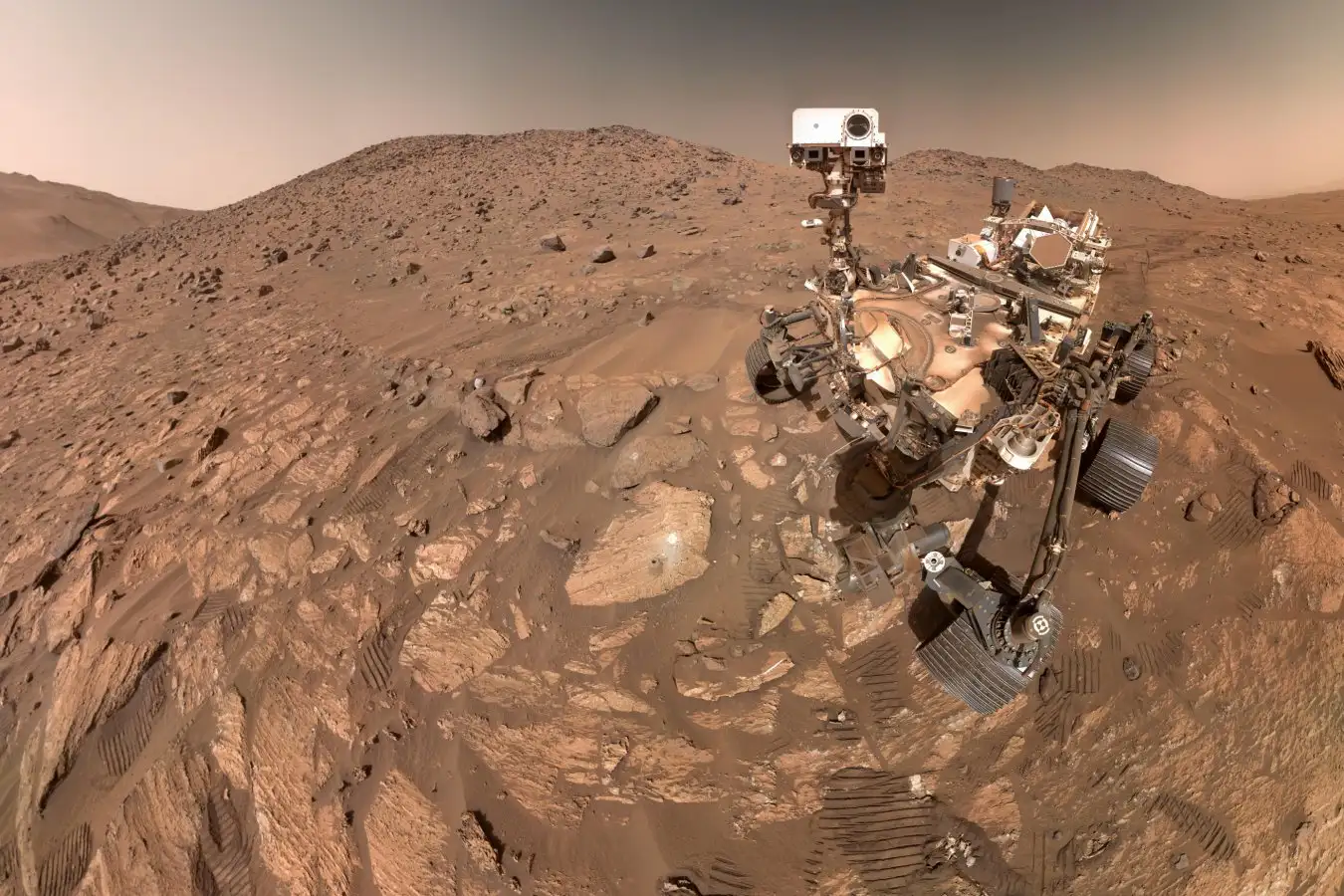
    NASA's Perseverance Rover on Mars

    NASA’s Perseverance Mars Rover Discovers Possible Signs of Ancient Life.

    Credit: NASA/JPL-Caltech/MSSS

    NASA’s Perseverance rover has made a groundbreaking discovery of complex carbon compounds in a Martian crater, specifically in the Bright Angel Formation. These compounds might be indicative of past life, displaying promising connections to ancient biological activity, although they have also been found in non-biological environments like meteorites.

    During its 2024 mission, Perseverance explored a rocky area near an ancient riverbed that once nourished a lake in Jezero Crater. Some photographed rocks exhibited peculiar mottling patterns, dubbed “leopard spots” or “poppy seeds” by NASA scientists. These designs, consisting of dark circular blotches up to 1 millimeter in size, bear resemblance to traces left by ancient microbial life on Earth.

    While abiotic origins can’t be eliminated, the discovered patterns present some of the most compelling evidence of potential ancient life on Mars. However, scientists seek more detailed insights regarding the chemical composition and distribution of these patterns within the Bright Angel Formation.

    Equipped with advanced instruments, including the SHERLOC tool, Perseverance has the capacity to analyze the chemical composition of Martian rocks. The SHERLOC instrument utilizes reflected light from an ultraviolet laser to identify various elements and compounds within rock samples.

    Researcher Ashley Murphy from the Planetary Science Institute in Tucson, Arizona, employed SHERLOC to detect large, complex carbon-containing molecules known as polymeric carbon both on a marked rock in the Bright Angel Formation and another rock located approximately 100 meters away.

    “On Earth, polymeric carbon is generally found in ancient rocks and in some instances, it represents the sole organic evidence of bygone microbial life,” says Murphy. “Discovering these organic macromolecules on Mars is pivotal in determining whether the chemical essentials and environmental conditions that could support life ever existed there.”

    It’s crucial to highlight that the presence of these carbon compounds does not imply a biological origin, as they have also been discovered in meteorites, notes Lewis Dartner at the University of Westminster, London. Yet, Murphy’s team found a significant association between these compounds and carbonate and sulfate minerals, which typically form in water-rich environments. “This gives vital geological context for where the organic materials are located,” explains Dartnell.

    Jezero Crater is believed to have harbored considerable amounts of water at some point in its history, so the finding of these carbon compounds is relatively unsurprising. However, as Kyle Uckert at NASA’s Jet Propulsion Laboratory in California notes, polymeric carbon has never before been observed on such rocky surfaces on Mars, suggesting it may exhibit unique resistance and characteristics compared to other carbon compounds on the planet.

    “The widespread presence of this polymeric carbon within the Bright Angel mudstone is unexpected compared to findings elsewhere in the crater,” Uckert observes. The reason for this prevalence remains unclear, but Dartnell states it is a positive sign that further indications of past life might still be uncovered. “This detection confirms that complex organic materials like these polymeric deposits can endure for extended periods.”

    While the SHERLOC instrument effectively identifies polymeric carbon, it does not provide detailed insights into the specific composition of the compounds beyond indicating they are carbon-rich. Sean McMahon from the University of Edinburgh, UK, emphasizes, “To determine whether the carbon in these rocks is biologically derived, we will need to return samples to Earth.”

    Topics:

    • Mars/
    • Extraterrestrial Life

    Source: www.newscientist.com

    Share. Facebook Twitter Pinterest LinkedIn WhatsApp
    Previous ArticleThunder and Wind Forecast Heightens Fire Danger in the Western United States
    Next Article Experts Warn: Mice and Rats Developing Resistance to Poison

    Related Posts

    Science

    Watch This Spine-Chilling AI Robot That Never Stops Chasing You!

    Science

    TESS Uncovers the Most Distorted Exoplanet Ever Detected

    Science

    Ancient DNA Reveals Neanderthal Life’s Last Chapter in Northwestern Europe

    Science

    Breakthrough in Cancer Research: Antarctic Creature Holds Promise for New Treatments

    Science

    How Daily Bright Light Exposure Can Help Prevent Dementia

    Science

    Instant Stress Relief Techniques: Quick Tips for Finding Peace Instantly

    Science

    Discover the Top 17 Must-Read Science Books of 2026

    Science

    Ancient Philosophers’ Lost Writings Rediscovered from Unreadable Scrolls

    Add A Comment
    Leave A Reply Cancel Reply

    Stay In Touch
    • Facebook
    • Twitter
    • Instagram
    • Pinterest
    Top Picks
    Science

    Exploring Earth’s Mysterious Triple Symmetry and Its Impact on Climate Change

    The 27 degrees east meridian divides the Earth into two equally reflective halves, running through…

    What would happen if you were without a suit in space?

    Ancient Anesthetic Unearthed in Chinese Doctor’s Grave: A Historical Breakthrough

    Of course! Please provide the title you’d like me to rewrite for SEO optimization.

    Empowering Girls: Launching Africa’s First Private Space Satellite

    Most Popular
    Science

    Can Lab-Grown Sperm Help Infertile Men Conceive Their Own Children?

    Science

    Why Most Portable Air Conditioners Underperform and How to Choose the Best One for Your Needs

    Categories
    • AI (13)
    • Gadgets (10)
    • Science (363)
    • Space (9)
    • Technology (37)
    • Wheels (9)
    Our Picks
    Science

    Transforming Polystyrene with Sunlight and Sulfur: Innovative Upcycling Techniques – Sciworthy

    Science

    10 Greatest Scientific Discoveries of the 21st Century

    © 2026 Hitechub.
    • Home
    • About Us
    • Privacy Policy
    • Terms & Conditions

    Type above and press Enter to search. Press Esc to cancel.

    We are using cookies to give you the best experience on our website.

    You can find out more about which cookies we are using or switch them off in .

    Ad Blocker Enabled!
    Ad Blocker Enabled!
    Our website is made possible by displaying online advertisements to our visitors. Please support us by disabling your Ad Blocker.
    Go to mobile version
    Hitechub
    Powered by  GDPR Cookie Compliance
    Privacy Overview

    This website uses cookies so that we can provide you with the best user experience possible. Cookie information is stored in your browser and performs functions such as recognising you when you return to our website and helping our team to understand which sections of the website you find most interesting and useful.

    Strictly Necessary Cookies

    Strictly Necessary Cookie should be enabled at all times so that we can save your preferences for cookie settings.