


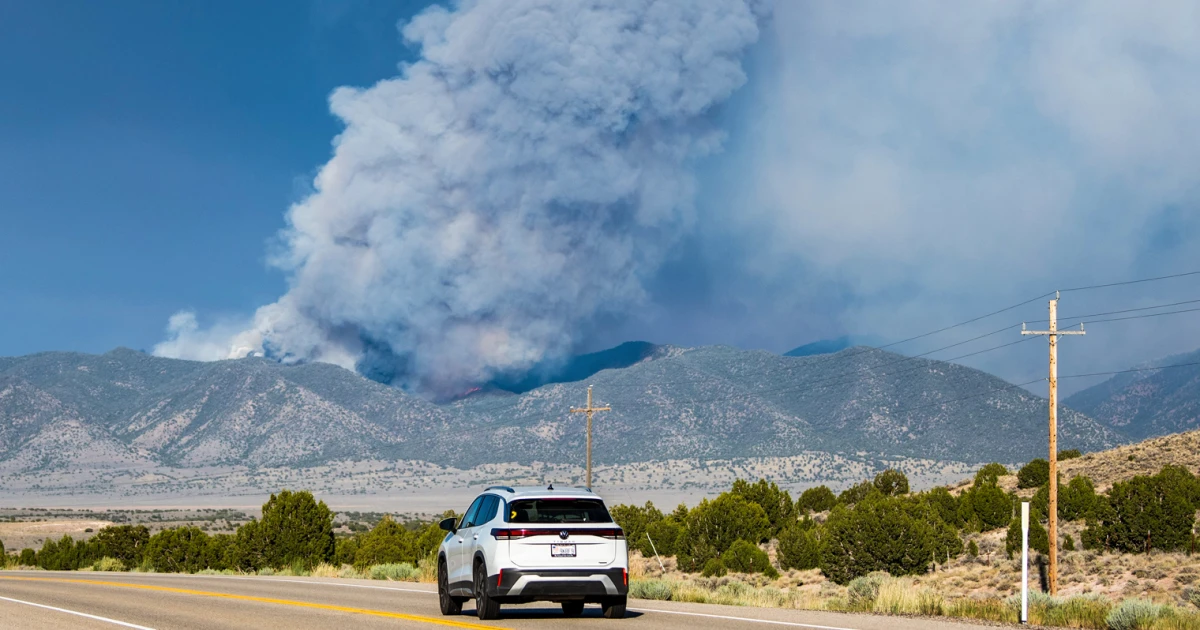
An unexpected recipe for wildfires is developing across drought-affected western states—thanks to a cold front.
Limited Time Offer: 25% Off Your NBC News Subscription!
Enjoy exclusive reporting, live Q&A, and an ad-free experience.

Meteorologists predict a substantial cold front will form over the Pacific Northwest by Thursday, moving southeast into the mountain West. This change will bring dry lightning at the storm’s forefront, increasing fire risks as lightning strikes may ignite fires, especially with strong winds expected throughout the weekend.
“A high risk of lightning is anticipated for southern and eastern regions today and tomorrow, followed by strong winds lasting several days,” advised Basil Neumelzycki, a forecaster at the Great Basin Coordination Center. He stated during an online conference on Wednesday. This center coordinates firefighting efforts for the Intermountain West, which includes portions of Arizona, Idaho, Nevada, Utah, and Wyoming.
“Overall fire danger remains high to extreme from Friday through the weekend. Some ongoing fires are already demonstrating extreme behavior,” he elaborated.
Expect strong storms to emerge in Utah, Colorado, Arizona, Nevada, and New Mexico starting Friday.
“Many areas in the West will be highly flammable due to minimal moisture in vegetation, creating very dry fuels and winds,” noted Daniel Swain, a climate scientist at UCLA and the National Center for Atmospheric Research. He expressed concerns during a press conference on Monday.
Swain indicated that storms may persist into Sunday across numerous locations.
“The situation will be widespread and prolonged, occurring during an atypical time of year for extended wind events—summer’s fire season amid significant drought,” Swain warned.
The cold front is projected to deliver considerable rainfall to certain regions along the Oregon and Washington coasts and west of the Cascade Mountains.
However, Utah is likely to experience widespread wind gusts of 40 to 50 mph, according to Glenn Merrill, a meteorologist with the Salt Lake City-based National Weather Service. He highlighted the area’s dry, flammable vegetation.
“These conditions are extremely conducive to rapid fire spread,” Merrill stated.
00:21
Wildfires Force Evacuations in Central Utah
00:0000:00
Currently, two sizable wildfires are raging in Utah, and worsening winds threaten to escalate them. The Iron fire, which ignited Friday, has already scorched over 37,000 acres and nearly devastated the town of Eureka, currently under evacuation.
“The fire reached the town’s edge,” Merrill confirmed.
The Cottonwood Fire near Beaver, which started on Monday, has already consumed about 60,000 acres, doubling in size daily.
“The rate of growth highlights how rapidly these fires are spreading due to dry vegetation and volatile weather conditions,” Merrill remarked.
Utah is experiencing its lowest recorded snowfall this year and is deep in drought. A March heatwave pushed temperatures approximately 30 degrees above normal, triggering an early runoff.
“We are currently drawing from the reservoir, a resource many areas have been relying on for over a month,” Merrill noted.
He pointed out that the area combating the Cottonwood Fire stands above 10,000 feet, an elevation where fires typically don’t ignite early in the year due to moist soil from melting snow.
“Regions currently ablaze are generally emerging from melting snow,” Merrill explained. “In 2023, there was still snow where fires are now occurring.”
All indications suggest an extended and severe fire season for western states. The National Interagency Fire Center reports that approximately 2.8 million acres have burned this year, exceeding the 10-year average by about 800,000 acres to date.
The center is generating predictive maps to forecast fire likelihood through September. A monthly outlook map shows expansive regions at above-average fire risk.
Source: www.nbcnews.com