


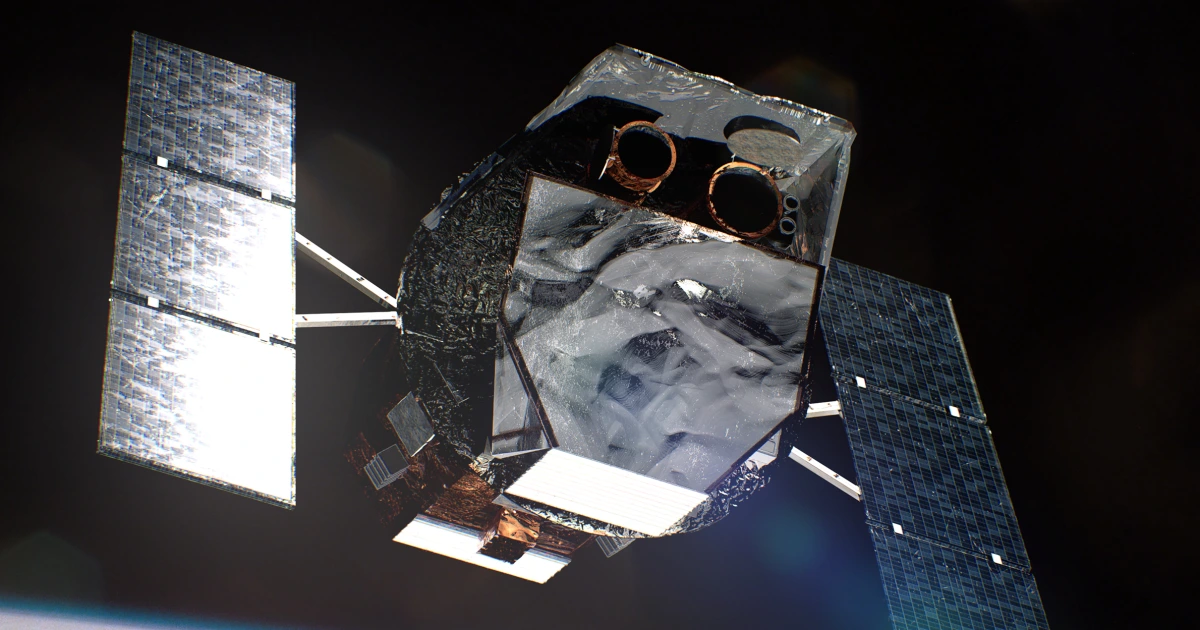
NASA is set to launch a crucial mission on Tuesday aimed at saving its flagship space telescope, the Neil Gehrels Swift Observatory, which has provided over two decades of groundbreaking research.
Limited Time Offer: Save 25% on Your NBC News Subscription!
Enjoy exclusive reporting, live Q&A sessions, and ad-free content.

The Neil Gehrels Swift Observatory, launched by NASA in 2004, has been orbiting Earth for over 20 years, dedicated to studying gamma-ray bursts—some of the universe’s most powerful explosions, triggered by events like black hole formations or the collision of dense stars at the end of their lifecycles.
Unfortunately, Swift is at risk of descending into the atmosphere and potentially breaking apart during re-entry. NASA’s predictive models indicate that Swift’s orbit could drop to an incredibly low altitude of less than 185 miles by October.
“This observatory is incredibly agile, able to quickly scan the night sky for transient events,” stated Sean Domagal Goldman, director of NASA’s astrophysics division, during a press conference on June 17. He added, “We believe this mission is vital, hence our decision to intervene.”
To prevent this degradation, NASA intends to launch a robotic spacecraft designed to boost Swift’s orbit. Last year, the agency awarded $30 million to Arizona-based Catalyst Space Technologies for constructing the spacecraft, with aerospace giant Northrop Grumman providing the necessary launch vehicles.
The plan is for Northrop Grumman’s Stargazer aircraft to lift off from the Marshall Islands by 6:17 a.m. ET on Tuesday. Upon reaching an altitude of 40,000 feet, the plane will deploy the Pegasus XL rocket carrying LINK, a 6-foot-tall, 880-pound robotic spacecraft.
Following this, the rocket will launch LINK into orbit, where it will attempt to capture the Swift Observatory and gradually elevate its orbit over several months.
All satellites in low Earth orbit slowly lose altitude due to atmospheric drag, which has impacted Swift. An increase in solar activity, particularly during the sun’s solar maximum phase in 2024, exacerbated this issue, causing the atmosphere to heat and increase drag on satellites, making them navigate through denser air.

John Nosek, an astronomy and astrophysics professor at Penn State University, believes that saving Swift could yield significant benefits, extending its operational life and scientific output.
“Beyond scientific data, recovering satellites not initially designed for servicing could allow NASA and other entities to reuse and enhance existing spacecraft, significantly lowering the costs of new missions,” Nosek stated in an email to NBC News. “If the LINK mission proves successful, it would only cost about $30 million (in 2026 dollars) to restore this $300 million (2004 dollars) satellite to its full operational capability.”
Kieran Wilson, vice president of technology at Catalyst Space Technologies, expressed hopes that the Swift Boost mission will reshape how astronomers approach satellite longevity.
“Traditionally, the approach to satellites has been to build them, launch them, and retire them at the end of their mission. We envision a future where refueling, repositioning, and upgrading satellites becomes standard practice,” he discussed at the June 17 press conference.
Since its launch in 2004, the Swift Observatory has compiled invaluable data, aiding scientists in analyzing more than 1,400 gamma-ray bursts and other high-energy cosmic phenomena. Notably, it has observed the furthest known object, originating from an exploding star roughly 13 billion light years from Earth.
NASA has granted Katalyst Space Technologies a contract to create and launch the LINK spacecraft by September 2025. While the timeline is ambitious, Wilson acknowledged that achieving a successful rendezvous with Swift and stabilizing its orbit will be a formidable challenge, especially since Swift lacks thrusters for orbital maneuvers.
“Successfully operating the spacecraft in orbit is a complex task,” he cautioned. “Rendezvous presents numerous challenges, but we are prepared to tackle them.”
Source: www.nbcnews.com