


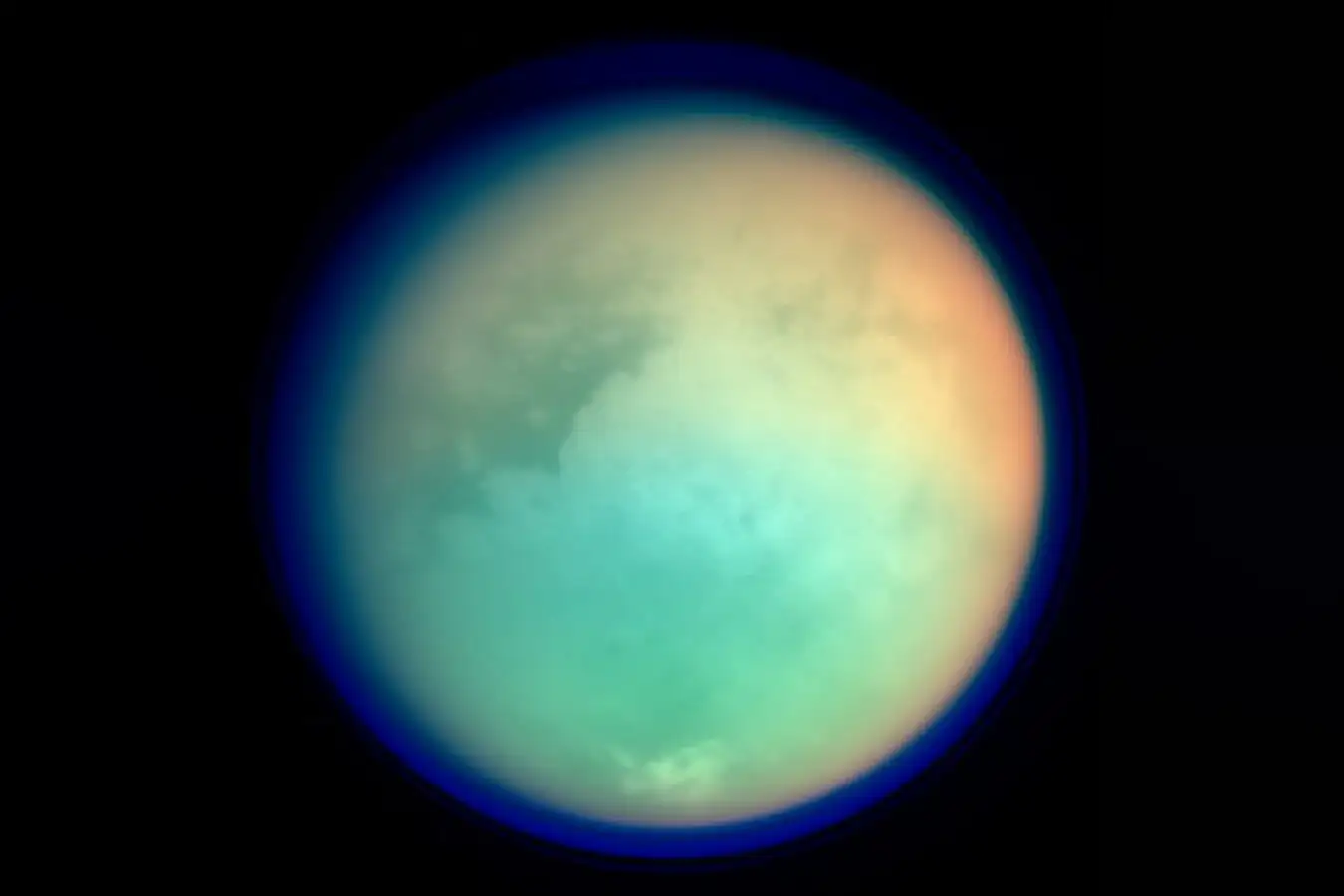
Titan as Observed by the Cassini Spacecraft in 2004 in Ultraviolet and Infrared
NASA/JPL/Space Science Institute
Researchers are investigating a mysterious substance present on the surfaces of both Pluto and Saturn’s moon Titan, though its exact nature remains unclear.
The thick atmosphere of Titan complicates the study of its surface, making the identification of this compound crucial for understanding the intricate chemistry at play. Titan is a prime candidate in the search for extraterrestrial life, so deciphering its chemical composition is essential.
Astronomers employ spectroscopy to analyze the wavelengths of light that chemicals absorb, reflect, and emit, aiding in the exploration of these distant worlds.
Bruno Besar and his team from the Paris Observatory uncovered this enigmatic compound using data from the James Webb Space Telescope (JWST). They observed that a narrow band of light wavelengths was absorbed by an unidentified material on Titan’s surface, which also showed similar absorption on Pluto, albeit over a broader range.
Despite their apparent differences—Pluto is far colder than Titan, lacks a liquid ocean, and has a significantly less dense atmosphere—the two moons share similarities in atmospheric chemistry. Both are primarily composed of nitrogen and methane, which leads to chemical reactions forming haze particles that settle as snow on their surfaces, according to Besar.
Researchers compared the spectral signatures from both moons against extensive astronomical data and laboratory results of known atmospheric compounds and ice forms present on Titan’s surface. Yet, none matched perfectly.
However, some almost-matching compounds suggest that slight alterations or combinations with other molecules might clarify the origin of this mystery substance. Variations in particle size and material shape between Pluto and Titan indicate more complexity. “Numerous candidates exist, but they are not simple compounds,” notes Besar. “If identified, it would be groundbreaking.”
To delve deeper into this mystery, researchers plan a multi-faceted approach. They’ve gathered additional data from the JWST to help pinpoint materials located on Titan’s surface, possibly linked to geological features. They are also conducting laboratory experiments to recreate the unique spectral signature. Additionally, NASA’s Dragonfly spacecraft, set to launch in 2028 and land on Titan’s surface in 2034, stands to offer significant insights.
Topics:
Source: www.newscientist.com