


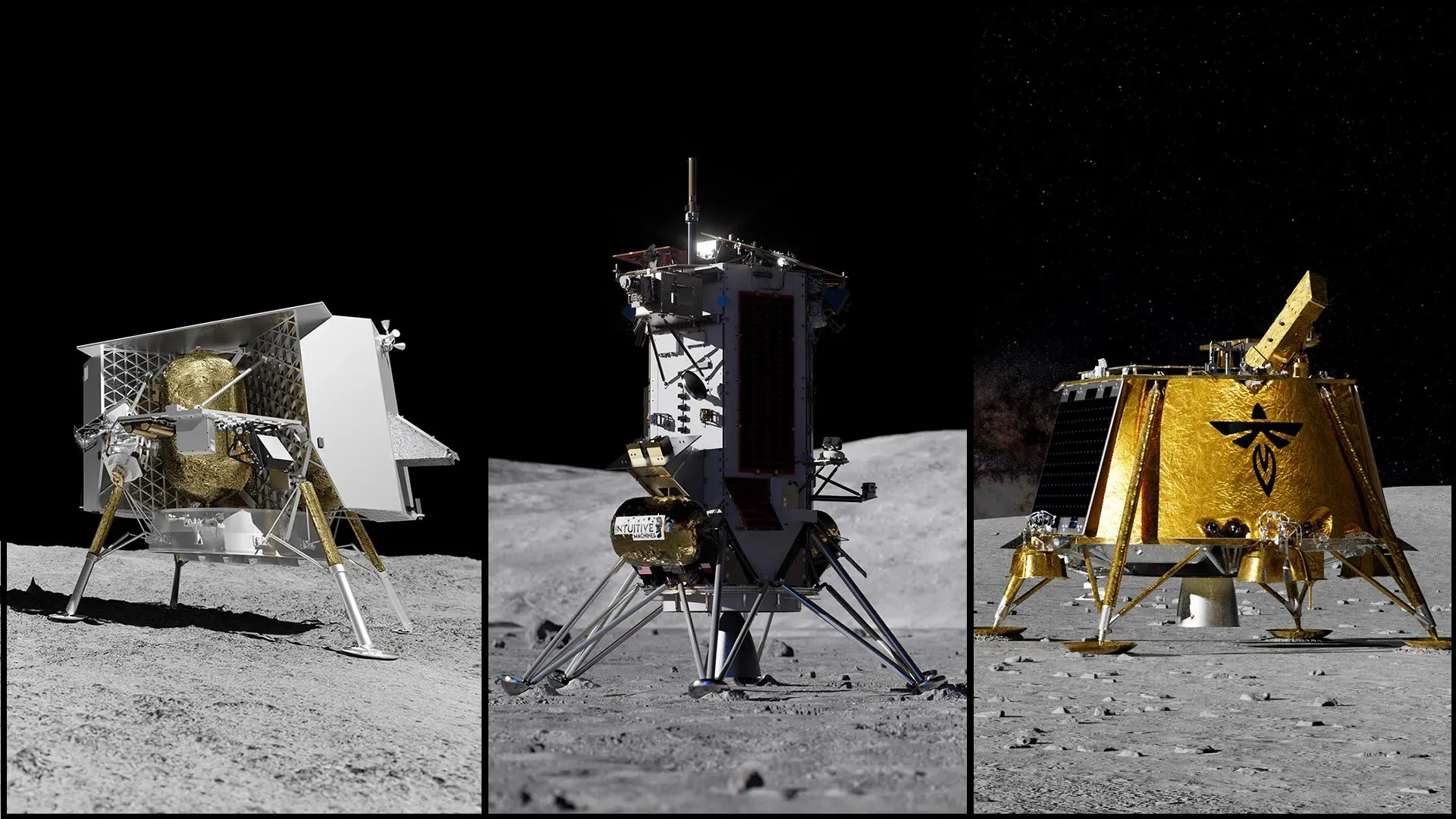
NASA has chosen three leading commercial space companies to undertake four new lunar missions set for late 2028. This significant milestone is part of NASA’s ongoing efforts to establish a permanent human presence on the Moon. Astrobotic, Firefly Aerospace, and Intuitive Machines will transport scientific equipment to the lunar surface as part of NASA’s ambitious Lunar Base Program, aimed at creating the first long-term outposts on another celestial body.
“Our recent allocation of nearly $600 million to our commercial partners for additional lunar missions underscores our commitment to accelerating the establishment of a lasting lunar presence,” stated Rory Glaze, Associate Administrator for the Human Spaceflight Mission Directorate at NASA Headquarters in Washington. “This initiative also enhances our capability to develop crucial skills for success on the Moon.”
Investment of $600 Million for Lunar Exploration Missions
The total contract value for the trio of companies is approximately $600 million. Astrobotic has secured $297.9 million to complete two deliveries, while Firefly Aerospace and Intuitive Machines received $144.2 million and $148.3 million for their respective missions.
All four missions will be conducted under NASA’s Commercial Lunar Payload Services (CLPS) initiative, crucial for the lunar base’s transportation system. The companies will employ upgraded versions of existing landers, enabling NASA to accelerate lunar exploration.
“We are creating a vital testing ground for lunar base operations,” commented Ryan Stephan, NASA’s Acting Director for Lunar Base Cargo Landers. “By speeding up our lunar mission sequence and increasing launch opportunities, we can rapidly learn, iterate, and enhance our approaches.”
Expanding Opportunities for Lunar Base Development
NASA plans a total of 17 lunar deliveries through various commercial providers. In addition to the recent mission awards, the agency has announced further opportunities for U.S. industry to contribute to future lunar base infrastructure.
One proposal under review is the launch of PROMISE (Polar Observation, Mapping, and Field Exploration Rover) to the Moon. This advanced vehicle is a hybrid development version of the Mars Perseverance and Curiosity rovers. If approved, PROMISE will study the Moon’s surface and subsurface to identify valuable resources for forthcoming exploration missions.
NASA is also looking for proposals for an additional lunar lander that will test power and avionics technology, carry scientific instruments, and support optical imaging for the Antarctic. The agency will issue a public request for lunar base technology demonstrations and work towards establishing a lunar communications and navigation relay constellation to enhance communication between the Moon and Earth.
Establishing Infrastructure for Future Lunar Exploration
The award announcement on June 30 aims to fortify the infrastructure necessary for sustained lunar operations. The companies involved will manage procurement activities, assess past lunar landers, and apply valuable lessons to ensure mission reliability.
Each mission will carry the same three NASA science payloads, allowing scientists to gather comparable data from multiple lunar landing sites.
SCALPSS: Studying Lunar Dust During Landings
The Stereo Camera for Lunar Plume Surface Studies (SCALPSS) consists of four cameras utilizing stereo photogrammetry to produce detailed 3D images of lunar dust disturbances caused by the lander’s engine exhaust during descent.
Researchers hope to enhance computer models predicting dust erosion and debris movement, which will become increasingly crucial as larger spacecraft and heavier equipment land in close proximity on the lunar surface.
Laser Retroreflector to Enhance Lunar Navigation
A laser retroreflector array (LRA) is a passive navigation device that reflects a laser beam from an orbiting spacecraft, improving position accuracy. Each cookie-sized array comprises eight quartz corner cube prisms within a domed aluminum frame, requiring no power or maintenance, thereby serving as a permanent lunar marker. Similar systems have previously been deployed on CLPS missions and the International Lunar Module, with plans for network expansion over time.
Radiation Monitors for Astronaut Safety
The Linear Energy Transfer Spectrometer (LETS) will monitor the lunar radiation environment during different landing approaches. Built with proven technology, this compact silicon detector measures the energy from incoming cosmic radiation, helping scientists understand the intensity and type of radiation astronauts might face, thus aiding the design of safer spacecraft for long-duration missions.
NASA is also assessing whether these landers can accommodate additional payloads beyond the standard scientific instruments.
“By deploying the same science instruments across various landers, we aim to enhance our understanding of landing hazards and create a global network for environmental data and location markers on the lunar surface,” stated Joel Kearns, NASA’s Deputy Assistant Administrator for Exploration in the Science Mission Directorate. “This approach is akin to establishing weather stations worldwide. The three payloads are flight-proven, crucial for ensuring safe human exploration of the lunar terrain.”
Preparing for a Permanent Moon Base and Future Mars Missions
NASA is committed to expanding its lunar base as part of a long-term strategy focused on establishing a sustainable human presence on the Moon while fostering scientific research and commercial activities.
As a pivotal part of the Golden Age of Innovation and Exploration, NASA plans to launch increasingly ambitious lunar missions that will facilitate scientific breakthroughs, open economic avenues, and lay the groundwork for the first manned mission to Mars.
Source: www.sciencedaily.com