


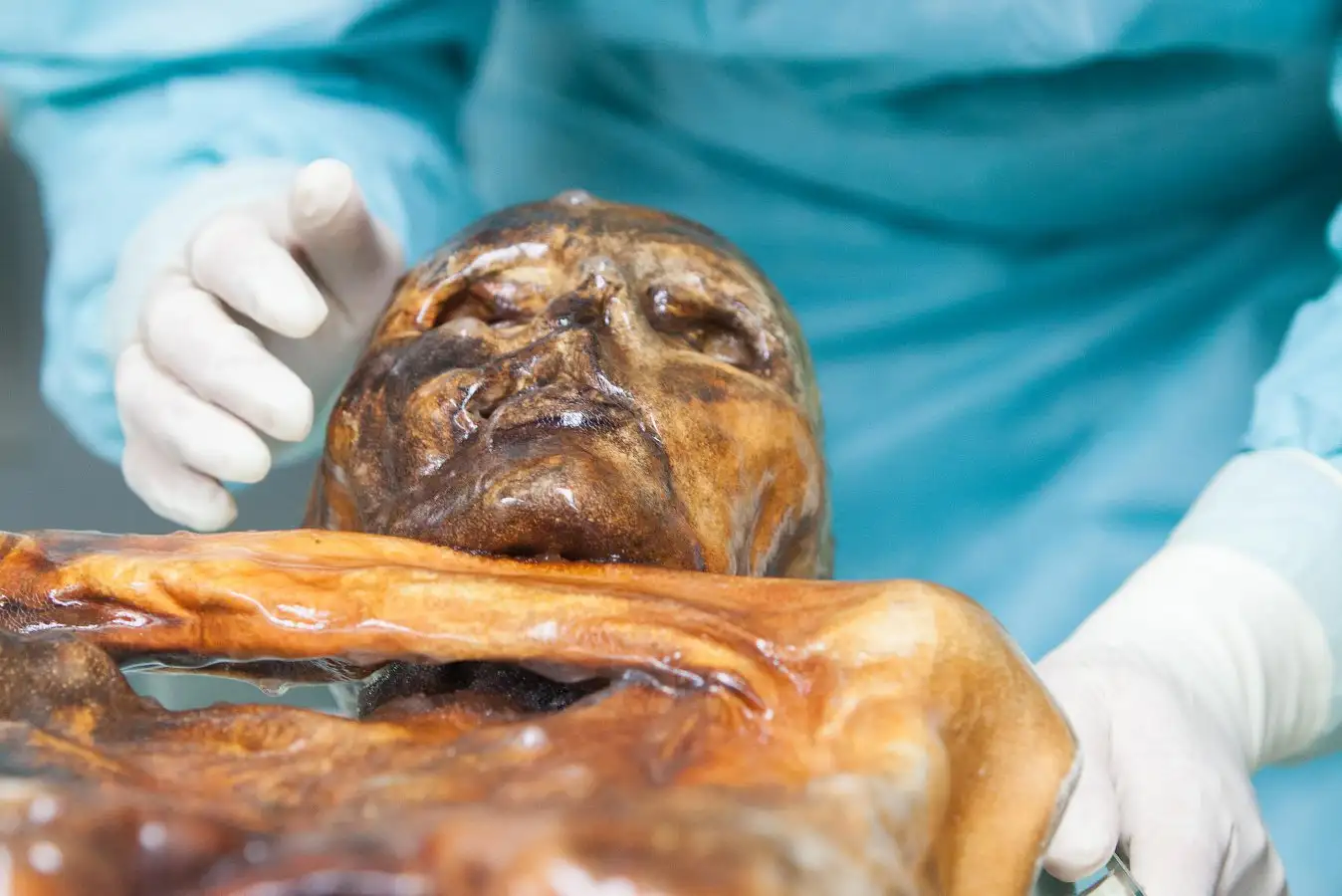
Ötzi the Iceman will be stored in a cold room at a constant temperature of -6°C.
South Tyrol Archaeological Museum/Eurac Research/Marion Lafogler
Research indicates that some microorganisms found in the 5,300-year-old remains of Ötzi the Iceman may still be metabolically active, even after long-term ice preservation.
Discovered in 1991 while melting from a glacier along the Austria-Italy border, Ötzi is believed to have lived between 3350 and 3120 BC. Over the past 35 years, extensive studies have uncovered fascinating details about him, suggesting he was likely dark-skinned and bald. He also had numerous tattoos and sustained an arrow wound, indicating he may have been murdered.
Ötzi is currently preserved at the South Tyrol Archaeological Museum in Bolzano, Italy, under conditions that replicate the glacier’s environment: -6°C (21°F) and 99% relative humidity.
Research led by Frank Meixner at the Eulac Institute Mummy Research Institute in Bolzano assessed bacteria and fungi from skin swabs, tissue fragments, and thawed water samples collected in 1992, 2010, and 2019. These samples were analyzed in comparison to soil and ice samples from the discovery site taken in the 1990s.
The findings include both ancient and modern microorganisms within Ötzi, some of which appear to be metabolically active. “We can differentiate between Ötzi’s endogenous gut bacteria and the external microbes that colonized after his death,” said Meixner.
Metagenomic analyses of internal tissues identified specific bacteria that thrive in mammalian intestines in low-oxygen environments, such as Treponema and Kineotrix. Based on DNA damage levels, it is likely that these bacteria were present during Ötzi’s life.
As observed in other prehistoric gut microbial communities, the diverse microbes are indicative of the richer diets consumed by Chalcolithic humans compared to modern Western diets, according to Meixner.
In addition, bacteria from the Pseudomonas genus were found, typically found in soil and water. The level of DNA damage suggests they were part of an ancient community at the site, Meixner reports.
The research team also detected cold-tolerant or psychrophilic yeasts in external samples from Ötzi, including Phenoripheria, Graciojima, Gofojima, and Murakia.
DNA analysis revealed these yeasts are ancient, with Graciojima increasing in abundance from 2010 to 2019 and becoming the dominant strain, suggesting metabolic activity or replication potential under current storage conditions.

Reconstruction of Ötzi the Iceman
South Tyrol Archaeological Museum/Augustin Ochsenreiter
“This is compelling evidence. The Graciojima yeasts seem to have settled post-mortem and appear to be proliferating,” noted Nikolai Oskolkov. However, more data points are needed to confirm that these results reflect authentic biological activity rather than experimental artifacts.
The increased prevalence of yeast is intriguing, according to Damra Kaptan from the University of Stavanger, Norway. Yet, the active status of the yeast remains uncertain until RNA produced from its DNA is analyzed, indicating gene expression. “There’s a possibility that the yeast was dormant or partially activated during thawing,” she explained.
Some of these yeasts possess enzymes that can degrade proteins and collagen, raising concerns about potential damage to the mummies, yet researchers found no evidence of harm.
The research team also identified microorganisms with genes capable of breaking down the toxic compound phenol. Professor Meixner speculated this might be a consequence of previous treatments during mummy processing in the 1990s, which aimed to eradicate fungal growth. “When Ötzi was discovered, mold growth was already present, and he was treated with a phenol-containing solution,” he said. “It’s possible this treatment fortified the microbiome.”
This research suggests that Ötzi is not merely a frozen time capsule, but rather a dynamic ecosystem sustained by microbial inheritance post-mortem, millennia of glacial layers, and subsequent preservation efforts. “Given that these microbes have been associated with the mummy since its discovery, should we consider them part of his biological identity?” asked Professor Meixner.
He recommends ongoing genomic monitoring to track signs of microbial activity, such as RNA and metabolite production. If indicators of revival emerge, this may necessitate reassessing the storage conditions, potentially lowering temperature or humidity to curtail microbial proliferation.
Topic:
Source: www.newscientist.com