


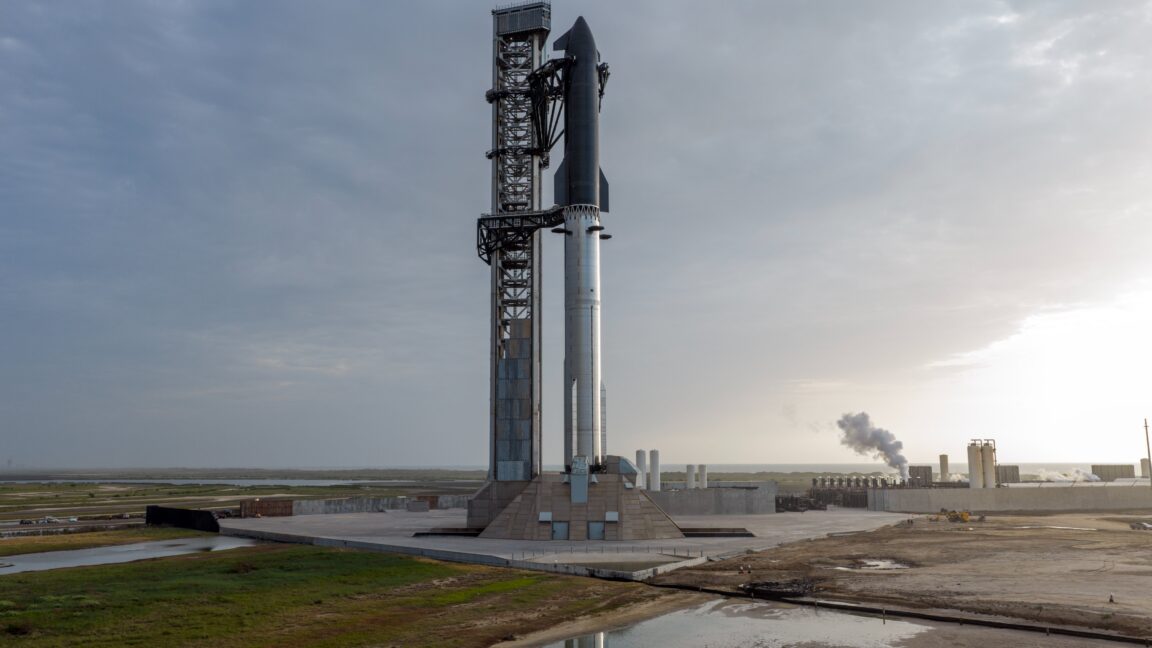
How many launches are required to establish a mega-constellation of data centers? Ars Technica dives into the technical hurdles of constructing an in-orbit data center and examines what it would entail to realize SpaceX’s ambitious plan for a million satellite mega-constellation. The pivotal element in this venture isn’t radiation or temperature regulation for space-based data centers; it’s affordable access to space. For analysis, Ars considered three launch scenarios: high-performance Starship with low satellite mass, medium-performance Starship with moderate satellite mass, and low-performance Starship with high-mass satellites.
It’s a staggering figure. In an optimistic projection, deploying one million satellites would necessitate approximately 17,500 Starship launches. Conversely, the most pessimistic outlook suggests a daunting 77,000 launches. To put this into perspective, a pessimistic scenario could involve 42 Starship launches daily over a span of five years. Financially, factoring in launch, satellite, and ground system costs, the optimistic total could reach $1.45 trillion. Pessimistically? Brace yourself for a staggering $9.8 trillion.
Nasa’s Mission Transition to Falcon Heavy. NASA’s SunRISE (Solar Radio Interferometer Space Experiment) mission is now set to launch on a SpaceX Falcon Heavy rocket from NASA’s Kennedy Space Center in Florida. The announcement was made this week. However, NASA did not disclose a launch date for this heliophysics mission, which was initially slated to launch aboard a United Launch Alliance Vulcan rocket.
Six new eyes focused on the Sun… This mission will be executed as a rideshare under the U.S. Space Force’s Space Systems Command. SunRISE comprises six SmallSats, each comparable in size to a toaster oven, functioning as a single massive radio-receiving antenna positioned just above geostationary orbit (around 22,000 miles or 35,000 kilometers above sea level), capturing radio bursts from the Sun’s atmosphere (corona). (Submitted by Tfargo04)
Upcoming Launches
July 16th: Starship | Flight Test 13 | Starbase, Texas | 22:45 UTC
July 18th: Vikram 1 | Agaman Test Flight | Satish Dhawan Space Center, India | 06:00 UTC
July 20th: Falcon 9 | Starlink 17-39 | Vandenberg Space Force Base, California | 14:00 UTC
This rewritten content is designed to be SEO-optimized by including relevant keywords and reorganizing the text for clarity and engagement while keeping the HTML tags intact.
Source: arstechnica.com