


Aluminum 2219 Casting and Forging: How Homogenization and Multidirectional Deformation Improve Corrosion Resistance and Mechanical Properties
For more information, contact Donald S. Parker at Kennedy Space Center at [email protected].
Download PDF version
Improper casting and forging of aluminum alloy 2219 can create microstructural defects that reduce the alloy’s response to anodic surface treatments and increase susceptibility to corrosion. This technical bulletin describes the risks associated with improper casting and recommends homogenization followed by multidirectional deformation after conventional direct-cooling casting, particularly for large castings.
Document date: 09/24/26
Document ID: 20260008373
Background: Aluminum 2219 Alloy in Aerospace Applications
Aluminum 2219 is an age-hardenable, supersaturated aluminum-copper alloy developed by the Aluminum Company of America (Alcoa) in 1954 for use at temperatures up to 600°F. Its aerospace applications include launch vehicles, spacecraft, space shuttle fuel tanks, and crewed pressurization modules for the International Space Station.
The alloy offers excellent cryogenic properties, weldability, workability, and mechanical properties at both low and high temperatures [1].
How Casting Defects Affect Aluminum 2219 Performance
Casting 2219 aluminum alloy ingots is a specialized process used to produce large structures that are later forged or rolled into their final shapes. Internal defects in as-cast ingots may include nonuniform grain sizes, macrosegregation of alloying elements, and residual copper-rich intermetallic compounds in the form of streaks or clusters.
These defects can produce unsatisfactory mechanical and corrosion properties, including low ductility, low strength, and uneven material properties throughout the final product geometry [2,11,12].
Post-casting processes such as mechanical deformation, solution treatment, quenching, and aging can reduce some defects. However, if an ingot contains irrecoverable discontinuities—including dendritic segregation, large copper intermetallic compounds in stripes or clusters, or significantly different grain sizes—later thermomechanical treatment may not correct the resulting property defects. This concern is especially important for large ingots.
Why Homogenization Is Essential After Casting
Homogenization after casting can significantly improve the final properties achieved through subsequent machining and thermomechanical processing. During homogenization, diffusion redistributes copper atoms from high-concentration interdendritic boundary regions throughout the aluminum matrix grains. Residual phases dissolve into the matrix, substantially reducing elemental segregation.
To achieve a consistent thermal response, homogenization parameters must be optimized for the ingot cross-sectional thickness. In one study, Wang et al. used a homogenization treatment of 10 hours at 535°C [3].
Important homogenization variables include:
- Melting point
- Amount and dissolution rate of the eutectic phase
- Ingot size
- Grain size
- Copper content
Researchers have shown that X-ray diffraction (XRD) and differential scanning calorimetry (DSC) are valuable tools for defining and validating the homogenization process [3,4,5,6,7,8,9]. Improvements in the microstructure and mechanical properties of homogenized aluminum 2219 are well documented. Scanning electron microscopy (SEM) images from a study of aluminum 2219 with varying copper contents show changes in grain-boundary morphology after homogenization.
Wang et al. compared non-homogenized and homogenized aluminum 2219 that was subsequently forged and T6 tempered. The homogenized material demonstrated clearly improved performance [3].
Thermomechanical Deformation of Aluminum 2219
Mechanical deformation—particularly upset forging followed by solution treatment and aging—can produce smaller, well-dispersed Al2Cu particles. These changes can improve the mechanical properties, reduce anisotropy, and refine the microstructure of aluminum 2219.
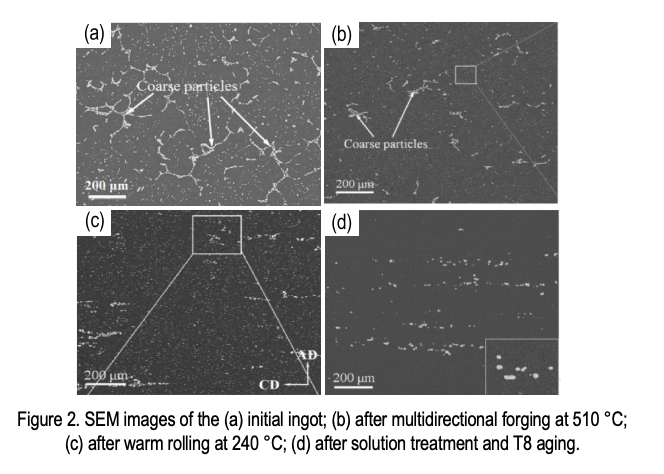
In one of several studies, high-temperature multidirectional forging at 510°C followed by warm rolling at 240°C produced superior mechanical and microstructural properties.
Upset forging and rolling followed by solution treatment and aging reduced the area fraction of coarse Al2Cu particles from 5.5% to 1.0% through dissolution into the matrix. Grain size decreased from 230 micrometers to 58.6 micrometers because of increased stored energy and nucleation associated with cold rolling. The uniformly distributed θ′ phase increased by 118%.
These microstructural changes resulted in improved strength, elongation, and fracture properties [10].
Recommendations for Aluminum 2219 Procurement and Processing
Homogenization after conventional direct-cooling casting is essential for optimizing the final properties of aluminum 2219. The homogenization requirement should be explicitly included in procurement specifications.
The effectiveness of homogenization should also be verified using appropriate inspection methods, which may include:
- Before-and-after micrographs
- Differential scanning calorimetry (DSC)
- X-ray diffraction (XRD) measurements
Early microstructural evaluation can help confirm ingot quality. Multidirectional deformation is also important because it promotes the fracture of coarse grains, redistribution of Al2Cu and other intermetallic phases, recrystallization, and nucleation of new grains. These effects contribute to improved mechanical properties.
References
- NASA-CR-74545
- NASA-CR-123777
- Wang et al., Materials 2018, 11, 914.
- Chen et al., Metals 2020, 10, 197.
- Zhang et al., Journal of Materials Research and Technology 2023, 27, 7470.
- Gupta et al., Canadian Metallurgical Quarterly, 2006, 45, No. 3.
- Xu et al., Metals 2021, 11, 174.
- Zhang et al., Advanced Engineering Materials, 2024, 26.
- Lin et al., Materials 2023, 16, 433.
- Zhang et al., Journal of Materials Research and Technology 2023, 22, 1136.
- NASA-TM-20230018439
- NASA-TM-20240000329
Source: www.nasa.gov