


Breakthroughs in physics often emerge through innovative inventions or new theories. However, many significant advancements result from researchers creatively integrating familiar technologies to produce outcomes more powerful than the sum of their parts.
This approach could be invaluable in the quest for weakly interacting particles, such as neutrinos and specific dark matter candidates. These elusive particles are challenging to detect due to their infrequent interactions with regular matter. While building larger detectors and enhancing spatial resolution boosts the likelihood of observing these faint signals, it can also complicate equipment design and escalate costs.
Calorimeters share similar challenges. These devices are essential in collider experiments for measuring particle energy.
Understanding the Complexity of Particle Detectors
Most particle physics experiments require the reconstruction of the three-dimensional (3D) trajectories that elementary particles follow as they pass through dense materials.
A commonly used detector material is scintillator, which emits brief flashes of visible light when charged particles traverse it. Researchers analyze these light flashes to determine particle pathways and interaction patterns within the detector.
To accurately pinpoint particle locations, scintillators are often segmented into numerous small active sections. An optical fiber collects photons emitted from each section and channels them to a photomultiplier tube or a silicon photomultiplier tube for counting.
This method is precise but challenging to scale.
For instance, Japan’s T2K neutrino oscillation experiment features a detector composed of approximately 2 tons of sensitive material, consisting of around 2 million cubes and 60,000 fibers. In experiments like LHCb and Mu3e at CERN and the Paul Scherrer Institute, millions of slim scintillating optical fibers achieve submillimeter spatial resolution.
While these systems showcase the potential of segmented detectors, they also highlight emerging issues. Increasing detector size can lead to manufacturing, assembly, and maintenance challenges, creating significant technical and financial constraints.
Innovative Approaches to Particle Tracking
Researchers from ETH Zurich and EPFL are now proposing a groundbreaking strategy.
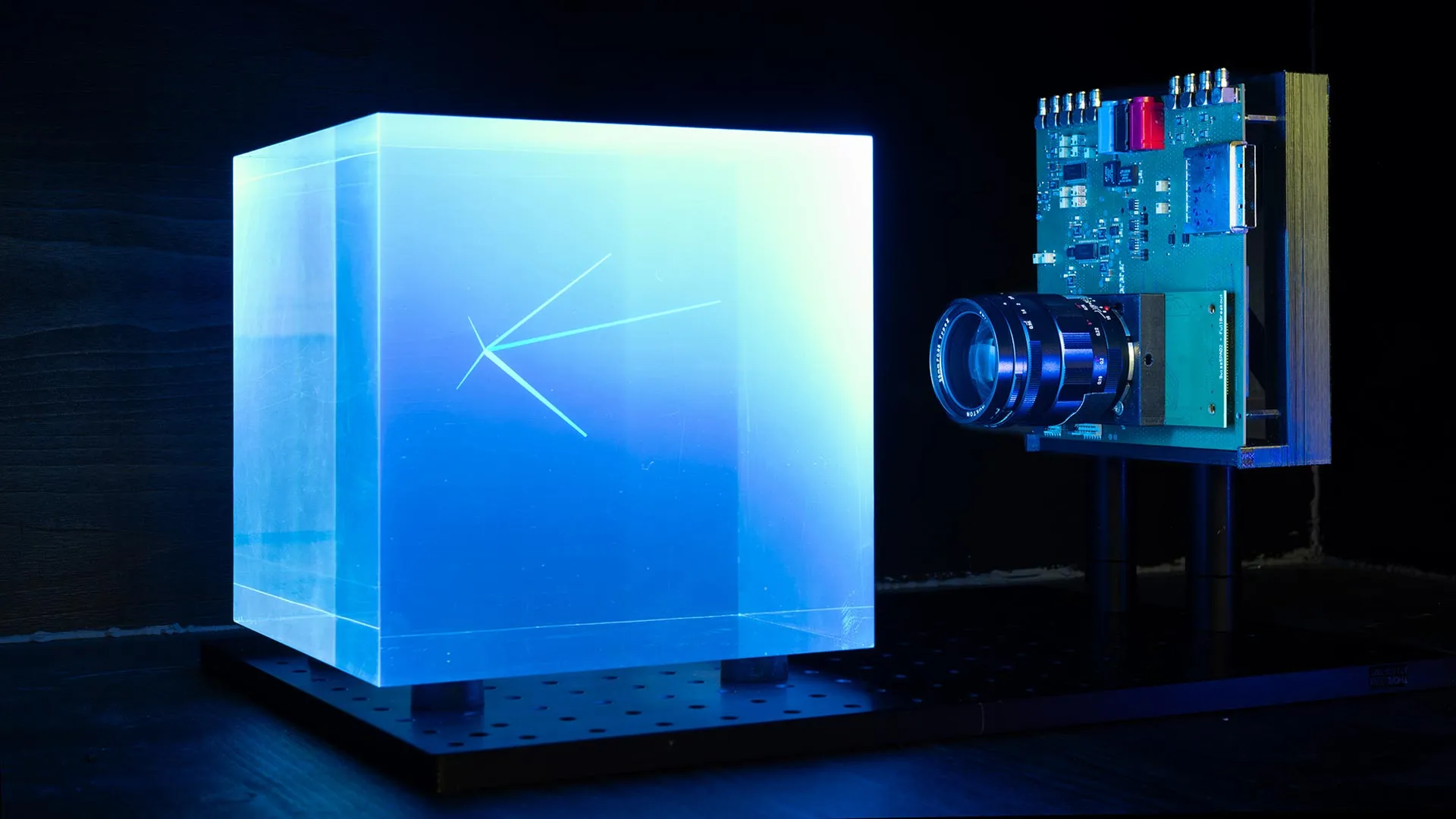
PhD student Till Dieminger, senior scientist Dr. Saul Alonso Monsalve, Professor Davide Sgaraverna, and their team, alongside members from EPFL’s Advanced Quantum Architecture Laboratory, led by Professor Eduardo Charbon, have developed and tested a pioneering prototype for ultrafast, high-resolution 3D particle imaging using large volumes of unsegmented scintillator material.
Instead of segmenting the detector into millions of minuscule units, this system employs advanced camera technology to determine the light’s source location.
For details on the prototype and extensive simulation studies, refer to the latest Nature Communications publication.
Transforming Light Field Photography into Particle Detection Tools
The detector incorporates concepts from plenoptic cameras, also referred to as light field cameras.
Different from traditional cameras that primarily capture light intensity, light field cameras gather information about incoming light’s direction, enabling 3D scene reconstruction.
This technology uses a microlens array (MLA) positioned between the main lens and the image sensor. Each microlens acts as a tiny camera, documenting the scene from slightly various angles. By integrating data from all lenses, the system reconstructs a light field that characterizes the intensity, position, and direction of incoming light.
This feature is particularly advantageous for particle detection, as scintillator-emitted light is generally weak.
Plenoptic cameras combined with single-photon avalanche diode (SPAD) array sensors can potentially detect individual photons and reconstruct particle paths, even under low-light conditions. Despite this promise, prior research has yet to utilize light-field cameras for particle tracking.
Exploring the PLATON Prototype
The PLATON project, funded by the Swiss National Science Foundation, spearheads this innovative system.
The ETHZ-EPFL team crafted a proof-of-concept detector that merges a microlens array with a SPAD image sensor known as SwissSPAD2, developed by the EPFL team. Raytrix GmbH designed and integrated the MLA into the sensor, forming a complete plenoptic imaging system.
SwissSPAD2 also features gated photon detection, allowing the sensor to capture photons only within a specified time frame.
This timing capability enables researchers to concentrate on periods when actual scintillation light is most likely present, filtering out random background noise and spurious counts.
Testing Detection with Minimal Photon Levels
Researchers assessed PLATON’s spatial resolution in laboratory tests with light levels ranging from hundreds to just five detected photons.
They also examined the prototype’s ability to detect electrons and reconstruct their positions within plastic scintillator blocks, with electrons generated using a strontium-90 source.
Across various testing conditions, the simulations aligned closely with laboratory measurements, bolstering confidence in the model’s accuracy for predicting detector performance.
The findings from the initial demonstrator are already influencing the team’s plans for PLATON’s next iteration.
Enhancing Timing and Sensitivity
Researchers are creating an upgraded SPAD array sensor aimed at boosting photon detection efficiency and achieving subnanosecond timing for individual photons.
Current systems allocate photons to fixed time windows; however, the new version will assign precise timestamps to each detected photon.
This additional timing data enhances the system’s capability to accurately track the source of each photon, improving particle tracking reconstruction.
The researchers are also optimizing the plenoptic camera to widen its field of view and capture more light, with simulations suggesting these modifications may further enhance PLATON’s spatial resolution.
Utilizing AI for Enhancing Particle Interaction Reconstruction
The team employed simulations to predict how the enhanced PLATON system might fare in detecting neutrinos.
This simulation incorporates a cutting-edge image processing technique based on neural networks (NN) using a Transformer architecture—commonly used in large-scale language models.
Instead of analyzing text, this transformer evaluates patterns of scintillation photons captured by the detector, allowing reconstruction of original particle interactions based on the correlation of photon appearance and location.
Simulation results indicate that an unsegmented PLATON detector with a volume of (10x10x10)cm.3 could realistically achieve a spatial resolution of less than 1 mm.
Additionally, the system shows promise in identifying neutrino interactions resulting in low-momentum protons with high efficiency and purity, effectively distinguishing events of interest from irrelevant signals.
Scaling to Larger Detectors
Researchers are also evaluating how this approach applies to larger detectors.
Due to limited computing resources, a comprehensive neutrino simulation on a 1 cubic meter block of unsegmented scintillator was not feasible. Instead, they modeled a simplified point-like photon source.
Simulations suggest a detector of this size can achieve spatial resolution of several millimeters, comparable to leading plastic scintillator detectors.
This outcome is particularly significant, as PLATON accomplishes this performance without subdividing the scintillator into millions of individual components.
The researchers assert that further enhancements in optical design and other system aspects could enable PLATON-type detectors to achieve submillimeter resolution with volumes exceeding 1 m.3.
Broader Applications Beyond Particle Physics
Experts at ETH Zurich believe this innovative technology could extend far beyond just neutrino experiments and particle colliders.
PLATON aims to reconstruct weak optical signals’ positions in 3D, potentially revolutionizing various imaging systems.
Researchers Dieminger, Alonso-Monsalve, and Sgalaberna have already filed three patents related to the application of PLATON technology in positron emission tomography (PET), a medical imaging method tracking radioactive tracers in the body to visualize organ and tissue activity.
The patents cover scanner design and image processing methodologies, including the NN developed by Alonso Monsalve.
Particle physics has a rich history of developing techniques later applied to broader fields—most notably, CERN’s creation of the World Wide Web and advancements in proton therapy stemming from innovations in particle accelerators and radiation physics.
PLATON could very well represent another instance of a physics experiment fostering significant scientific and medical advancements.
Source: www.sciencedaily.com