


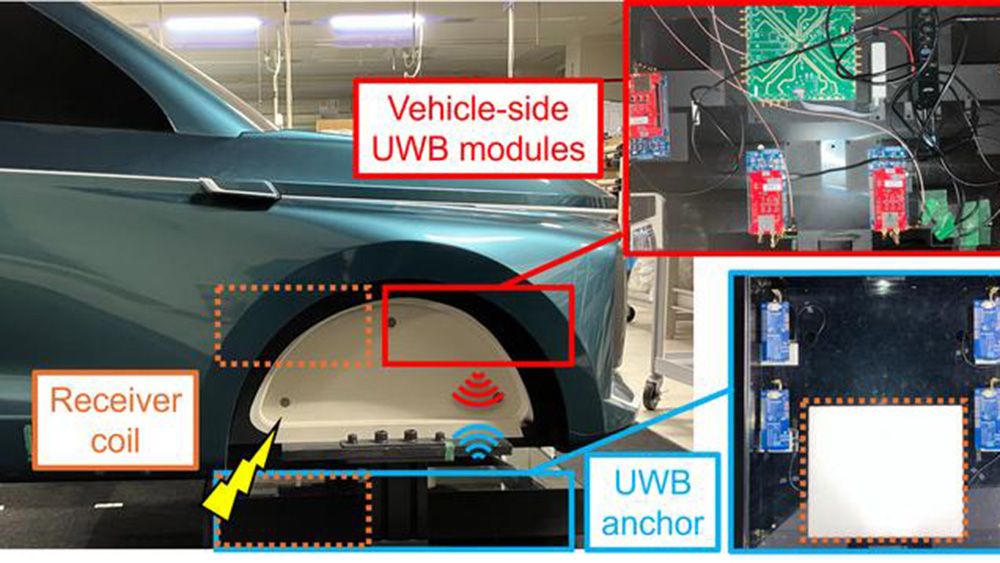
Japanese researchers have developed a wireless charging system that could allow electric vehicles (EVs) to charge simply by parking over a charging pad. The system uses short-range radio signals to locate the vehicle’s charging coil and guide it into an efficient position, potentially allowing driverless vehicles such as robotaxis to charge without human assistance.
Wireless charging is still relatively new in the EV market, but researchers hope that installing charging equipment in roads and parking spaces could reduce reliance on bulky plug-in infrastructure. The technology is based on wireless power transfer systems used in some smartphones and other consumer electronics.
A transmitting coil in a ground pad generates a magnetic field, which induces an electric current in a receiving coil beneath the vehicle. That current charges the EV’s battery cells. Even a slight misalignment between the two coils, however, can reduce charging speed and efficiency.
Using radio signals to position the vehicle
The new system uses short-range radio signals to determine the distance and angle between an EV’s charging coil and the equipment in the ground. This helps position the vehicle so it can charge more efficiently.
The technology could be particularly useful for driverless “robotaxis.” A self-driving car must be able to charge quickly and efficiently without human assistance, the researchers said.
The team detailed its findings in a study published on August 26th in the IEEE Vehicle Technology Open Journal.
“We hope this research will lead to a future where EVs can be charged simply by parking, similar to placing a smartphone on a wireless charger,” Ryotaro Haneda, the study’s lead author and a master’s student at Osaka University’s Graduate School of Information Science and Technology, said in a statement.
Borrowing from digital car keys
Existing systems for adjusting the positions of EV charging coils and wireless charging pads use magnetic sensors or cameras. Magnetic systems work best when the coil is close to the pad, while cameras can be affected by rain, poor lighting or dirt obscuring the pad.
The new system uses four ultra-wideband wireless devices mounted around the vehicle’s charging coil. These devices communicate with four antennas positioned around the charging pad.
By measuring the time it takes for radio signals to travel between the ultra-wideband devices and the antennas, the system can estimate the coil’s position. It also detects subtle differences in how the signals reach each sensor on the vehicle, allowing it to determine the coil’s angle relative to the ground pad.
The same technology is used in some digital car keys. Short radio pulses can detect when a driver is nearby, allowing the vehicle to be unlocked without a physical key.
In laboratory experiments using scaled-down vehicle models, the system located the charging coil to within 0.09 inches (2.32 millimeters) of its actual position and determined its direction to within 0.25 degrees. According to the research team, correcting distortion in the wireless signals reduced positioning errors by approximately five times.
The researchers said the system still needs to be tested outdoors, on full-size EVs and under real-world charging conditions.
Source: www.livescience.com