


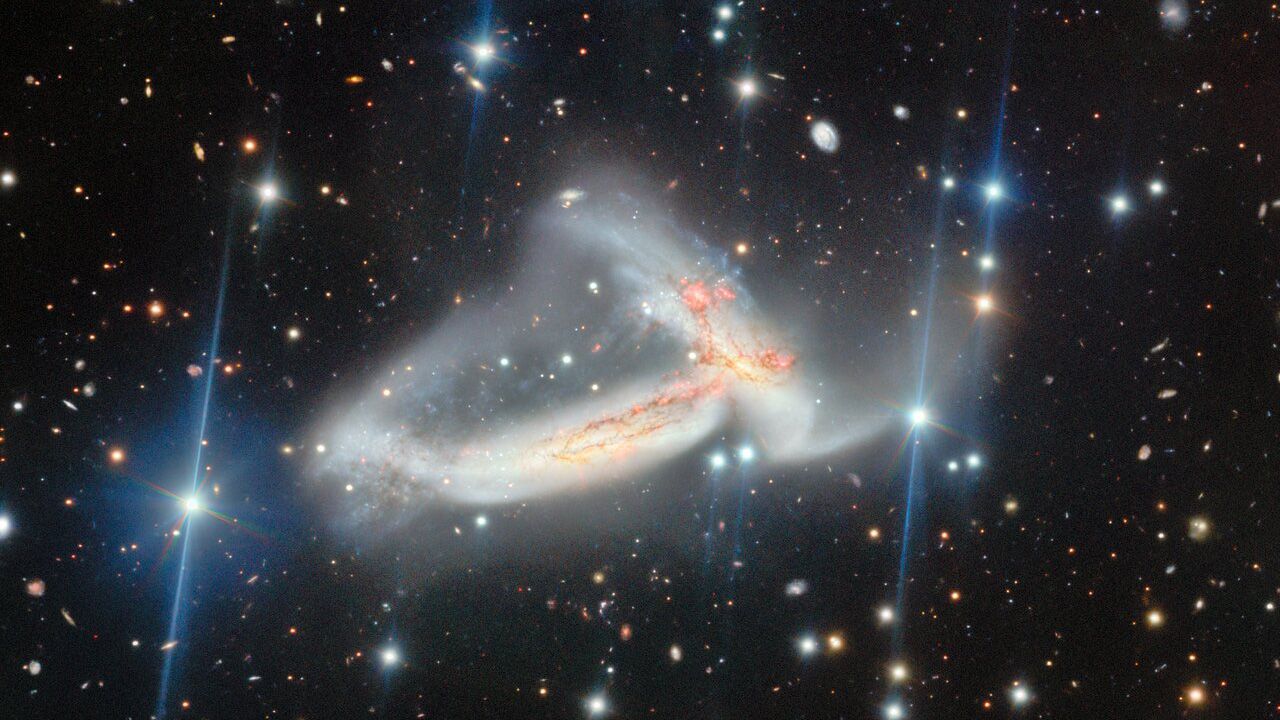
NGC 7253, also known as Arp 278, is a pair of spiral galaxies about 200 million light-years away in the constellation Pegasus. Recent images from the Gemini North Telescope on Mauna Kea, Hawaii, show their spiral structures being stretched and disrupted by mutual gravity. Although the galaxies appear to be colliding, their individual stars are unlikely to physically strike one another. Instead, the interaction is compressing clouds of gas and dust and may be triggering the formation of new stars.
A galactic encounter
Spiral galaxies are usually defined by their orderly arms of stars. NGC 7253 looks very different: its distorted form resembles a strange balloon animal rather than a neat cosmic spiral. In reality, it consists of two spiral galaxies caught in each other’s gravitational pull.
Their encounter is stretching and deforming the galaxies’ spiral arms, creating a tangled arrangement of stars, gas and dust. Despite the chaotic appearance, the galaxies’ stars are separated by such vast distances that direct stellar collisions are unlikely.
Gravity can trigger new stars
Spiral galaxies contain enormous clouds of cold gas and dust, particularly within their arms. As the galaxies interact, their gravity can disturb and compress these clouds. If enough material becomes dense enough to collapse under its own gravity, it can produce a burst of new star formation.
Evidence of this process appears as concentrated clusters of bright pink light scattered across the image. These are H II regions: giant clouds of hydrogen gas energized by intense ultraviolet radiation from hot, young stars.
A possible future merger
The gravitational encounter is rearranging structures that contain billions of stars while helping to create new ones. Interactions of this kind can fundamentally alter the shapes of the galaxies involved and may eventually cause them to merge into a single galaxy.
For now, NGC 7253 is included in the Atlas of Peculiar Galaxies, a catalog of galaxies that are neither perfectly symmetrical spirals nor smooth, spherical elliptical galaxies.
A new Hawaiian name
The system has also been given the Hawaiian name “Na Uhane Mahoe Huki Pui Ke Ola,” meaning “twin souls working together to create life.” Hawaiian high school students participating in the 2026 Project Hokulani Internship Program chose the name.
One reason for the choice is the galaxies’ location within Ka Lupe o Kawelo, the Hawaiian constellation corresponding to Pegasus. “Twin Spirits” also represents both the two galaxies and Gemini Observatory’s twin telescopes, one in Hawaii and the other in Chile.
Source: www.livescience.com