


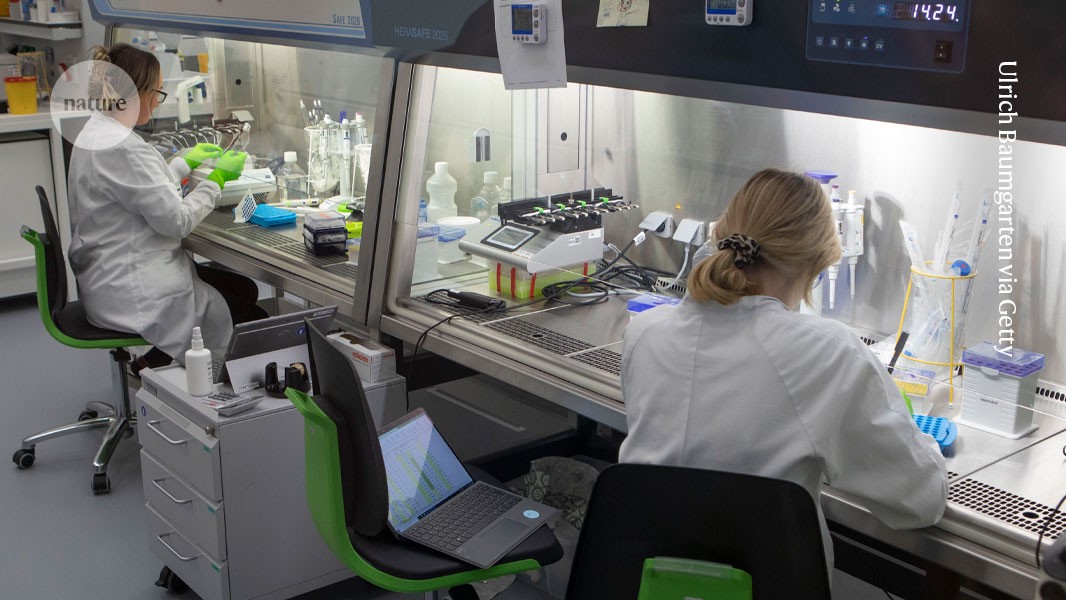
A record number of applications are being received for research funding opportunities across Europe.Credit: Ulrich Baumgarten (via Getty)
Researchers have criticized the application process for the Humboldt Research Fellowship after the programme reached a new 800-application limit within 21 hours, preventing some applicants from submitting their work. The surge comes as competition for research funding opportunities across Europe intensifies and more researchers use artificial intelligence to prepare applications.
Swastik Choubey, an astrophysicist at the University of Milan in Italy, spent three and a half months preparing an application for the fellowship. On November 14, he stayed up all night completing forms and coordinating with referees in different time zones.
After sending the application to his prospective academic host in Germany for a final check, Choubey took a break to go hiking. When he returned to submit it at about 8:50 p.m., applications had closed because the fellowship had reached its limit.
Choubey was among many researchers around the world who were unable to apply last Sunday and expressed their frustration on social media.
“It is extremely frustrating to invest so much time and effort into developing a powerful scientific project only to find out that the timing of the application process could put some researchers at a disadvantage,” Aida Skubis, an AI researcher at the Silesian University of Technology in Gliwice, Poland, wrote on LinkedIn.
A highly competitive fellowship
The Humboldt Research Fellowship supports researchers from abroad who want to conduct research in Germany. It provides €3,000 ($3,300) per month for postdoctoral researchers and €3,600 per month for experienced researchers. Fellowships run for six to 24 months for postdoctoral researchers and six to 18 months for experienced researchers.
Competition is intense partly because the fellowships and awards are internationally recognized, says Marcela Hernandez, an environmental microbiologist and former fellow at the University of Birmingham in the United Kingdom.
“Being a Humboldtian is a mark of academic excellence. Humboldtian has an extraordinary international network,” Hernandez says.
A spokesperson for the Alexander von Humboldt Foundation in Bonn, Germany, said the organization had not anticipated that the application limit would be reached within 24 hours of opening. The foundation introduced the cap this year after a significant increase in applications from 2024 onwards. Application rounds will take place in March, July and November.
The spokesperson said application numbers have also grown as more researchers use AI to prepare applications more quickly. The Humboldt Foundation does not prohibit the use of generative AI in applications and does not require applicants to disclose whether they have used it.
Calls for a fairer process
Simon Hamann, a chemist at the University of Hohenheim in Stuttgart, Germany, supported research proposals as a prospective academic host for applicants who successfully submitted their materials. He said opening the application process on a Sunday disadvantaged families and researchers with caregiving responsibilities.
“That absolutely needs to change,” Hamann said.
A Humboldt Foundation spokesperson said the organization publishes the date on which applications will open, but acknowledged that this round began on a Sunday.
“We recognize the impact this has had on those who were unable to apply, particularly given the challenges of arranging weekend availability. We sincerely apologize for the disappointment and frustration this has caused,” the spokesperson said.
The foundation added that it would “use this opportunity to continue to reflect and improve our processes” to “find a transparent and fair solution.”
Source: www.nature.com