


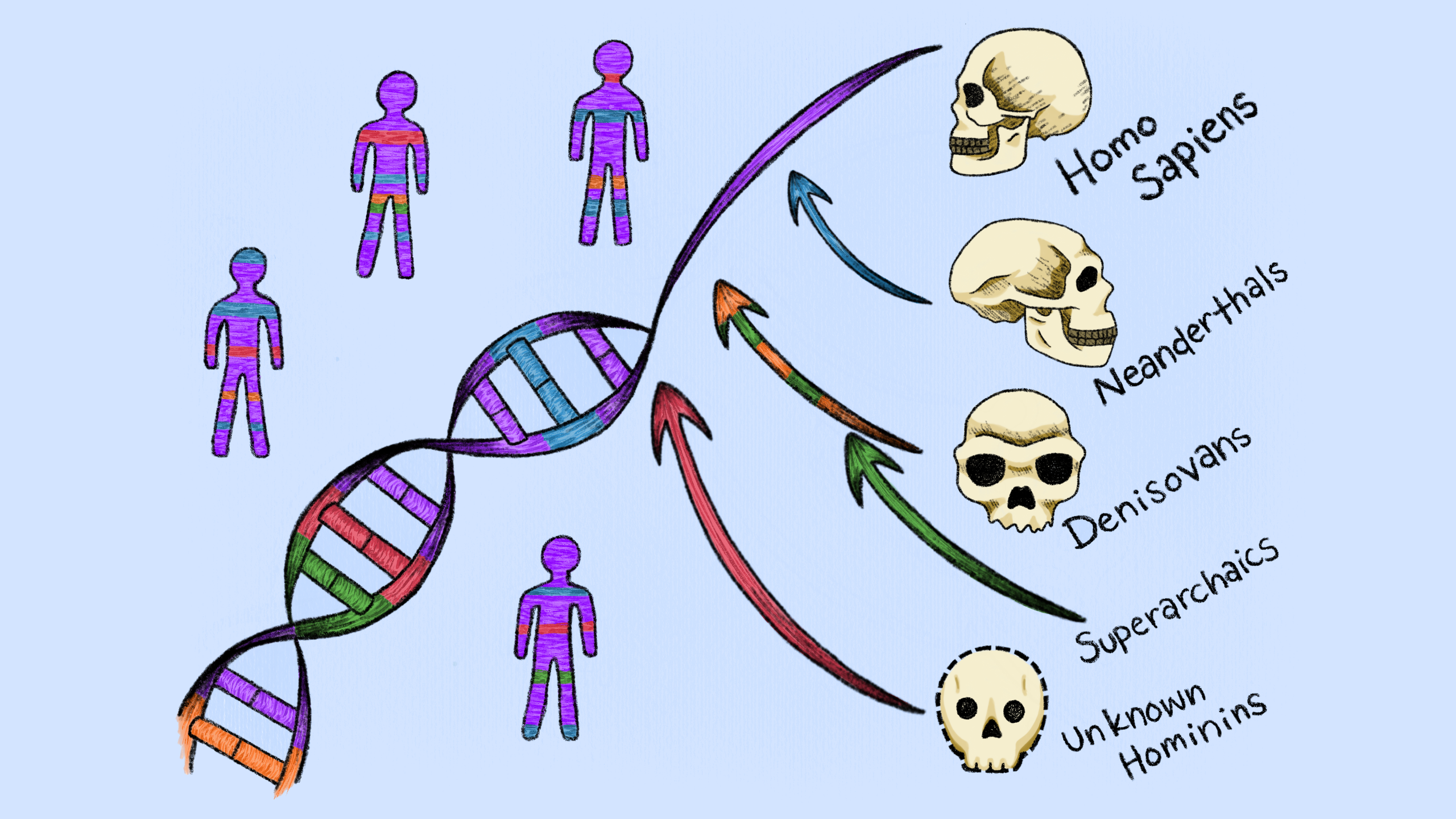
Scientists have discovered evidence of two extinct “ghost lineages” hidden in the genomes of modern humans, offering new clues about the complex history of human evolution.
One of these unknown human populations contributed small amounts of DNA to every person alive today. The second, known as a “super-archaic” lineage, may have separated from the ancestors of modern humans nearly 2 million years ago, according to a study published Thursday (July 30) in the journal Science.
“These extinct populations may have lived hundreds of thousands — or even more than a million — years ago, yet traces of their genetic legacy remain preserved in our genomes today,” study co-author Priya Moorjani, a human evolutionary geneticist at the University of California, Berkeley, told Live Science.
Latest Videos FromLive Science
For decades, researchers have known that Homo sapiens interbred with extinct human relatives, including Neanderthals and Denisovans. Most people of non-sub-Saharan ancestry carry roughly 1% to 2.4% Neanderthal DNA. People from Asia and Oceania may also carry between about 0.1% and 6% Denisovan ancestry.
However, scientists have long suspected that modern humans also exchanged genes with other extinct populations that have not yet been identified. These unknown groups are called ghost lineages because their fossils and DNA have not been conclusively found.
“Ancient DNA has transformed our understanding of human evolution, but it can only reveal information about populations whose DNA has survived,” Moorjani said. “DNA survives only under very specific conditions — usually in cold, dry environments. As a result, much of our evolutionary history, especially in Africa, tropical regions and deep time periods, remains difficult to study.”
Searching modern human DNA for extinct ancestors
Moorjani and her colleagues reasoned that the genomes of living people preserve a record of ancient ancestry. They wanted to determine whether genetic data could reveal evidence of “long-extinct ancestors preserved within the genomes of present-day people,” Moorjani said.
To investigate, the team developed a new computational method and analyzed more than 500 complete genomes from people around the world. The researchers reconstructed genealogical relationships across each genome, creating family trees that showed when genetic lineages separated and later merged.
The scientists focused on sections of DNA that had unusually ancient common ancestors and showed deep genetic differences from modern human DNA. These patterns can indicate that a genetic segment originated in a human population that split from our ancestors hundreds of thousands or even millions of years ago.
Get the world’s most fascinating discoveries delivered straight to your inbox.
“Most regions of our genome share a common ancestor relatively recently in our evolutionary history,” Moorjani said. “Occasionally, however, we find stretches of DNA whose common ancestor lived much farther back in time. That suggests they originated in a long-separated human lineage.”
Unlike methods that depend on DNA extracted from fossils, this approach can identify ancient genetic sequences using only the genomes of living people. “We no longer have to wait for extraordinary fossil preservation to learn about extinct human populations,” Moorjani said. “The genomes of living people contain traces of these ancient ancestors, allowing genealogical methods to recover part of this hidden history.”
The researchers first tested their technique by searching for known Neanderthal and Denisovan ancestry. The method successfully identified these genetic contributions, but it also revealed previously unknown evidence of interbreeding between modern humans and extinct human groups.
The researchers found that one ghost lineage contributed DNA to all modern human populations. This interbreeding likely occurred in Africa more than 50,000 years ago, before the most recent major migration of Homo sapiens out of Africa.
“Earlier studies suggested that modern humans may carry ancestry from unknown archaic populations, but they did not establish whether this ancestry was limited to African populations or determine when the interbreeding occurred,” study co-author Yulin Zhang, a computational biologist at UC Berkeley, said in a statement. “We were able to identify and map genomic regions inherited from this ghost lineage and show that the ancestry exists in all modern humans, not just in Africans.”
The ghost lineage accounts for approximately 0.5% to 1% of the genomes of modern humans — a contribution comparable to the Neanderthal ancestry found in many people today. Based on the age of the DNA, the researchers estimate that this lineage diverged from the ancestors of modern humans around 800,000 years ago, roughly when the Neanderthal and Denisovan lineages separated from our ancestors.
Which extinct human species could be the ghost lineage?
One possible candidate is Homo heidelbergensis, an extinct human species that lived in Africa and Europe between approximately 700,000 and 200,000 years ago.
“I agree with the researchers’ suggestion that this ghost lineage could represent Homo heidelbergensis, which survived in Africa until at least 300,000 years ago,” Chris Stringer, a paleoanthropologist at the Natural History Museum in London who was not involved in the study, told Live Science.
The analysis also found evidence that people from Oceania inherited a small amount of DNA from a much older “super-archaic” human lineage. This population may have diverged from the ancestors of modern humans approximately 1.8 million years ago — before the common ancestor of modern humans, Neanderthals and Denisovans emerged.
On average, super-archaic DNA made up about 0.002% of the Oceanian genomes analyzed. The genetic material appeared within sections of Denisovan DNA, suggesting that the DNA may have entered modern human populations through interbreeding between Denisovans and the super-archaic group.
The age of these genetic segments suggests that the super-archaic ancestry may have come from Homo erectus, one of the longest-surviving human species. The DNA may have passed first into Denisovan populations and later into modern humans, Fernando Villanea, a population geneticist at the University of Colorado Boulder who was not involved in the study, told Live Science.
This possibility is consistent with evidence from Homo erectus skulls discovered in Yunxian, China, which share some traits with Denisovan fossils. However, scientists have analyzed only a limited amount of H. erectus genetic material, so the connection remains uncertain.
The findings reinforce the idea that modern humans are the result of repeated interactions between different human species. “Hybridization is the norm and not the exception,” Villanea said. “These discoveries help move scientific thinking away from the idea of human evolution as an isolated or exceptional process.”
DNA inherited from the two newly identified lineages appears throughout the human genome, but it is especially common in regions linked to immune-system activity and metabolism. This pattern may reflect the evolutionary advantages of acquiring genes that helped early humans respond to unfamiliar diseases, new environments and changing food sources.
“This work reinforces a fundamental shift in how we understand human evolution,” Moorjani said. “Rather than a simple branching tree, human history is increasingly emerging as a complex web of populations connected through repeated episodes of divergence, migration and interbreeding.”
Stringer agreed, noting that the technique offers an indirect way to reconstruct parts of the genomes of poorly understood ancient human species, including Homo erectus and Homo heidelbergensis.
The researchers plan to use the method to search for additional ghost lineages, particularly those from Africa and South Asia, which remain underrepresented in ancient-DNA research. The technique could also help scientists study the evolutionary history of other species whose fossil DNA is rare or completely absent.
Test your knowledge of early humans with our human evolution quiz!
Source: www.livescience.com