


Feathered Dinosaur Fossil Suggests Flight Evolved Multiple Times
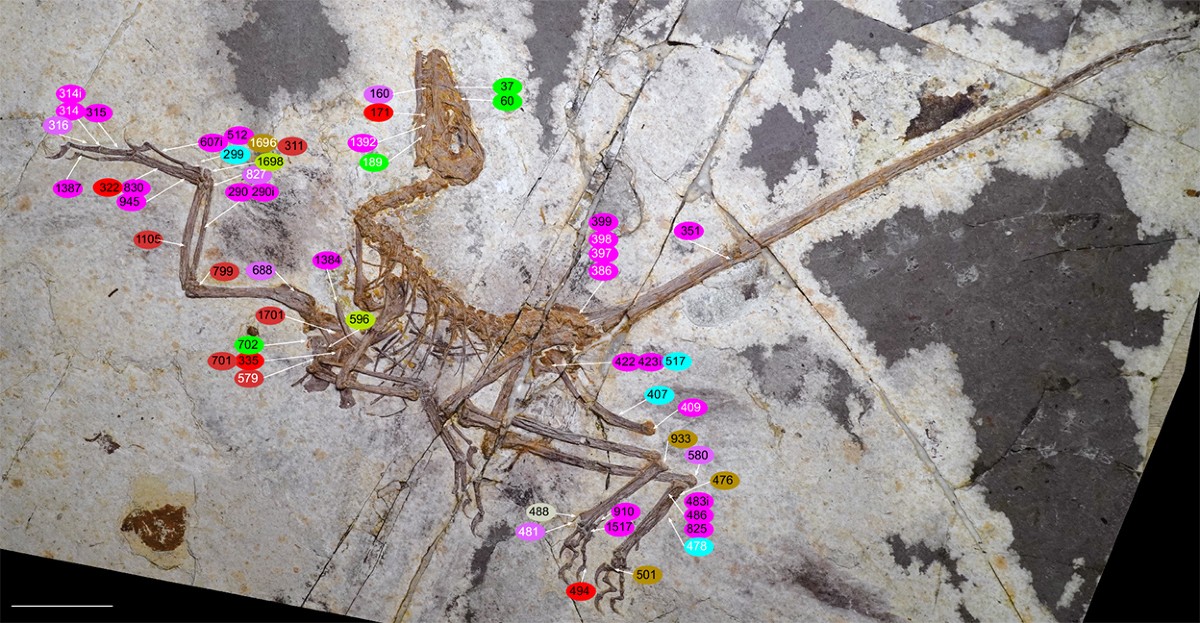
The fossil of Norellaptor barboldii shows evidence of feathers on the front and hind legs and at the end of the tail.
Credit: Shuri Wang et al./Nat. Commun.
A remarkably well-preserved fossil of a feathered dinosaur discovered in China is adding to evidence that birds and their relatives evolved the ability to fly multiple times, rather than through a single lineage.
The 57-centimetre-long specimen is a microraptorin, a small feathered dinosaur that lived in what is now China’s Liaoning province between 145 and 100 million years ago. A local farmer discovered the fossil, which was later studied by an international research team from China, Italy and Slovakia. The researchers reported their findings in Nature Communications on 29 September1.
The team named the species Norellaptor barboldii. The specimen is estimated to have been about three years old when it died.
Microraptorins were relatively small, carnivorous dinosaurs that had feathers on their limbs and weighed about 1 kilogram. Hundreds of specimens have been discovered. These feathered animals belong to Microraptoridae, a distinct branch, or clade, of the tree of life. Because microraptorins are closely related to birds, they provide important clues about the origin and evolution of flight.
Evidence that dinosaur flight evolved more than once
Researchers compared flight-related adaptations in known microraptorins with those found in the avian lineage. They identified 194 such adaptations in microraptorins, 30% of which also evolved in birds.
These shared traits include wing feathers, hooked toe bones and a forearm bone that is longer than the upper arm bone.
This small skull belonged to a dinosaur weighing 2 grams
However, these adaptations did not appear in the same sequence in microraptorins and birds. The researchers therefore concluded that the two groups could not be considered to have followed a common developmental pathway.
Paleontologists welcomed the findings. “This study provides important new evidence that further supports the hypothesis that flight evolved multiple times among feathered dinosaurs, including at least once in microraptorids and at least once in birds,” said Michael Pittman, a paleontologist at the Chinese University of Hong Kong.

The fossilized hind limb of Norellaptor barboldii.
Credit: Shuri Wang et al./Nat. Commun.
Neil Gostling, an evolutionary and developmental biologist at the University of Southampton in the UK, was surprised that most of the evolutionary changes in this lineage of flying dinosaurs were not shared with their bird relatives.
The study suggests that many species were “exploring every avenue open to them”. Flight appears to have provided benefits that encouraged extensive experimentation among these feathered dinosaur groups, Gostling says.
Source: www.nature.com