



For many early-career researchers, finding a secure academic job can feel like an impossible task.
Credit: Amit Basu/Getty
I am struggling to find job security in academia. Over the past two years, I have been rejected for positions including senior research fellow, lecturer and research funding manager. My initial one-year contract was extended to 2.5 years, but it officially ends in three months. Every job application feels like a lottery ticket, and every rejection feels personal, even when I know it should not. I have started to wonder whether I am no longer good enough for academic research. The stress is building, and I am facing difficult questions about how I will pay my rent when my contract ends.
I know I am not alone. At least five friends and colleagues at a similar career stage are also applying for jobs with only months, or even weeks, left on their current contracts. For early-career researchers, achieving independence through a fellowship or permanent academic position is difficult when the usual career path is dominated by short-term contracts and intense competition.
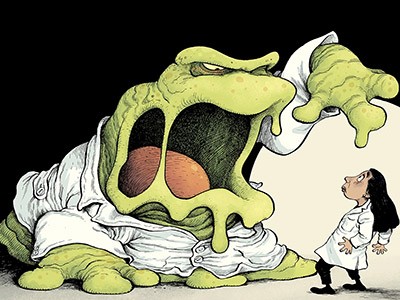
My relationship with my PhD supervisor has become toxic — what do I do?
I hold a PhD in behavioural science and a doctorate-equivalent qualification required to become a chartered health psychologist. I currently work as a researcher at Imperial College London, studying the mental-health effects of climate change at one of the world’s leading universities.
I have followed many of the traditional steps expected of researchers seeking an academic career. I have published papers, won research grants and consultancy funding, taught across disciplines and co-hosted a United Nations webinar about solutions young people want to improve their mental well-being during the climate crisis. I have also presented and contributed to strategy discussions at a European Commission meeting on climate and health, and appeared on the BBC World Service programme The Climate Question.
I work with several youth-led organizations, co-lead the lived-experience advisory board for the Lancet Psychiatry Commission on climate change and mental health, and deliver training on having difficult conversations about climate change, including at London’s Natural History Museum. I also have academic mentors who support my career. Outside universities, I have worked in several sectors, including charities and non-governmental organizations supporting hurricane recovery in the Caribbean.
Many people have achieved far more, but on paper I hoped my experience would make me look like someone with a secure future in academia.
Why academic job insecurity is getting worse
My colleagues and I keep returning to the same question: is the difficulty of finding an academic job a personal failing, or is it evidence of a wider systemic problem? A meta-analysis published in Nature Human Behaviour in June1 found that early-career researchers experience symptoms of poor mental health, including depression and anxiety, more often than the general population. Job insecurity was identified as one of the contributing stressors.
This issue feels particularly important to me as a health psychologist. If uncertainty about employment turns into persistent self-criticism, it can harm mental health and make the already difficult academic job search even harder.
Postdoc depression and anxiety rates are rising, finds survey of 872 researchers
Discussions with academic mentors have helped me understand that this situation is not necessarily a reflection of my abilities. The academic labour market is shaped by broader economic and political forces, many of which are outside an individual researcher’s control.
The academic job market does not operate in isolation. Global conflicts have increased energy prices and destabilized economies. In the United States, the administration of President Donald Trump has changed science-funding priorities, creating knock-on effects for global health and climate research. In the United Kingdom, projections indicate fewer vacancies and rising unemployment, while low- and middle-income countries are facing particularly severe pressures. These economic changes affect entire research systems, reducing opportunities and increasing competition for academic positions.
Professors are also under financial and institutional pressure. Another factor intensifying competition is the rapid use of artificial intelligence in grant and job applications. AI tools can help individual researchers create clearer and stronger applications, but they also allow highly competitive applicants to submit increasingly polished proposals. As a result, the number of submissions has grown, placing further strain on already overstretched review systems. The European Research Council recently proposed, and then withdrew after criticism, a rule that would have prevented applicants whose proposals received low scores from reapplying for up to four years.
Across many sectors and regions, finding stable employment has become more difficult. For early-career researchers, however, the combination of fixed-term contracts, limited permanent positions and lengthy application processes creates a particularly challenging environment.
Competing in an impossible academic job market
I first began to feel panicked in July 2024, around 18 months before my contract was due to end. I started applying for academic fellowships, which are widely viewed as the next career step for researchers at my stage. As the end of my contract approached in January, I secured a small amount of funding that gave me an additional six months.
With the deadline approaching and limited success from my applications, I broadened my search. Instead of applying only for fellowships, I began considering a wider range of academic and non-academic roles. But each type of application requires a substantial investment of time, creating difficult choices for anyone already working full time. It is impossible to pursue every opportunity while maintaining a demanding research job (see ‘Practical support for struggling jobseekers’).
Developing a fellowship proposal can take about a year, while adapting it for another funder may require a further three months. Academic job applications often take around three full days to complete properly, including tailoring a CV, reading the prospective group’s research and developing a five-year research plan. By comparison, adapting a CV and writing a cover letter for a non-academic position takes me approximately three hours.
Source: www.nature.com