


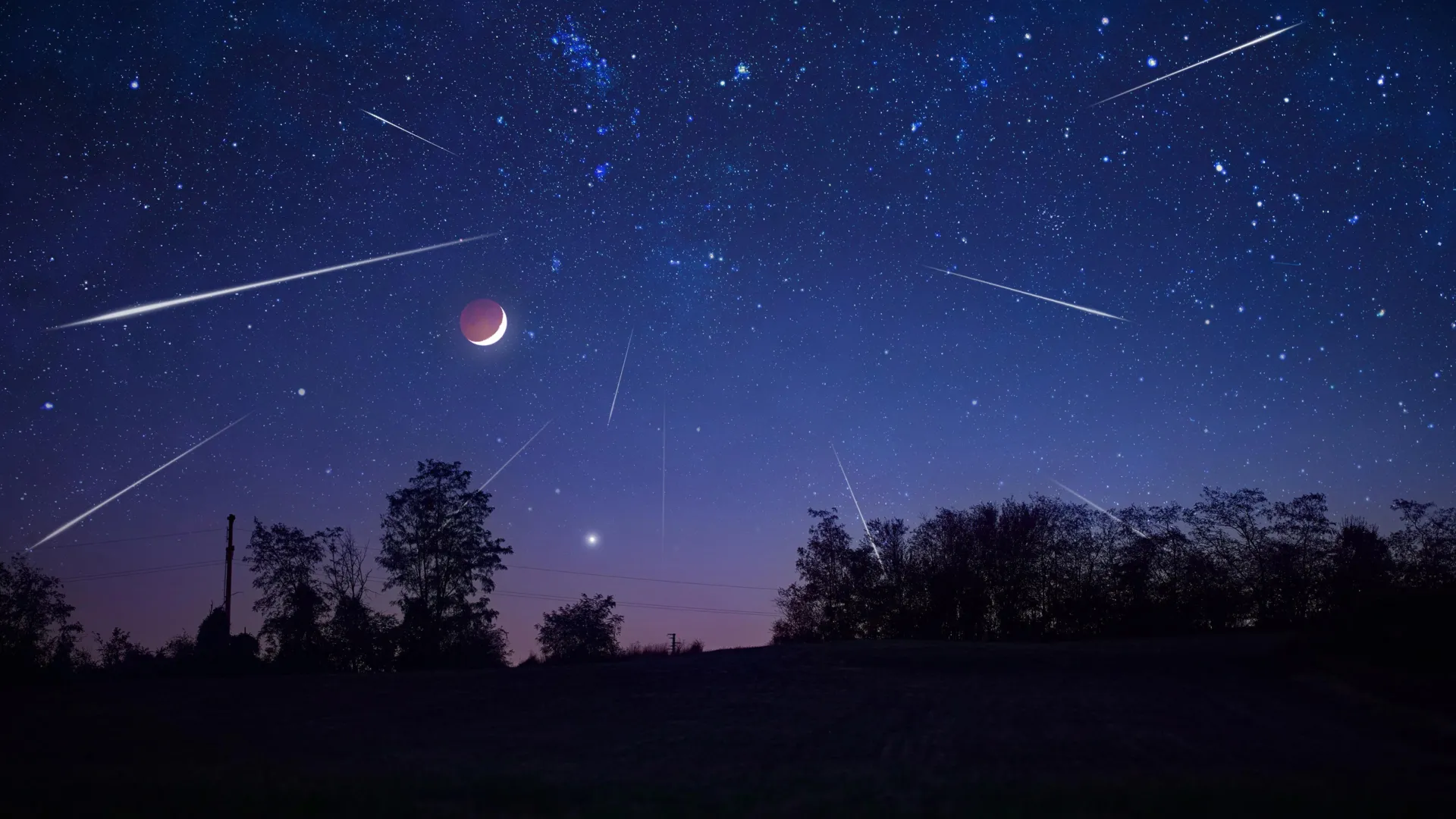
August offers an exceptional lineup of celestial events for skywatchers, including a total solar eclipse, the peak of the Perseid meteor shower, brilliant Venus at greatest eastern elongation, and a deep partial lunar eclipse.
August Skywatching Highlights
Aug. 5: Last Quarter Moon.
Aug. 12: A total solar eclipse will cross northern Russia, Greenland, Iceland, northern Spain, and part of Portugal. A partial solar eclipse will be visible from portions of the United States. The New Moon also occurs on this date.
Aug. 12 and 13: The Perseid meteor shower reaches its annual peak under exceptionally dark, moonless skies.
Aug. 14 through 16: Venus reaches greatest eastern elongation and shines brightly in the western sky after sunset.
Aug. 27 and 28: A deep partial lunar eclipse will be visible across much of North and South America, along with parts of Europe and Africa.
[See Video Link After Article.]
A Total Solar Eclipse Crosses the Northern Hemisphere
August will be one of the most exciting months of the year for astronomy enthusiasts. A total solar eclipse, the annual Perseid meteor shower, brilliant evening Venus, and a partial lunar eclipse will all appear in the night sky.
That’s “What’s Up” for August.
On Aug. 12, the path of totality for a total solar eclipse will sweep across northern Russia, Greenland, Iceland, and northern Spain. A small region of Portugal will also experience totality.
Skywatchers in parts of the United States, from Alaska to North Carolina, will see a partial solar eclipse. From these locations, the Moon will cover only part of the Sun, with the amount of coverage varying by location.
How to Watch the Solar Eclipse Safely
Safe eye protection is essential whenever any portion of the Sun is visible. Use certified eclipse glasses or another approved solar-viewing device. Regular sunglasses do not provide sufficient protection.
Never view the Sun through binoculars, a telescope, or a camera unless a properly rated solar filter is securely attached to the front of the instrument.
Dark Skies Enhance the Perseid Meteor Shower
Later on Aug. 12 and into the early morning of Aug. 13, the Perseid meteor shower will reach its peak. Because the New Moon occurs on Aug. 12, bright moonlight will not wash out the sky, creating excellent conditions for meteor viewing.
The Perseids occur every year as Earth passes through debris left behind by Comet Swift-Tuttle. Tiny particles from the comet enter Earth’s atmosphere at high speeds, heat up, and create the bright streaks commonly known as shooting stars.
After darkness falls, face northeast and wait for the constellation Perseus to rise above the horizon. Perseid meteors appear to originate near Perseus, but they can travel across nearly any part of the sky. For that reason, scan a broad area overhead rather than focusing on one location.
For the best view, travel to a dark location with a wide, unobstructed horizon. Stay outside as long as possible and allow approximately 30 minutes for your eyes to adjust to the darkness.
Venus Shines Brightly After Sunset
From Aug. 14 through 16, Venus will reach greatest eastern elongation. This is when the planet appears farthest from the Sun in the evening sky during its current visibility period.
Shortly after sunset, look low toward the western horizon to find Venus. The planet will shine brighter than any nearby star. Through a telescope, Venus will appear nearly half illuminated, showing a phase similar to a miniature half Moon.
A Deep Partial Lunar Eclipse
On the night of Aug. 27 and into Aug. 28 in some time zones, the Full Moon will move through Earth’s shadow, producing a deep partial lunar eclipse. The event will be visible across much of North and South America, as well as parts of Europe and Africa.
At maximum eclipse, approximately 93% of the Moon’s diameter will be inside Earth’s darkest shadow, called the umbra. Although the Moon will not be completely covered, most of its surface may appear noticeably darkened. The eclipsed portion could also take on a striking rusty or copper-colored hue.
Unlike a solar eclipse, a lunar eclipse is safe to watch with the unaided eye and does not require special eye protection. Binoculars or a small telescope can offer a closer view as Earth’s curved shadow slowly moves across the lunar surface.
Here are the Moon phases for August.
Source: www.sciencedaily.com