


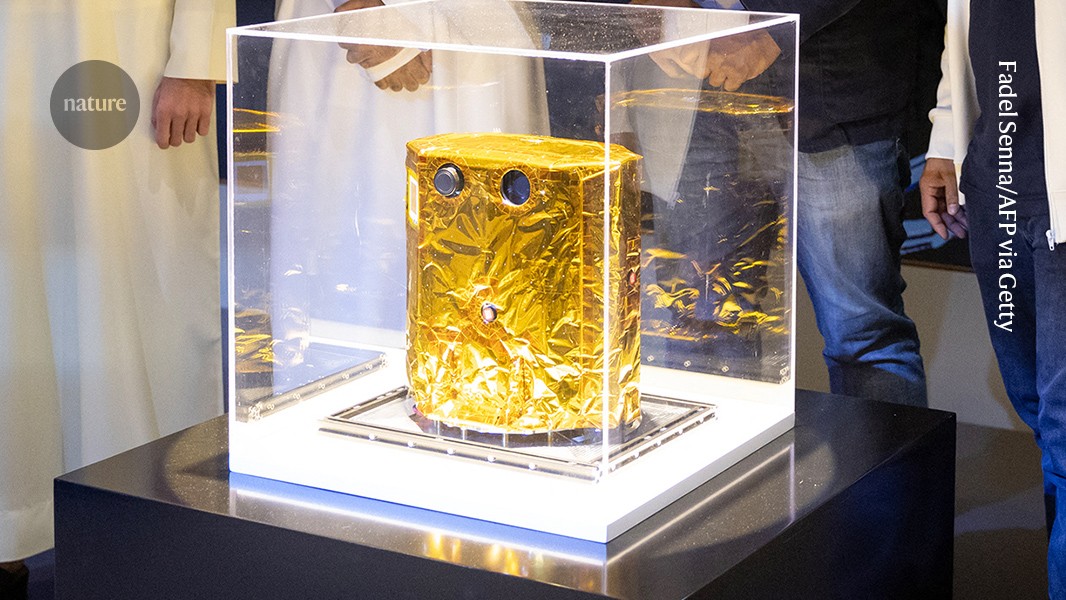
UAE asteroid mission aims to reach Justicia in 2035
Credit: Fadel Senna/AFP via Getty
The United Arab Emirates (UAE) is on track to become the fourth space power to reach an asteroid. Scientists and engineers involved in the country’s space programme say a probe will plunge into the reddish asteroid Justicia in 2035.
The spacecraft, which was designed and manufactured in the UAE, will be shipped to the University of Colorado Boulder. There, collaborators will integrate it with the main MBR Explorer spacecraft before its scheduled launch in March 2028.
UAE asteroid mission will study six asteroids
The Emirates’ Asteroid Belt Exploration Mission (EMA) will observe six asteroids using cameras and spectrometers capable of remotely analysing their material composition. The MBR Explorer will also study Venus and Mars before releasing a small, 10-kilogram probe to its final destination: Justicia.
Justicia’s unusual red colour suggests that it contains material more commonly found farther out in the Solar System, despite orbiting between Mars and Jupiter. If the asteroid originated at the Solar System’s outer edge and later migrated inward, it could be an ancient “traveller from the past”, said Elias Tsotanis, a principal scientist at the Abu Dhabi-based Technology and Innovation Institute (TII) Propulsion and Space Research Center.
Studying Justicia could provide clues about how the Solar System formed and the origin of its water, Tsotanis said at an event in the city on 1 October commemorating the probe’s completion. TII, a government-sponsored research institute, designed and developed the spacecraft.
UAE seeks greater independence in space exploration
The asteroid mission will be the UAE’s second interplanetary project, following the success of the Hope orbiter, which arrived at Mars in 2021 after six years of development.
The UAE has joined the ranks of spacefaring nations relatively quickly by working with international partners to design and build spacecraft while training researchers and engineers in the country.
The latest mission developments demonstrate the UAE’s growing independence in space science and technology, said computer scientist Najwa Alraj, chief executive of TII, at the 1 October event. Although every part of Hope involved collaboration, the UAE built EMA’s exploration component independently.
“I’m confident we won’t need Colorado on our next mission,” Alraj said. “Everything can be done end-to-end here.”
Space programme boosts STEM education
The UAE’s space activities also appear to be influencing education. Since the country announced plans to send a mission to Mars in 2014, the number of students studying science, technology, engineering and mathematics has increased by 30%, said Ahmad Belhoul Al Falashi, head of the UAE Space Agency.
He later said that, between 2015 and 2025, the number of UAE universities offering aerospace engineering and space-related degree programmes nearly doubled.
Nature.
Source: www.nature.com