


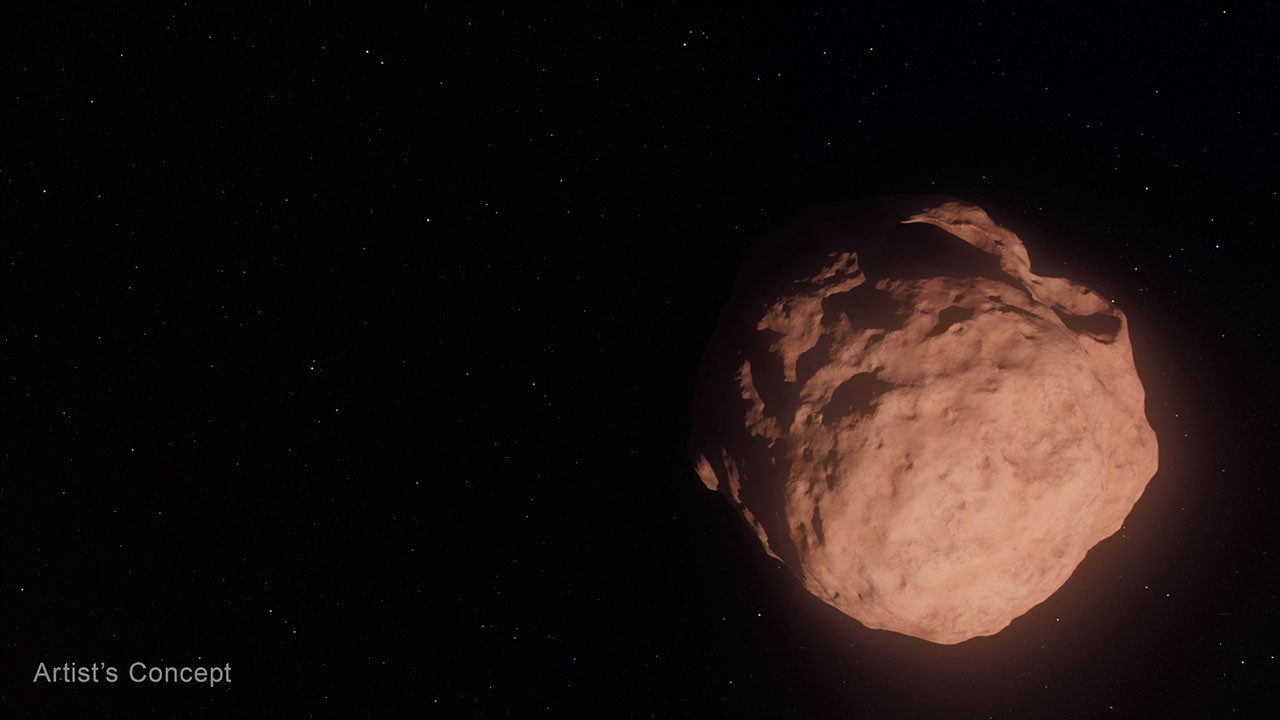
This artist’s concept shows a trans-Neptunian object, a small icy body orbiting the Sun beyond Neptune. These distant objects are so faint that even NASA’s Hubble Space Telescope and James Webb Space Telescope often see them as tiny points of light.
Artwork: NASA, ESA, Leah Hustak (STScI)
NASA’s Hubble and Webb Telescopes Reveal New Details About Tiny Trans-Neptunian Objects
For the first time, scientists combined observations from NASA’s Hubble Space Telescope and the James Webb Space Telescope to study some of the most distant objects in the solar system: trans-Neptunian objects, or TNOs. The research identified some of the smallest and faintest TNOs ever directly observed.
The team unexpectedly found fewer small TNOs than predicted by some planet-formation models. Researchers also discovered that the colors of these tiny objects follow the same patterns seen among their larger counterparts, suggesting that their surfaces have preserved clues about their origins.
What Are Trans-Neptunian Objects?
Trans-Neptunian objects are small, dark, icy bodies that orbit the Sun beyond Neptune. Most are more than 100 million times fainter than objects visible to the unaided eye, making them extremely difficult to detect from Earth.
In two complementary papers published in The Astronomical Journal, researchers analyzed the colors, compositions, sizes, and orbits of 27 newly discovered faint TNOs.
These distant objects offer an important look at the early stages of planet formation. In the young solar system, disks of dust and pebbles gradually combined into city-sized planetesimals—the solid building blocks from which planets formed. Beyond Neptune, many of these planetesimals never merged into larger worlds, leaving behind a population of frozen remnants.
Hubble and Webb Study the Solar System’s Frozen Remnants
As part of one of the deepest surveys of TNOs ever conducted, a research team led by scientists from the University of Victoria and Northern Arizona University observed the same region of sky using visible-light observations from Hubble and infrared observations from Webb.
By combining data from both space telescopes, the researchers measured each object’s color and size and determined its orbit. An object’s color provides important information about its surface composition, much like a fingerprint can help identify a person.
Two Distinct Populations of TNOs
The study examined two major groups of trans-Neptunian objects. The first group consists of dynamically “cold” TNOs, which remain in relatively circular orbits near the plane of the solar system and are thought to have formed near their current locations.
The second group includes dynamically “hot” TNOs. These objects likely formed between the present-day orbits of Uranus and Neptune before being pushed outward when the giant planets migrated early in the solar system’s history. Today, hot TNOs travel along more highly elliptical and tilted orbits.
Tiny TNOs Preserve Their Ancient Surface Characteristics
Before these observations, astronomers expected small TNOs from both populations to have experienced frequent collisions. Those impacts should have altered their surfaces and made the smallest objects look different from larger members of the same population.
Instead, the observations showed that small TNOs resemble larger objects in color and surface characteristics. This suggests that their surfaces have not been significantly reshaped by impacts. The result could mean that collisions are less common than previously believed, or that some TNOs retain relatively pristine material from the time they formed.
“You can imagine a scenario where the surface composition changes when it collides and fragments, and the surface color of a small TNO is different compared to its larger sibling. So it’s really interesting to see that the smallest objects somehow ‘remember’ and preserve the history of how they were made,” said Anastasia Morgan, a doctoral candidate at Northern Arizona University who led the study. Read the study of TNO colors and composition.
“These dynamically ‘hot’ TNOs retain traces of their birthplace, even though they have since been scrambled in orbit,” said co-author David Trilling of Northern Arizona University.
Both the hot and cold TNO populations appear to have changed very little since the solar system formed. Their colors still reflect the conditions in which they originated billions of years ago.
Similar Size Distributions Challenge Planet-Formation Models
Webb’s infrared observations also allowed researchers to estimate how many objects exist within different size ranges. The team found that the hot and cold populations have remarkably similar size distributions, even though they formed in different regions of the early solar system.
“It’s very interesting that the planetesimal formation process ends up with the same size distribution for the cold and hot populations, even though they formed in different regions of the early solar system. This process seems to be unaffected by disk conditions, producing similar planetesimal sizes regardless of whether the disk is hot or cold, dense or fluffy,” said Mariel Eduardo, a PhD candidate at the University of Victoria who led the study. Read the research on TNO size distribution.
The researchers also detected fewer extremely small TNOs than some planet-formation models predicted. Webb identified 27 new, exceptionally faint trans-Neptunian objects. One was so dim that observing it would be comparable to standing on Earth and trying to see a swarm of tiny fireflies on the Moon.
The smallest object observed was approximately 3 miles, or 5 kilometers, across—about one-fifth the size that the most sensitive ground-based telescopes can typically detect.
Why Hubble and Webb Were Both Needed
The discovery and characterization of these TNOs would not have been possible without Hubble and Webb working together. Hubble’s visible-light capabilities and Webb’s infrared sensitivity provided complementary information, revealing more about the objects than either telescope could determine alone.
The Hubble Space Telescope has been in operation for more than 30 years and continues to make groundbreaking discoveries that shape our fundamental understanding of the universe. Hubble is an international cooperation project between NASA and ESA (European Space Agency). NASA’s Goddard Space Flight Center in Greenbelt, Maryland, manages telescope and mission operations. Denver-based Lockheed Martin Space also supports mission operations at Goddard. The Space Telescope Science Institute in Baltimore, operated by the Association of Universities for Astronomical Research, conducts Hubble science operations for NASA.
The James Webb Space Telescope is the world’s premier space science observatory. Webb explores our solar system, studies distant worlds orbiting other stars, and investigates the structure and origins of the universe. Webb is an international program led by NASA and its partners ESA (European Space Agency) and CSA (Canadian Space Agency).
For more information about NASA’s space telescopes, visit:
Source: science.nasa.gov