


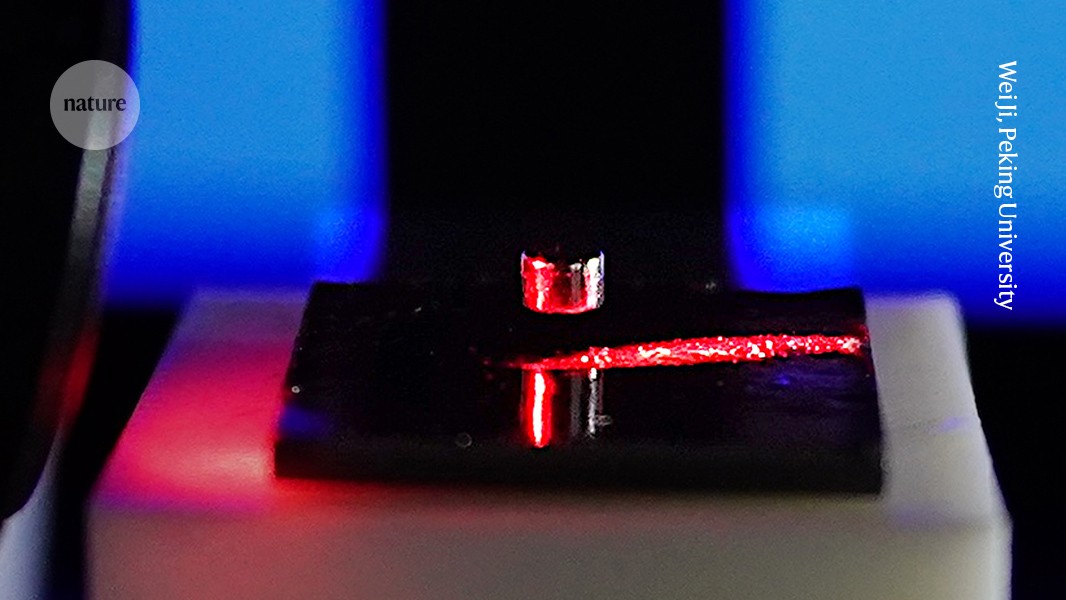
A laser beam tracks the motion of a tiny magnet suspended in a vacuum chamber as it responds to magnetic fields.
Credit: Wei Ji, Peking University
Scientists have developed a highly sensitive levitating magnetometer that can measure extremely weak magnetic fields, including signals linked to the brain’s electrical activity. The simpler device uses a levitating magnet to detect magnetic changes and is described today in Science1.
Some of the world’s most sensitive magnetometers are superconducting quantum interference devices, or SQUIDs. These instruments must operate at temperatures near absolute zero, requiring complex cryogenic systems. Another advanced technology, known as a spin-exchange relaxation-free (SERF) magnetometer, requires almost complete shielding from external magnetic interference. Such demands make these systems more complicated and increase the distance between the sample and the sensor.
The new levitating magnetometer reduces the gap between the sensor and the sample to just a few hundred micrometres. It is also orders of magnitude more sensitive than diamond-based magnetometers, offering a compact approach to high-precision magnetic field detection.
At the centre of the device is an exceptionally sensitive compass needle measuring less than one millimetre across. Wei Ji, a physicist at Peking University in Beijing, and his colleagues suspended the tiny sensor magnet between a ‘lifting’ magnet positioned above it and a diamagnetic material beneath it. A diamagnet produces an opposing magnetic field when exposed to an external field, pushing the sensor magnet upwards and stabilizing it in place.
A laser reflects from the sensor magnet onto a detector, allowing researchers to track changes in its orientation when a sample is placed nearby. The entire setup is housed inside a vacuum chamber roughly the size of a Tupperware box.
Ji says the instrument achieves its high sensitivity through a sophisticated combination of noise-reduction methods. Magnetic coils and damping systems help suppress interference from stray magnetic fields and mechanical vibrations. “When you’re probing the femtotesla scale, even a thin film of aluminium foil can introduce 100 femtoteslas of noise,” says Ji. A femtotesla is ten billion times weaker than Earth’s magnetic field.
Source: www.nature.com