


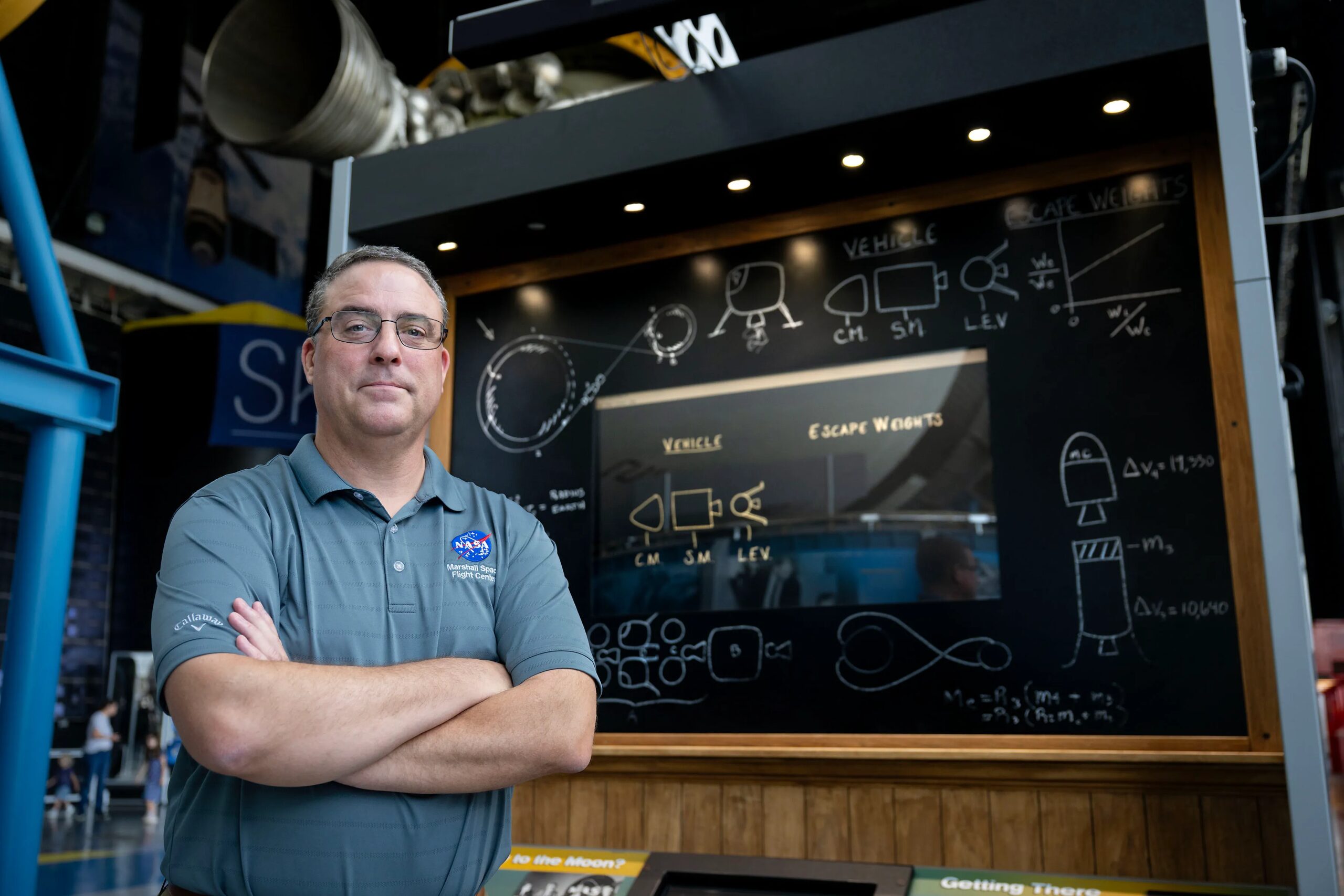
As NASA prepares for long-term human exploration of the Moon and Mars, the agency is increasing the pace of its Artemis missions. Tom Percy, manager of systems engineering and integration for NASA’s Human Landing System Program, plays a key role in making these ambitious lunar exploration plans possible.
Percy works closely with commercial providers SpaceX and Blue Origin to advance and streamline human landing system designs, manufacturing, testing, and certification. He helps ensure the crewed lunar landers being developed for Artemis are safely and effectively designed, built, tested, and integrated with NASA’s other exploration systems.
“You might say that all human landing system integration work lands on my desk. And with the rest of my talented, hard-working systems engineering and integration team, we’re working to make it all happen,” Percy said.
A native of North Easton, Massachusetts, Percy earned a bachelor’s degree in mechanical engineering from the Rochester Institute of Technology in Rochester, New York. While studying there, he gained hands-on experience designing systems that could support NASA’s future sustainable lunar exploration architecture.
“As an undergrad, I served as president of the Rochester Institute of Technology’s chapter of the American Society of Mechanical Engineers. To get some real-world engineering experience, we decided to participate in the Great Moonbuggy Race,” Percy said. “Now called the Human Exploration Rover Challenge, the competition is held annually at NASA’s Marshall Space Flight Center in Huntsville, Alabama.”
“At the time, I had never heard of Marshall Space Flight Center,” Percy said. “But our student team designed and built a rover and traveled to Huntsville for the race. That’s when I learned about the projects in Marshall’s diverse portfolio supporting NASA. It was also when I began planning a career at NASA’s Marshall Space Flight Center.”
Percy later moved south to earn a master’s degree in aerospace engineering from the Georgia Institute of Technology in Atlanta. His research in the university’s advanced propulsion laboratory and coursework in space systems design culminated in a spacecraft design course and an opportunity to work directly with engineers at Marshall.
Since joining NASA Marshall in 2003, Percy has evaluated transportation architecture options for human deep-space exploration, including missions designed to return astronauts to the Moon and eventually send crews to Mars. His expertise includes space transportation, advanced propulsion technology development, trajectory analysis, and spacecraft and mission concept development. Percy also earned a doctorate in aerospace systems engineering from the University of Alabama in Huntsville.
This broad experience supports Percy’s current role as manager of human landing systems engineering and integration, where he helps guide the development of NASA’s next-generation lunar landers for the Artemis program.
“The world watched the amazing success of Artemis II. NASA and our commercial providers are looking forward to flying again soon and executing increasingly complex Artemis missions,” Percy said.
Through the Artemis program, NASA will send astronauts on increasingly complex missions to explore more of the Moon, support scientific discovery and economic opportunities, establish a lasting human presence on the lunar surface, and build the foundation for the first crewed missions to Mars.
To learn more about NASA’s Artemis program and future Moon-to-Mars exploration missions, visit:
Source: www.nasa.gov