


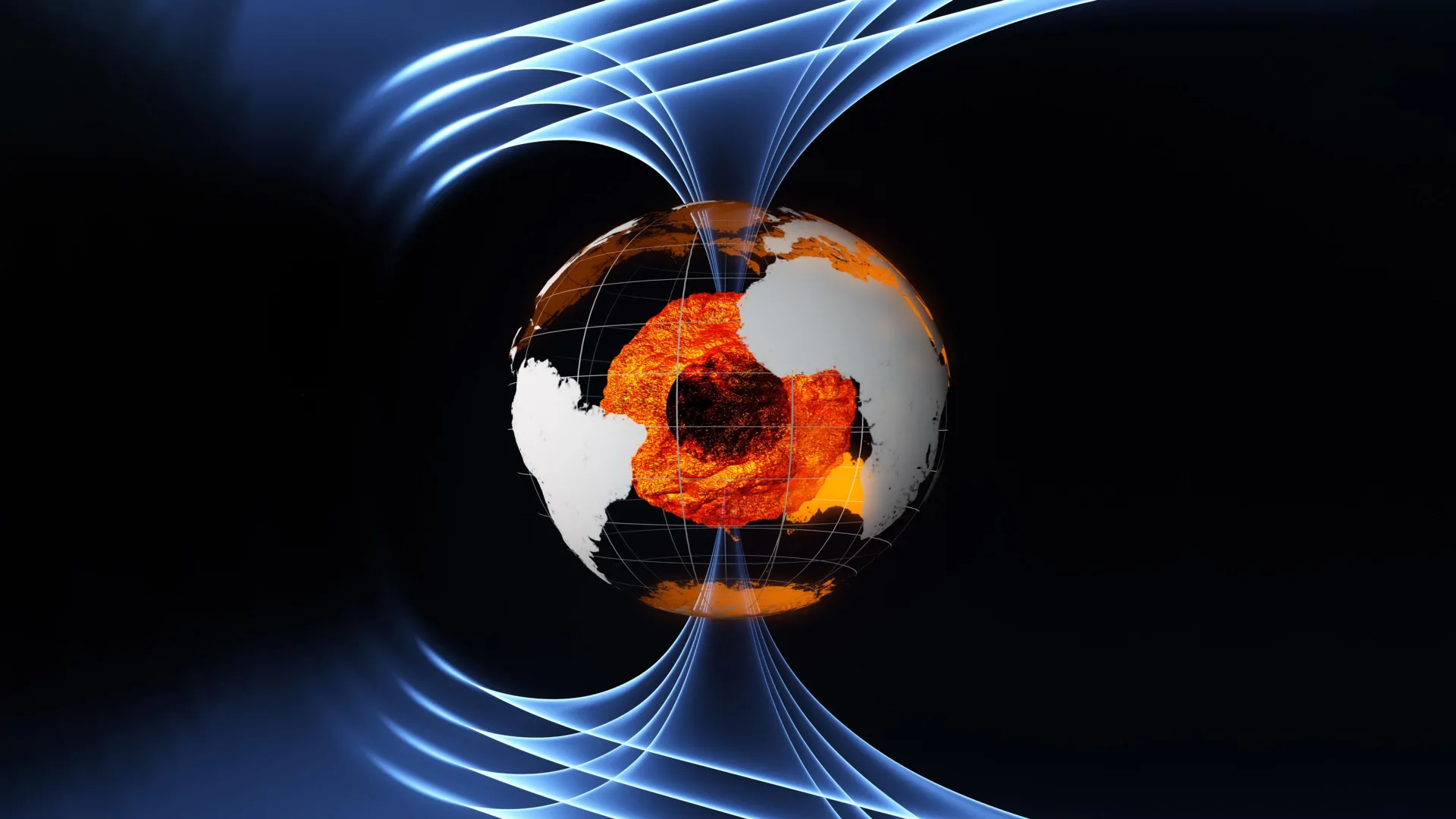
Earth’s liquid outer core is constantly moving, and new research shows that its behavior can change in unexpected ways. Scientists have found that a broad flow of molten iron beneath the Pacific Ocean reversed direction around 2010, shifting from a weak westward movement to a much stronger eastward flow. Data from ESA satellites are helping researchers investigate this mysterious change and better understand the processes taking place deep inside Earth.
Earth’s molten outer core is located approximately 2200 km beneath the surface. As electrically conductive liquid iron circulates within this layer, it generates the planet’s geomagnetic field. For decades, measurements of small changes in Earth’s magnetic field suggested that much of the outer core was moving primarily westward.
Earth’s Outer Core Flow Reversed Beneath the Pacific
That established pattern changed significantly around 2010. Beneath the Pacific Ocean, a large region of molten iron began moving strongly eastward instead of continuing its weaker westward motion. The exact cause of this flow reversal remains unknown.
Researchers have now examined the event in greater detail using satellite observations from ESA’s Swarm and CryoSat missions, as well as data from earlier magnetic-field missions.
Published in the Journal of Studies of Earth’s Deep Interior, the study combines ground-based observations with satellite measurements collected between 1997 and 2025. The analysis includes data from ESA’s Swarm and CryoSat missions, Germany’s CHAMP mission and Denmark’s Ørsted mission.
The results show that a wide region of iron-rich fluid beneath the equatorial Pacific shifted from a slow westward flow to a powerful eastward movement in 2010.
Scientists previously viewed large-scale circulation in Earth’s outer core as relatively stable. The sudden change beneath the Pacific suggests that core dynamics may evolve much faster than expected. The discovery provides new insight into the turbulent motions that generate Earth’s magnetic field and may reveal connections between the outer core, inner core and deeper layers of the planet.
Lead author Frederik Dahl Madsen of the University of Edinburgh’s School of Geosciences said, “The large-scale flow reversal beneath the Pacific raises new questions about the behavior of Earth’s deep interior. Scientists now want to determine whether the reversal is a short-lived fluctuation, part of a repeating oscillation or the beginning of a new stable pattern in outer-core circulation. Continued monitoring will be essential to track how this flow develops in the years ahead.”
Could the Flow Reversal Be Linked to Earth’s Inner Core?
Madsen said the study’s model indicates that the strong eastward flow beneath the Pacific has weakened since 2020. He added, “The emergence of the strong eastward flow in the Pacific coincided with a change in the behavior of the inner core, as inferred from geodesy and seismology. We hypothesize that these changes deep inside Earth may be connected to the flow changes beneath the Pacific.”
How Satellites Detect Earth’s Molten Core
Earth’s magnetic field is generated by movement within the liquid outer core. Electrically conductive molten iron circulates around the solid inner core, creating a process known as the geodynamo. This system is constantly changing, although many broad patterns of core circulation appeared stable over several decades of observations.
ESA launched its three Swarm satellites in 2013. Each satellite carries highly sensitive magnetometers capable of measuring Earth’s magnetic field with exceptional accuracy. By flying in carefully coordinated orbits, the satellites can distinguish magnetic signals produced by the core from those generated by the crust, oceans, ionosphere and magnetosphere.
These measurements enable scientists to reconstruct changing flow patterns near the core-mantle boundary. They have also helped researchers identify abrupt magnetic changes associated with the Pacific flow reversal and the 2017 geomagnetic jerk.
According to Anja Stromme, ESA’s Swarm Mission Manager, the mission’s long-term record has been crucial to the research. She said, “Although Swarm was launched after the dramatic 2010 reversal, it has provided high-precision measurements of Earth’s magnetic field during the period that followed.
“Swarm provides continuous global coverage over many years, allowing scientists to track changes in the outer core without relying solely on ground-based magnetic observatories. Long-term satellite magnetic measurements make it possible to follow the evolution of the geodynamo and improve models of Earth’s changing magnetic field. Future observations from missions such as Swarm will be essential.”
Evidence of a Natural Cycle in the Outer Core
The satellite data also revealed wave-like accelerations and rapidly changing flow structures that may have been difficult to identify in less precise datasets.
The research suggests that the eastward flow may now be weakening after reaching its maximum strength several years ago. This raises the possibility that the reversal was temporary or that it forms part of a longer natural cycle within Earth’s outer core.
Why Earth’s Core and Magnetic Field Matter
These changes occur thousands of kilometers beneath the surface and do not pose a direct threat to people or the climate. However, studying them is essential to understanding how Earth works.
The movement of liquid iron in the outer core generates the magnetic field that shields the planet from charged particles released by the Sun. Without this protective field, Earth’s atmosphere and technological infrastructure would be far more exposed to solar radiation.
Earth’s magnetic field is continually changing. As the flow of molten iron evolves, the field shifts as well. These variations can affect navigation systems, spacecraft operations and scientific models of near-Earth space weather. Understanding how and why the outer core changes is therefore important for both fundamental research and practical technology.
According to Elisabetta Iorfida, ESA’s Swarm Mission Scientist, the Pacific flow reversal challenges the long-held assumption that stable westward circulation dominates Earth’s outer core. She said, “This study shows that regional changes can develop rapidly over just a decade. The findings may also help scientists investigate possible interactions between the outer core, inner core and lower mantle, providing greater insight into the core-mantle boundary, a critical region for deep-Earth dynamics.
“This research raises important questions about how Earth’s deepest layers are connected. As the magnetic field continues to evolve, satellite missions are providing an increasingly detailed view of the dynamic processes unfolding deep inside our planet. The findings suggest that Earth’s core may be much more variable and complex than scientists once believed.”
Source: www.sciencedaily.com