


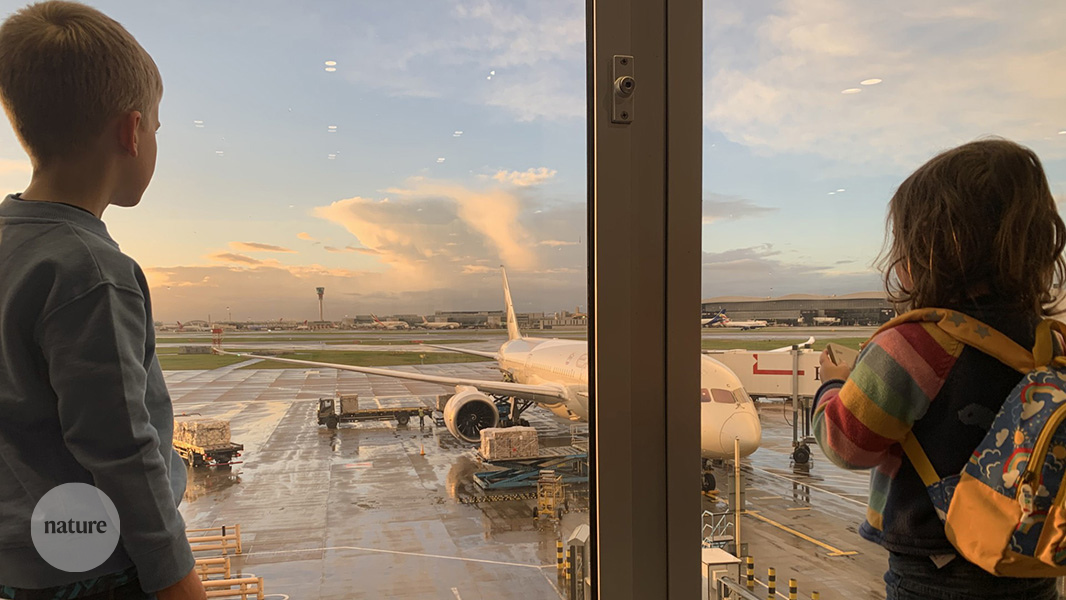
Researcher Laura Carter’s children look out at the tarmac at Heathrow Airport before the family boards a flight to Australia for a research trip.
A trip in November 2025 showed me just how complicated it can be to balance academic careers with family life. For a brief period, my husband and I were both in the air, flying in opposite directions across the Indian Ocean. We had two work-related trips, two long-haul flights and one demanding family schedule. Our children, aged five and eight, were cared for by a combination of grandparents and close friends.
After landing in Manchester, UK, and travelling home, I realized that this journey represented a much larger challenge: the ongoing negotiation required to maintain two academic careers while raising children. I am an environmental chemist and my husband lectures in psychology. Both of us work in an academic system that often assumes researchers have few family responsibilities.
Many academics are familiar with the ‘two-body problem’: the difficulty of finding suitable academic positions for a couple within commuting distance of one another. But for us, the challenge has never been limited to finding jobs in the same location. Once we became parents, our two children fundamentally changed how we plan our careers, work and travel.
With two academics balancing conferences, fieldwork, project meetings and deadlines, alongside childcare and school routines, family logistics can become extremely demanding. We maintain overlapping calendars, negotiate every travel plan carefully and constantly calculate who needs to be where, when they need to be there and what backup arrangements are available (see ‘Packed schedule’).

When I travelled to China for a conference towards the end of 2025, my husband was responsible for school drop-offs, after-school activities and changing work commitments. At the same time, he was preparing for his own conference in Indonesia. Once he left for that meeting, we entered unfamiliar territory, relying on our parents and carefully coordinated contingency plans to keep daily family life running.
It was the first time we had both been away from home at the same time. For parents of two school-age children, that is a significant undertaking. Leaving the children behind creates a distinctive form of stress. There is the emotional worry, but also the practical challenge of organizing school runs, activities, meals and bedtime routines. Being in another time zone adds to the anxiety because, if something goes wrong, returning home or changing arrangements may not be straightforward.
Why academic travel is essential
Travel is an important part of academic work. Conferences, workshops and research collaborations allow scientists and scholars to share findings, build professional networks and keep up with developments in their fields.
Academic conferences are rarely scheduled with much flexibility. Meetings take place on fixed dates, leaving researchers to organize everything else around them. Many events appear to cluster during the spring and summer in the Northern Hemisphere. Although this timing may fit the academic calendar, it often overlaps with school holidays, creating additional pressure for parents in academia.

How I managed my work and personal life as a sole parent during the pandemic
For our family, this can mean several meetings occurring just as our usual childcare arrangements disappear. Rather than being spread evenly across the year, academic commitments often become concentrated in particularly demanding periods, when professional deadlines collide with school and family responsibilities.
Balancing these demands has led to some extreme travel schedules: early departures, late arrivals and very short turnarounds. My personal record is four connecting flights during one trip. I chose that complicated route because it brought me home two hours earlier than a direct flight, allowing me to be present for my children’s bedtime. These decisions reflect the effort required to remain engaged both professionally and as a parent.
When I can, I ask hosts and collaborators whether meeting dates can be adjusted. Sometimes that means moving a presentation by a day to fit around childcare, or grouping several commitments into one shorter visit to reduce time away from home. I have been fortunate that people with whom I have established working relationships have often been receptive. But those conversations depend on trust, and not every researcher has the confidence or flexibility to ask. Small changes to academic schedules can make a meaningful difference. For many working parents, the goal is not to do less, but to pursue an academic career without exhausting themselves.
Why financial support is not enough
At different times, my husband and I have declined professional opportunities to avoid travelling at the same time. Extended academic travel quickly reveals how few sustainable options are available to dual-career academic families. We are fortunate to have support from relatives, but that help is neither guaranteed nor easy to arrange. Our parents travel for more than three hours when they are called upon, while also managing their own responsibilities, including caring for older family members.
This reflects a wider problem: academic mobility is rarely made possible by individual effort alone. It often depends on an invisible and complicated network of family support. No one told me that success in academia might depend on having relatives nearby who can provide childcare. Yet this can become an unspoken requirement for maintaining a research career. Should access to that kind of support really determine who can succeed?

Collection: Juggling scientific careers and family life
Relocation can make the situation even more difficult. Moving to another city or country may mean leaving behind the informal childcare networks and family connections that make academic family life manageable.
Our situation does have some advantages. My husband and I understand the demands, routines and emotional pressures of academic work. We support each other when one of us must travel for a conference or research project. We also recognize the guilt and pressure that come from trying to be fully present at home while meeting the expectations of an academic career.
An unequal division of responsibilities
Source: www.nature.com