


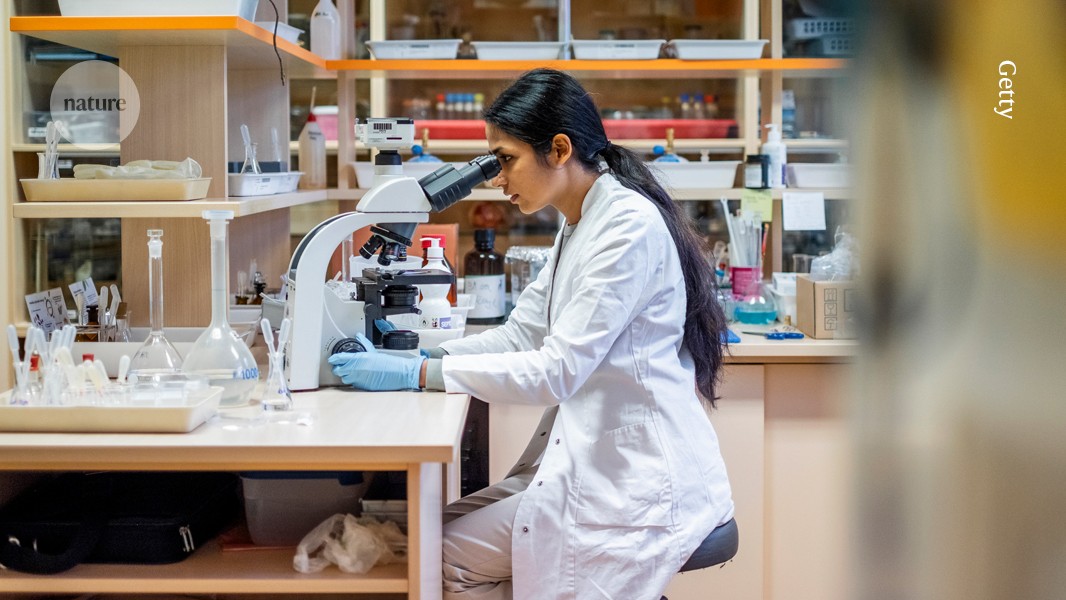
Private companies will host US doctoral students through a new industry-focused research programme.
Credit: Getty
The US National Science Foundation (NSF) has launched a major initiative to strengthen connections between PhD students, universities and industry. The pilot Industry-Integrated PhD (I-PhD) Scholars Program will give more than 250 doctoral students hands-on industry research experience, alongside four years of financial support from universities, companies and the NSF.
The programme is designed to help PhD graduates apply their academic research to real-world challenges, according to an NSF spokesperson. It will also allow companies to play a more direct role in doctoral training, Michael Kratsios, director of the White House Office of Science and Technology Policy, said in a statement. Kratsios noted that most US graduates with PhDs in science, technology, engineering and mathematics, or STEM, pursue careers outside academia.
Researchers have responded with both enthusiasm and caution to the Industry-Integrated PhD programme, which was announced in July.

Pay, perks and culture shocks: a toolkit for scientists moving to industry
Industry-linked doctoral training can benefit both students and employers, says Wojtek Chodzko-Zajko, dean of the Graduate College at the University of Illinois at Urbana-Champaign. The university already offers PhD programmes that include industry partnerships. “I really like the idea that NSF is moving in that direction,” he says, adding that the model has been available for years but remains underused at many research universities.
However, chemistry Nobel laureate Carolyn Bertozzi of Stanford University in California argued on the social-media platform Bluesky that NSF funding should instead support basic research that industry is unlikely to fund. The pilot programme comes as the NSF considers recovering money from its core science programmes, Nature reported last month.
The NSF declined to comment on internal budget discussions but said it “remains committed to supporting curiosity-driven research and our high standards of merit review”.
How the NSF’s four-year PhD funding programme works
Participants will receive one year of funding from their university and three years of support from the NSF. Each industry partner must host at least one year of dissertation research at its site and contribute at least US$100,000 per student. During the final three years, students will receive tuition support and annual stipends of $37,000.
If a student needs more than four years to complete their degree, the university will be responsible for providing funding for the additional period, according to Tony Boccanfuso, president and chief executive of the University–Industry Demonstration Partnership (UIDP). The non-profit organisation supports university–industry collaboration and will lead the programme.
NSF plans cuts to core science programmes to fund White House initiative
Students in the I-PhD programme will still complete all the academic requirements of a traditional PhD, including a dissertation that meets university standards, says Gretchen Bollar Fiorenza, a programme manager at the UIDP. They will also submit an annual report detailing activities such as research conducted with an industry partner.
The NSF plans to invest $47 million in the pilot over five years. More than 30 universities, including Columbia University, New York University and Northwestern University, have signed letters of intent to participate. Industry partners include Procter & Gamble, BP and Rolls-Royce.
Many US universities already maintain close relationships with companies. The difference is that the NSF will act as a central channel for the programme and provide additional financial leverage, says Peter Beling, a data scientist at the University of Virginia in Charlottesville.
Concerns about the PhD programme timeline
The initiative could encourage valuable partnerships between universities and industry, says Chodzko-Zajko. However, he questions whether a guaranteed four-year PhD is realistic. “PhDs depend on faculty committees and the progress of the research, and that’s to some degree unpredictable,” he says. In the United States, students in science and engineering take an average of 5.6 years to complete a doctorate.
Source: www.nature.com