


James Webb Space Telescope Reveals How “Little Red Dots” May Evolve Into Galaxies
quick facts
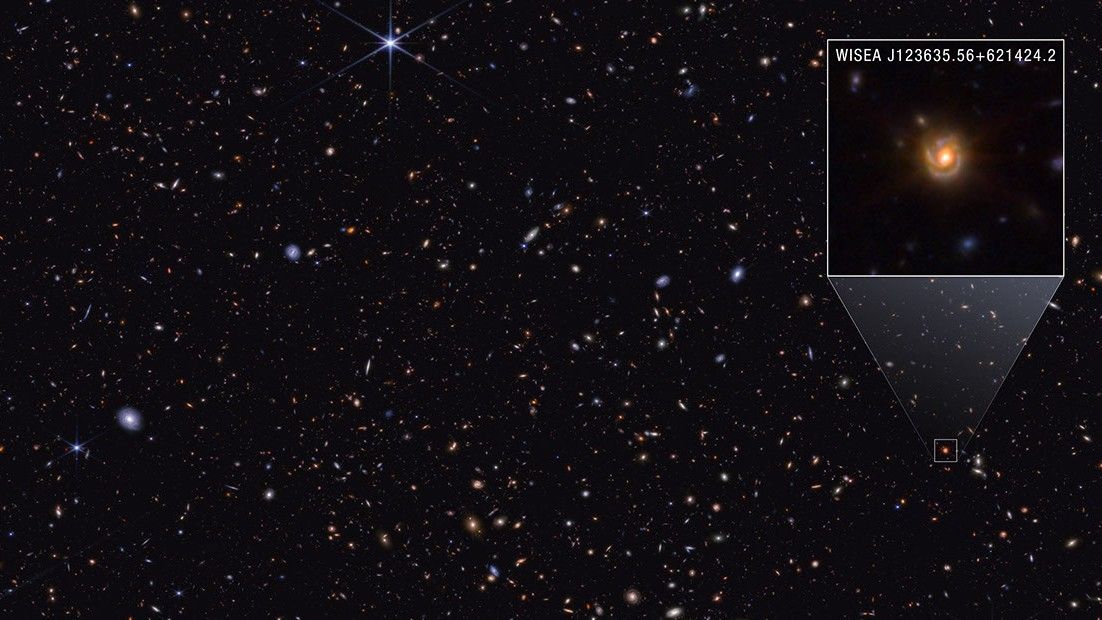
What it is: Saguaro, a relatively nearby spiral galaxy with a compact red core
Where it is: Approximately 10 billion light-years away in the constellation Ursa Major
When it was shared: July 29, 2026.
Since NASA’s James Webb Space Telescope (JWST) began science operations in 2022, astronomers have been investigating a strange population of distant objects known as “little red dots” (LRDs). These compact, crimson-colored sources appear extremely bright in infrared wavelengths, yet they are difficult to classify. They were detected in large numbers when the universe was only about 600 million years old, before apparently becoming far less common less than a billion years later.
The unusual appearance of these little red dots has led scientists to debate whether they represent a new type of galaxy, rapidly growing supermassive black holes or something even stranger. New observations from JWST, together with data from the Hubble Space Telescope and NASA’s Chandra X-ray Observatory, now suggest that many LRDs may not have disappeared. Instead, they could have changed appearance as their host galaxies evolved.
To investigate this possibility, researchers studied a comparatively nearby galaxy near the Big Dipper called WISEA J123635.56+621424.2. The galaxy has been nicknamed the Saguaro because its broad spiral arms resemble the iconic Sonoran Desert cactus, which produces red fruit.
Latest Videos FromLive Science
The Saguaro galaxy existed roughly 3.3 billion years after the Big Bang, well after the period when little red dots were thought to have faded from view. At its center is a compact, reddish core that shares many of the characteristics associated with LRDs, including unusually weak X-ray emissions. Its relative proximity allowed JWST to resolve the galaxy’s spiral arms and bright central region—features that would be impossible to see in the most distant LRDs.
Rather than observing the Saguaro only as it appears today, the researchers used computer models to calculate how it might look from much greater distances. As the galaxy was moved farther away, its spiral arms gradually disappeared into the darkness. Eventually, only the small, luminous red core remained visible, creating an image remarkably similar to the little red dots found in JWST’s deepest surveys of the early universe.
These findings indicate that many little red dots could be ordinary galaxies viewed from enormous cosmic distances. At those distances, the bright, active centers remain detectable, while the surrounding stars and spiral structures become too faint for even the powerful James Webb Space Telescope to observe.
If this interpretation is correct, LRDs may not be an entirely new class of cosmic object. Instead, their distinctive red appearance could represent a brief stage in the early growth of supermassive black holes and their host galaxies.
Get the world’s most fascinating discoveries delivered straight to your inbox.
Astronomers are now searching for more nearby galaxies that resemble the Saguaro. Finding additional examples could help researchers create a larger catalog of little red dots and determine how galaxies and their central black holes grew together throughout cosmic history.
TOPICS
Source: www.livescience.com