


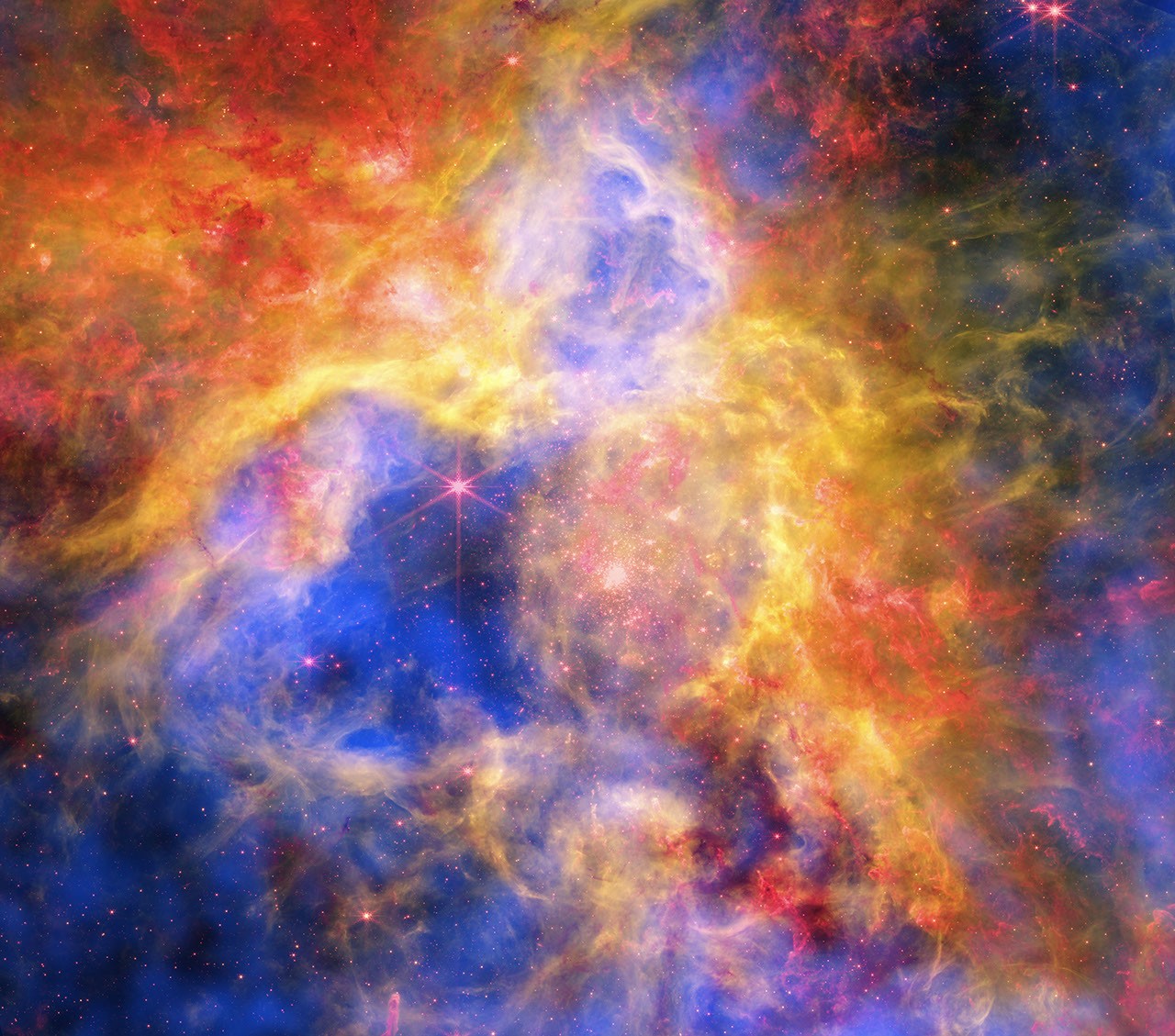
NASA Telescopes Reveal New Details of the Tarantula Nebula
A striking new composite image from NASA’s Chandra X-ray Observatory, James Webb Space Telescope, and Hubble Space Telescope offers an unprecedented look at 30 Doradus, also known as the Tarantula Nebula. By combining X-ray, infrared, and optical observations, astronomers have uncovered new clues about how massive stars shape their surrounding environment.
The Tarantula Nebula is located in the Large Magellanic Cloud, a small neighboring galaxy approximately 160,000 light-years from Earth. This enormous star-forming region contains thousands of young stars surrounded by a complex, honeycomb-like network of gas and dust.
A Multicolor View of the Tarantula Nebula
The new NASA image combines observations across multiple wavelengths. Chandra X-ray data appear in blue and reveal gas heated to millions of degrees. This superheated material is created when powerful winds from young, massive stars collide and generate shock waves similar to sonic booms produced by supersonic aircraft.
Infrared observations from NASA’s James Webb Space Telescope appear in red. They show thousands of young stars as well as vast clouds of cool dust—the raw material needed to form future stars and planets.
Optical observations from NASA’s Hubble Space Telescope are shown in green. These data highlight warm hydrogen gas and reveal individual stars scattered throughout the nebula. Where the three datasets overlap, the image produces a spectrum of colors, including red, orange, yellow, green, and blue.
The composite includes the complete Hubble and Webb views of the region, along with a large portion of the Chandra observations. The findings were recently published in The Astrophysical Journal.
Why Is the Tarantula Nebula Cooler Than Expected?
Astronomers have long studied the energy released by stellar winds in the Tarantula Nebula. Based on the power of these winds, researchers expected to find much more X-ray-emitting gas than was observed. The surprising shortage of hot gas raised an important question: Where is the missing energy going?
After analyzing data from Chandra, Hubble, Webb, and NASA’s retired Spitzer Space Telescope, the research team identified several processes that may be removing energy from the nebula.
- Hot gas may be escaping: Up to half of the superheated gas could be leaking through openings in the shells of gas and dust and escaping into space.
- Hot and cold gas may be interacting: Turbulence and mixing near the shell walls can reduce the overall temperature of the material.
- Heat may be transferred through conduction: Computer simulations suggest that hot gas may lose energy through direct contact with cooler gas in the nebula’s dense shells.
Together, these processes help explain why the Tarantula Nebula contains less X-ray-emitting gas than scientists originally expected. They also create the colorful and intricate structure captured by NASA’s space telescopes.
Research Team and NASA’s Chandra Mission
The study was led by Jennifer Rodriguez of The Ohio State University in Columbus. Co-authors include Laura Lopez, Lachlan Lancaster, Anna Rosen, Omnaraynai Nayak, Sebastian Lopez, Tyler Holland-Ashford, and Trinity Webb.
NASA’s Marshall Space Flight Center in Huntsville, Alabama, manages the Chandra X-ray Observatory program. The Smithsonian Astrophysical Observatory’s Chandra X-ray Center oversees scientific operations in Cambridge, Massachusetts, and flight operations in Burlington, Massachusetts.
Learn more about the Chandra X-ray Observatory and NASA’s exploration of the universe in X-ray light.
Source: science.nasa.gov