


Close Menu
HitechubHitechub
    What's Hot
    Technology

    How many cars there are on Earth right now?

    Science

    Unlocking Multitasking: How Science Reveals Your Brain’s Potential with Practice

    Science

    How Capitalism Distorts Our Understanding of Ecology and the Origins of Life

    Important Pages:
    • About Us
    • Privacy Policy
    • Terms & Conditions
    Facebook X (Twitter) Instagram Pinterest
    Facebook X (Twitter) Instagram
    HitechubHitechub
    Friday, June 26
    • Technology
      1. AI
      2. Gadgets
      3. View All

      This is the most popular CEO in the world

      Sectors in which “Chat-GPT” is most often used

      AI Pioneer Expresses Concern About Potential for AI to Surpass Humanity

      Artificial intelligence has begun to “swallow” professions

      What’s new in Android 14

      Europeans have about 700 million old mobile phones in their drawers

      Here’s how you can tell if your phone is being tapped

      “Sneaker X” – computer case in the shape of a sneaker

      Russian Gamers Unite to Prevent Nuclear War: Join the Fight Online

      Challenges of Space Travel: Why Journeying to Space is So Difficult

      NASA Astronaut Casts Historic Vote from Space

      Discover the Future of Comfort: What If You Could Wear a Chair?

    • Science
      1. Space
      2. Wheels
      3. View All

      Galaxies in the universe are growing more slowly than they should

      “Espace” presented the new lander “Apex 1.0”

      The largest asteroid sample ever collected has arrived on Earth

      (VIDEO) Incredible flight of the Parker Solar Probe

      Toyota wants to make a new generation battery with a range of up to 1,200 km

      Meet Toyota’s lunar “baby” that could make exploring the Moon easier

      Microlino – Is this the perfect city car?

      Alfa Romeo 4C gets an electric successor

      The Ultimate Guide to the Best and Worst Washing Temperatures for Laundry

      First Discovery of Ancient Human DNA in Cave Paintings: A Breakthrough in Archaeology

      Rare Gene Increases Cancer Risk: 100% Probability Explained

      Exploring Brazil’s Extensive Network of Free Milk Banks: A Lifesaving Resource for Infants

    HitechubHitechub
    Home » Exploring Brazil’s Extensive Network of Free Milk Banks: A Lifesaving Resource for Infants
    Science

    Exploring Brazil’s Extensive Network of Free Milk Banks: A Lifesaving Resource for Infants

    Share Facebook Twitter Pinterest WhatsApp
    Share
    Facebook Twitter LinkedIn Pinterest WhatsApp

    At the Fernández Figueira Institute in Rio de Janeiro, breast milk undergoes rigorous testing before distribution.

    Christine Bethge

    For new mothers who are unable to breastfeed, Brazil offers vital support through its network of milk banks. These vital facilities, which collect and distribute donated breast milk, have been in operation since the early 20th century. Originally costly and limited, innovations in the 1980s by chemist João Apurigio Guerra de Almeida revolutionized their accessibility and affordability. Recent strategies involve repurposing food industry hot tubs—ten times cheaper than standard pasteurizers—and sterilizing various jars for reuse as milk bottles.

    This innovative, Brazilian approach is encapsulated in the term: Jeitinho, according to photographer Christine Bethge. Alongside journalist Niklas Franzen, she explored several milk banks in Brazil, including the Fernández Figueira Institute.

    Brazil’s milk banking system is now internationally recognized as one of the most efficient, ensuring the safest and most affordable access to breast milk. The country boasts over 200 milk banks, providing essential services to hundreds of thousands of infants—making it the largest network globally. This initiative has significantly contributed to a more than 70% reduction in the under-five mortality rate from 1990 to 2015, with many attributing success to the nationwide milk bank system.
    Many studies highlight the impact of this program.

    A courier with the Instituto Fernandes Figueira collects breast milk from a donor.

    A courier at the Fernández Figueira Institute collects breast milk from generous donors.

    Christine Bethge

    The success of Brazil’s milk bank system lies in its operational efficiency and accessibility, enabling effortless milk donations and distributions, supported by an extensive network of delivery personnel across the country. For instance, a delivery driver cycling through Flamengo, a suburb of Rio de Janeiro, illustrates the community-focused approach. “I spoke with one donor who stated that without the courier’s pick-up service, she would not have donated,” Bethge explains, underscoring the program’s effectiveness.

    A lab assistant examines breast milk for larger contaminants, starting quality control procedures.

    A laboratory assistant inspects breast milk for contaminants, a crucial step in quality control.

    Christine Bethge

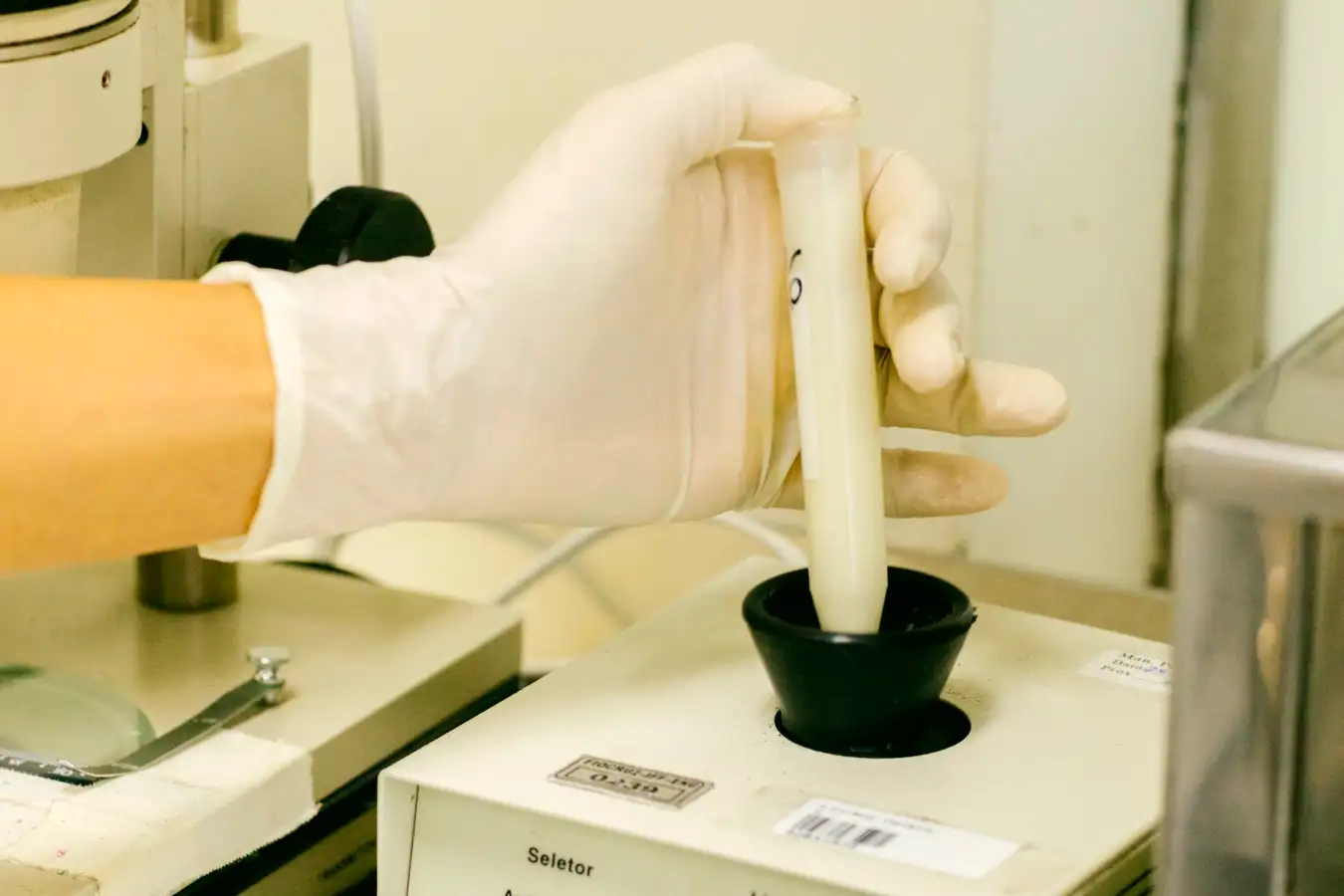
    Each milk bank functions as a multi-purpose facility, providing comprehensive support for new mothers. They manage milk collection, sterilization, storage, and supply it directly to premature infants. Every batch undergoes inspection for large contaminants like hair or dust, with potential rejections for unclean samples. The milk is then carefully warmed in a water bath for rigorous testing to ensure biological safety (as seen in the main image above).

    Milk is pasteurized at 62.5°C for half an hour to eliminate bacteria.

    Milk is pasteurized at 62.5°C for 30 minutes to eliminate harmful bacteria.

    Christine Bethge

    Additionally, nurses are available to help mothers express milk for premature infants, ensuring essential support in the neonatal wards.

    “The woman delivering the milk can provide critical updates on the condition of her baby,” Bethge adds, highlighting how integral the courier service is in supporting vulnerable familles.

    A nurse assists a mother in expressing milk for her twin premature infants.

    A nurse assists a mother in expressing milk for her premature twins at the Fernández Figueira Institute.

    Christine Bethge

    Topic:

    Source: www.newscientist.com

    Share. Facebook Twitter Pinterest LinkedIn WhatsApp
    Previous ArticleCan Video Games Enhance Our Understanding of Quantum Mechanics?
    Next Article Rare Gene Increases Cancer Risk: 100% Probability Explained

    Related Posts

    Science

    The Ultimate Guide to the Best and Worst Washing Temperatures for Laundry

    Science

    First Discovery of Ancient Human DNA in Cave Paintings: A Breakthrough in Archaeology

    Science

    Rare Gene Increases Cancer Risk: 100% Probability Explained

    Science

    Can Video Games Enhance Our Understanding of Quantum Mechanics?

    Science

    Exploring the Cosmos: My Journey into Science Fiction Inspired by a World-Ending Supernova – New Scientist Book Club

    Science

    New Scientist Book Club: Exclusive Excerpt from “Slow Gods” by Claire North

    Science

    Europe’s Record-Breaking Heatwave: Hottest and Wettest Conditions Ever Recorded

    Science

    Discover If Holding an Onion Will Make You Cry: A Simple Experiment

    Add A Comment
    Leave A Reply Cancel Reply

    Stay In Touch
    • Facebook
    • Twitter
    • Instagram
    • Pinterest
    Top Picks
    Science

    Rethinking Consciousness: Here’s Why We Need a Fresh Perspective

    If you’re reading this, you likely consider yourself conscious. You probably also believe that your…

    Tropical Storm Arthur: First Named Storm of the Season with Flash Flooding Threat

    Exploring the Surprising Genetic Diversity of Late Neanderthals

    NASA Launches Nancy Grace Roman Space Telescope: Fastest Space Scans in History Await

    Space Exploration: Unveiling the Wonders of the Universe

    Most Popular
    Technology

    The story of traffic lights

    Science

    How the HPV Vaccine Significantly Lowers Cervical Cancer Death Rates

    Categories
    • AI (13)
    • Gadgets (10)
    • Science (380)
    • Space (9)
    • Technology (37)
    • Wheels (9)
    Our Picks
    Science

    New Scientist Book Club: Exclusive Excerpt from “Slow Gods” by Claire North

    Science

    Unlock Your Potential: Science-Backed Secrets to Mastering Any Skill

    © 2026 Hitechub.
    • Home
    • About Us
    • Privacy Policy
    • Terms & Conditions

    Type above and press Enter to search. Press Esc to cancel.

    We are using cookies to give you the best experience on our website.

    You can find out more about which cookies we are using or switch them off in .

    Ad Blocker Enabled!
    Ad Blocker Enabled!
    Our website is made possible by displaying online advertisements to our visitors. Please support us by disabling your Ad Blocker.
    Go to mobile version
    Hitechub
    Powered by  GDPR Cookie Compliance
    Privacy Overview

    This website uses cookies so that we can provide you with the best user experience possible. Cookie information is stored in your browser and performs functions such as recognising you when you return to our website and helping our team to understand which sections of the website you find most interesting and useful.

    Strictly Necessary Cookies

    Strictly Necessary Cookie should be enabled at all times so that we can save your preferences for cookie settings.