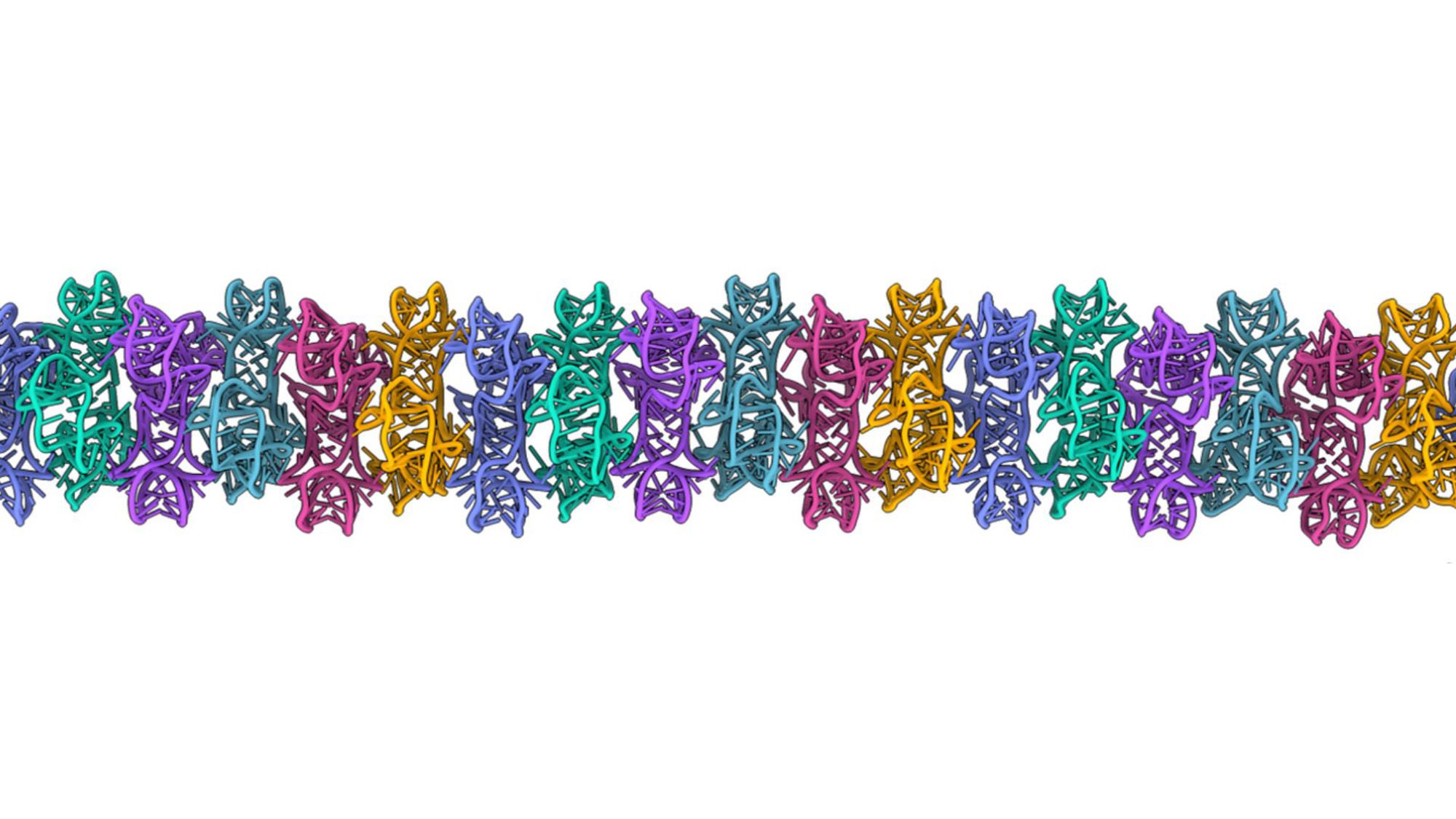
Researchers now propose that RNA, a crucial component in the origin of life on Earth, might have played a larger role than previously believed. 4 billion years ago, only simple molecular structures existed, yet new findings reveal that naturally occurring RNA molecules can form complex shapes like filaments and cages. This raises compelling questions about the structure of RNA at life’s inception.
According to the RNA world hypothesis, early life forms primarily relied on RNA instead of DNA and proteins. This molecular relative of DNA still contributes to modern cellular functions but does not serve as the primary genetic material. In contrast, RNA stored genetic information and catalyzed biochemical reactions, acting as primitive enzymes.
Eventually, proteins took over as the primary enzymes. Proteins’ diversity exceeds that of RNA due to their complex structures formed from 20 different amino acids, compared to the four nucleotides that comprise RNA.
Historically, scientists believed that only proteins could form intricate structures. However, a recent study demonstrates that RNA can also assemble into larger forms. The study, published on the preprint server BioRxiv on July 1, 2026, awaits peer review.
“Our findings prove that RNA can perform functions previously unobserved,” stated co-author Lin Fan, an RNA biologist at Sun Yat-sen University, conveying a significant implication for the understanding of RNA at life’s origin.
Huang and colleagues theorized that RNA molecules could bind through sequences that form a “kissing stem loop,” resembling shoelace loops. This interaction allows RNA strands to fuse and create larger complexes.
After analyzing extensive RNA sequences, researchers identified a subset of RNA molecules from bacteriophages that exhibit this behavior. They purified these RNA segments in the lab, assembled them in dishes, and utilized cryo-electron microscopy to visualize their intricate structures.
Get the world’s most fascinating discoveries delivered straight to your inbox.
Results indicated that some RNA molecules form elongated filaments akin to the cytoskeleton in cells, essential for various cellular functions, including formation and migration.
Other RNA formations clustered into cages, comparable in size to common viruses. Some structures even adopted an icosahedral shape—20 equilateral triangles creating a structure resembling a soccer ball. This aligns with how certain viruses, like the herpes virus, encapsulate their genome in protein-based icosahedrons called capsids. This finding encourages speculation that RNA-based capsids could have existed in the RNA world.
The RNA structures assemble into icosahedrons, similar to protein-based viral capsids.
(Image provided by Lin Fan)
While this research showcases the potential for RNA to assemble into complex structures, Huang emphasizes that it does not confirm that such events occurred in early life.
“Environmental conditions are crucial,” noted Anna Medved, an evolutionary biologist at Eötvös Lorand University in Hungary. She questioned the likelihood of these structures forming in a hypothetical RNA world.
If we could replicate the environmental conditions reminiscent of life’s origins—high temperature and low pH—and observe these structures spontaneously forming, the hypothesis of their existence in the RNA world would gain further credibility, she added.
Despite the significant sizes of RNA cages and filaments observed, Huang’s team created them using only short RNA strands, each containing fewer than 200 subunits. According to Medved, if shorter strands could assemble into these complex structures, it may suggest the feasibility of larger RNA molecules’ formation in the RNA world.
An intriguing question remains whether these RNA complexes are assembled within bacterially infected bacteria. Thus far, Huang’s team has only documented these structures forming in laboratory settings, requiring further investigation into whether interaction with proteins influences the formation process in living cells.
In addition to offering insights about the origins of life, Huang sees potential applications for these RNA cages in biotechnology. Ongoing research aims to leverage DNA folded into DNA origami, and Huang believes RNA, as DNA’s precursor, could similarly serve valuable roles in future medical applications.
Ren, Y., Zhang, Z., Chen, K., Li, M., Xie, Y., Bai, T., Huang, B., Xiao, B., Westhof, E., Lilley, DMJ, Wang, J., Miao, Z., Wei, X., and Huang, L. (2026). Structural assembly of RNA world. BioRxiv.