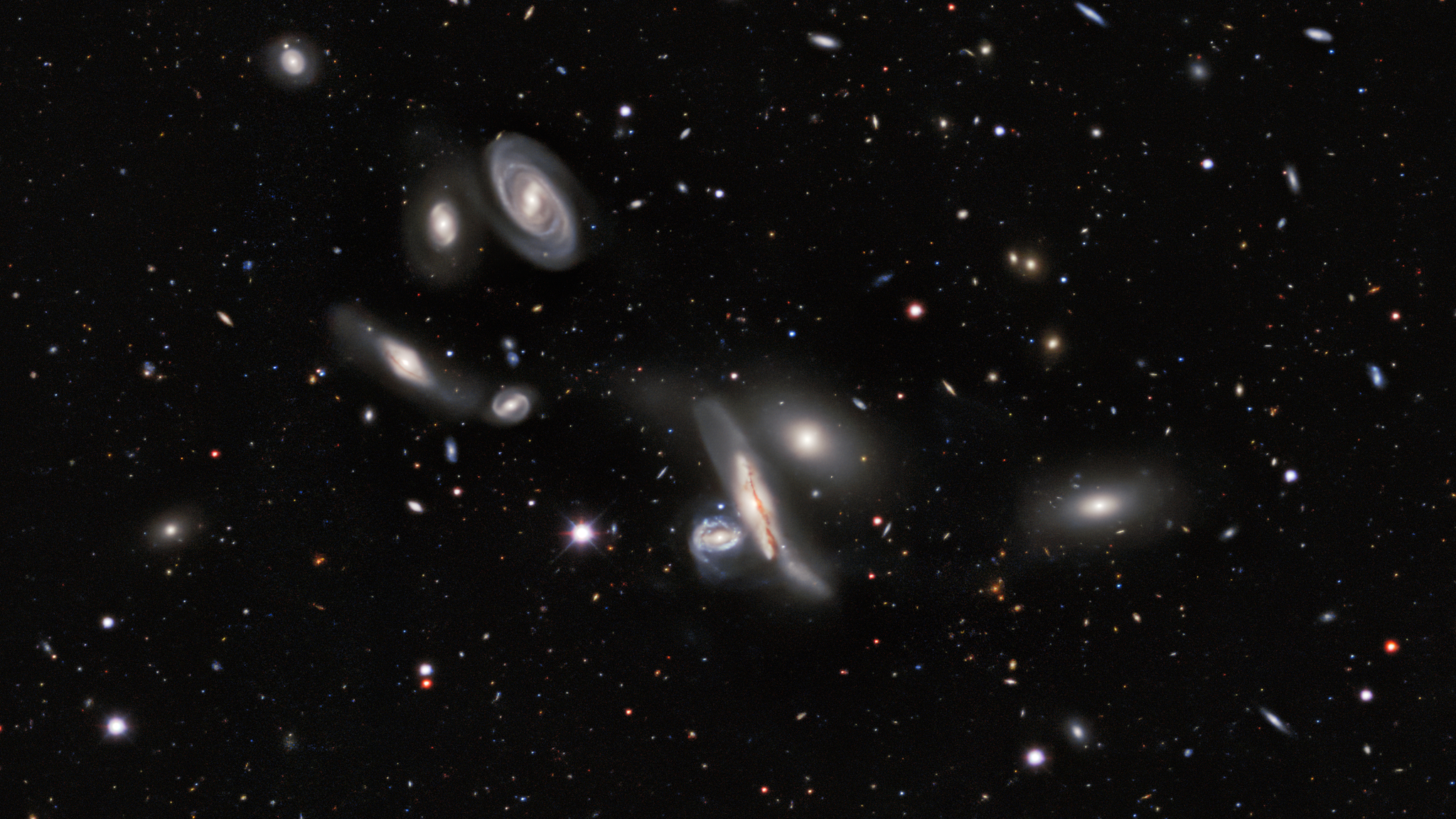
Astronomers have released the largest 2D map of the universe ever created, revealing approximately 4 billion stars, galaxies, black holes, asteroids and other celestial objects. Built from more than a decade of observations, the detailed cosmic map offers an unprecedented view of the night sky.
The new map covers roughly three-quarters of the sky in high resolution. It combines visible and near-infrared observations while focusing on regions not obscured by cosmic dust and gas. Because the complete map is too large to display as a single image, you can explore it using the free Legacy Survey Sky Browser webpage.
Creating the largest 2D cosmic map took 13 years and required three major ground-based sky surveys. Researchers used telescopes operated by the National Science Foundation (NSF) and the University of Arizona to collect the data. The completed map is now available to scientists worldwide and is expected to guide future observations of the universe.
Latest Videos FromLive Science
“Astronomers and citizen scientists can combine this map with their own observations to gain a deeper understanding of the universe,” NSF officials from NOIRLab said in a statement released Aug. 10.
The statement noted that researchers can use the map to search for rare gravitational lenses, track short-lived events such as supernovae and study two of modern physics’ biggest mysteries: dark matter and dark energy. Dark matter is the invisible material believed to make up most of the universe’s mass, while dark energy is linked to the accelerating expansion of the cosmos.
Spiral galaxy Messier 96 is one of the remarkable details visible in the new 2D map of the universe.
Earlier versions of the cosmic map have already contributed to at least 1,800 scientific papers, according to NOIRLab. The latest release is expected to support upcoming observatories and surveys, including the Vera C. Rubin Observatory and the Nancy Grace Roman Space Telescope.
The imaging surveys also provided the foundation for the Dark Energy Spectroscopic Instrument, or DESI. While the new map is two-dimensional, DESI is building a 3D map of the universe by measuring the light from distant celestial objects and calculating their distances.
DESI’s first five-year survey concluded in April. Initial findings indicate that dark energy may be weakening over time, a possibility that could change scientists’ understanding of cosmic expansion and the ultimate fate of the universe. Additional DESI data is expected soon, with improved results from the first five years anticipated next year. The project is scheduled to continue through 2028.
Get the world’s most fascinating discoveries delivered straight to your inbox.
Three telescopes supplied the core observations for the map: the Dark Energy Camera on the NSF’s Victor M. Blanco 4-meter Telescope in Chile, the NSF Nicholas U. Mayall 4-meter Telescope at Kitt Peak National Observatory in Arizona and the University of Arizona Bok 2.3-meter Telescope, also located at Kitt Peak. Researchers supplemented these observations with years of infrared data from NASA’s Wide-field Infrared Survey Explorer, or WISE, satellite mission.