


A nearly complete bovine skeleton discovered at the early Pliocene site of Camp dels Ninotz in northeastern Spain indicates that the ancestors of today’s buffaloes and cows had already reached significant sizes long before humans populated the continent.
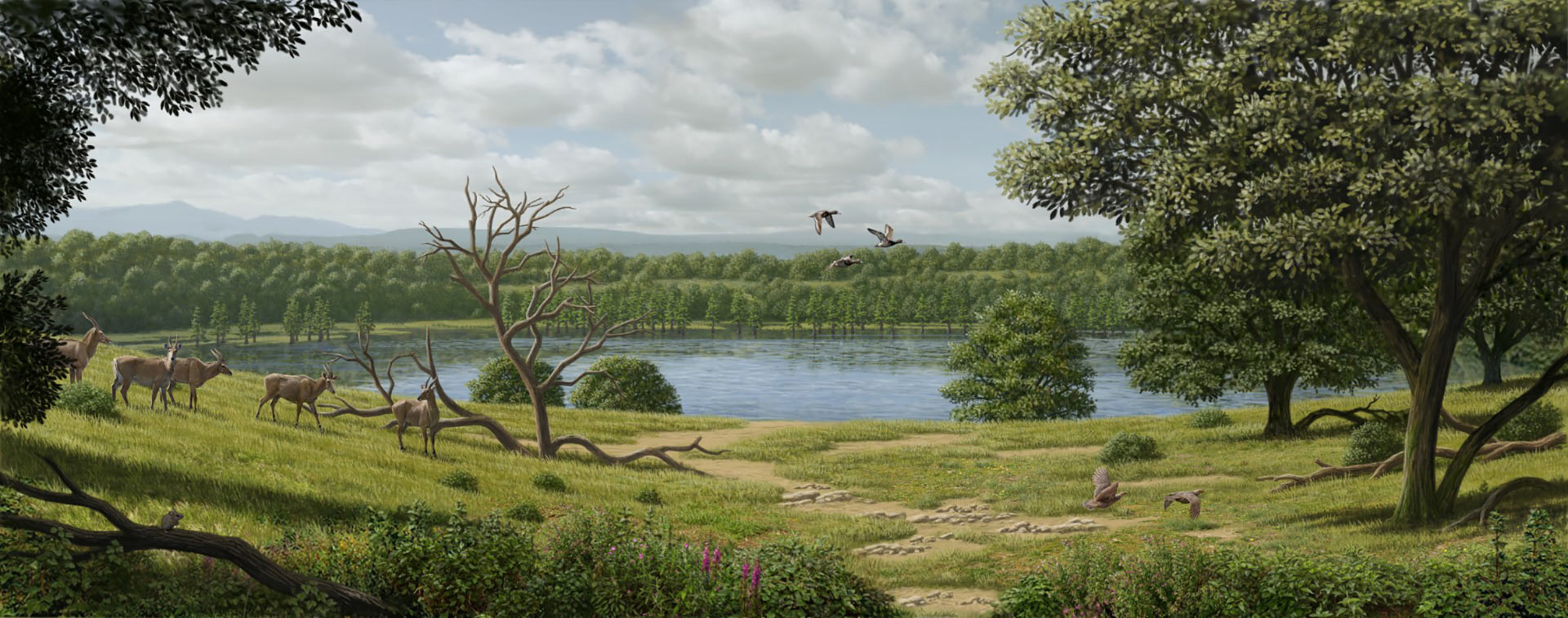
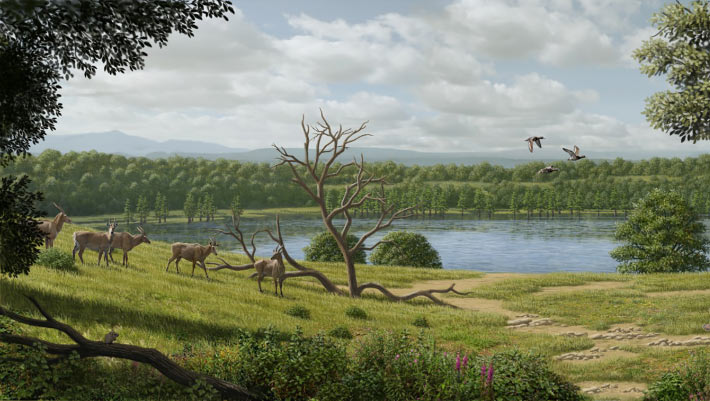
A paleo-artistic reconstruction of the environment around Lake Camp Dels Ninotz Mar from the early Pliocene. Image credit: Mauricio Anton.
“Cows play a vital role in modern ecosystems and human agriculture, especially Bovini species like bison, buffalo, and cattle,” stated Dr. Leonardo Solberg from the Leibniz Institute for Evolutionary and Biodiversity Sciences and colleagues.
“Despite their importance, the evolutionary origins and relationships with related species remain unclear due to a lack of well-preserved early fossils.”
In this research, the authors analyzed at least 14 fossil remains excavated from the Camp dels Ninotz site in Spain.
They identified the specimen as Parabos tineresi, one of five buffalo-like species that thrived in Europe during the early Pliocene.
The largest among these creatures is estimated to have weighed nearly 500 kg, making it smaller than most modern bovine species yet larger than other similar bovid species of the era.
This finding suggests an early stage of increased body size in the bovine lineage, likely as an adaptation to the climatic and environmental changes that characterized continental Europe during the Pliocene.
The anatomical features of these animals imply that they inhabited moist, plant-rich environments, aligning with the understanding of a water-abundant ecosystem at the Camp dels Ninotz site.
Researchers indicate that the early Pliocene marked the emergence of large cattle, although the exact relationship between ancient cattle and modern cows remains ambiguous. Parabos shows uncertainty in this lineage.
Based on comparisons with other species, they propose that Parabos may either represent early members of the Bovini tribe or later members of the related Tragoportacini lineage, which were later supplanted by true water buffalo, cattle, and bison.
Future research into the anatomy and ecology of Parabos will clarify its position in the bovine evolutionary timeline.
“The Camp dels Ninots bovid is one of the most well-preserved fossils from the European Pliocene,” the scientists noted.
“This exceptional preservation of the species enables us to gain deeper insights into their anatomy and the ecology of the continent’s earliest large bovids.”
“Studying these fossils presented both challenges and rewards.”
“The remarkable preservation and richness of the finds have provided us with an invaluable source of data from such an ancient geological era, shedding light on the pre-human world.”
For more details, refer to the study published in the online journal PLoS ONE.
_____
L. Solberg et al. 2026. First or last dynasty? Parabos tineresi and the evolution of Eurasian Bovidae during the early Pliocene. PLoS ONE 21 (6): e0340256; doi: 10.1371/journal.pone.0340256
Source: www.sci.news