


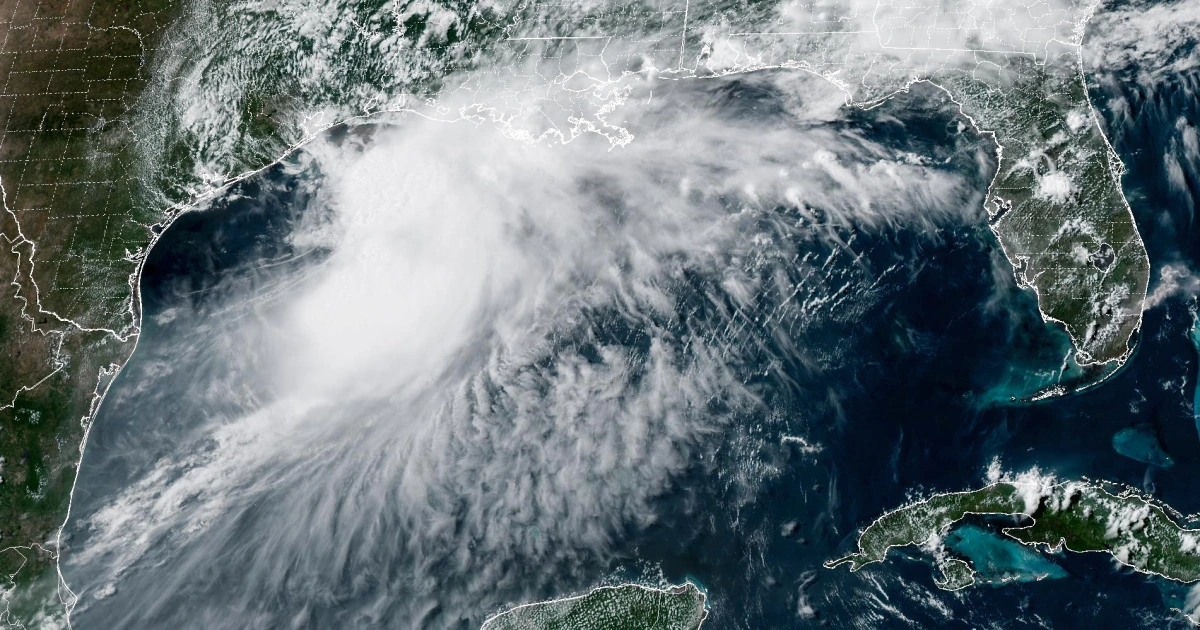
The Southeastern United States is bracing for significant flash flooding and extended flooding as Tropical Storm Arthur progresses through the area.
Subscribe for ad-free access to this story
Enjoy unlimited access to exclusive content and articles without ads.

Tropical Storm Arthur, which originated off the coast of Texas, marks the first named storm of this hurricane season. A storm is designated with a name when its wind speeds exceed 39 mph.
According to forecasters at the National Hurricane Center, Arthur’s winds have reached approximately 45 mph with stronger gusts anticipated. They predict rainfall of 5 to 10 inches along the Texas coast, continuing into early Friday morning, before the storm progresses towards Louisiana, Mississippi, western Georgia, and Florida, with some areas potentially experiencing up to 20 inches of rainfall.
“Heavy rainfall and dangerous flash flooding are the primary threats of this system,” forecasters emphasized Wednesday morning.
The greatest likelihood of flash flooding in the next three days is anticipated from Lake Charles, Louisiana, to Montgomery, Alabama, with the highest precipitation totals expected near Mobile, Alabama, as reported by the National Hurricane Center.
Atmospheric scientist Zachary Handros from Georgia Tech notes that the potential for flash flooding hinges on the storm’s speed at any given location.
“The crucial factor is whether the rain will either stop or linger in these regions,” Handros stated. “That can be challenging to predict.”
Parts of Texas are already facing heavy rain. On Monday, Governor Greg Abbott declared a disaster in response to severe storms affecting 101 counties.
Prior to this month, many areas in the Southeast, particularly northwest Mississippi and Louisiana, were enduring a prolonged drought, according to Handros. Recent rainfall has alleviated some of that dryness, but the region is now at risk for flooding as Arthur approaches.
“March, April, and parts of May saw considerably low precipitation levels, but conditions have shifted recently,” Handros noted.
“If soils are already saturated or water is accumulating without adequate drainage, additional moisture can lead to localized flooding,” he explained.
Houston and Atlanta have both hosted World Cup events in rainy conditions. Houston canceled the FIFA Fan Festival on Monday due to precipitation and reopened with a modified schedule on Tuesday. However, Handros believes major disruptions to the games are unlikely.
“Currently, we have a game underway in Houston. I believe the West is facing the most severe impact,” Handros commented. “In Atlanta, the worst-case scenario may involve minor flooding or congested traffic for individuals on the road.”
Arthur is the initial storm in what is projected to be a relatively mild hurricane season. NOAA forecasters indicated in May that only three to six hurricanes (which are classified as storms reaching 124 mph) and eight to fourteen tropical cyclones are anticipated this season.
The ongoing El Niño pattern in the tropical Pacific Ocean is a primary factor contributing to the mild forecast. El Niño typically correlates with a season characterized by fewer hurricanes in the Atlantic but increased activity in the Pacific.
El Niño often induces significant vertical wind shear, which refers to variations in wind speed and direction across different atmospheric layers. Hurricanes tend to form in conditions of low wind shear, so El Niño usually hinders their development.
Nonetheless, conditions are favorable for storm development should it occur.
“Despite El Niño, sea surface temperatures in the Gulf and Atlantic remain relatively warm enough for storms to develop if the right conditions align. This scenario is evident with Arthur,” Handros added.
“Even if this season sees fewer named storms than previous years, just one named storm can have significant impacts,” he concluded.
Source: www.nbcnews.com