


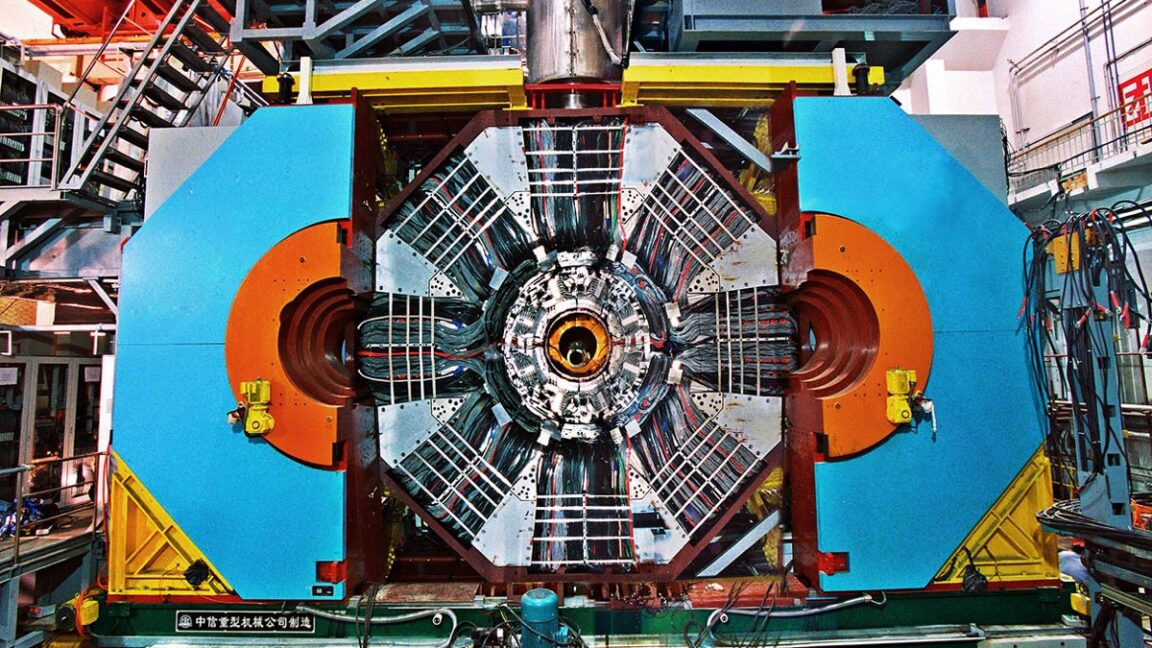
Physicists working with the Beijing Spectrometer III (BES III) experiment have reported compelling new evidence for the existence of a glueball—an elusive composite particle made entirely of gluons and predicted by quantum theory. The findings were published as a preprint on arXiv last month and were also presented at last week’s International Conference on High Energy Physics (ICHEP).
Ordinary matter is made of quarks bound together by gluons, the particles that carry the strong nuclear force. These interactions form protons and neutrons, which make up the nuclei of atoms. The Higgs boson, discovered in 2012 after decades of research, was widely described as the final missing piece of the Standard Model of particle physics. However, many important questions remain—including whether glueballs actually exist.
If the Standard Model is correct, glueballs should be possible. They are a direct prediction of quantum chromodynamics, the theory describing the strong nuclear force. Physicists also expect that several different types of glueballs may exist, each with distinct properties.
Matthew Francis explained the importance of glueballs in Ars in 2015:
Like the Higgs boson, glueballs are part of the reason matter has mass. The Higgs boson is a manifestation of the “Higgs field,” which exists throughout the universe. Quarks, electrons, and other fundamental particles would be massless in a universe without the Higgs field, but they acquire mass through their interaction with it. In contrast, most of the mass of protons and neutrons does not come from their quarks. It comes from the energy of the “glue” that binds them together.
That glue is made of gluons. Although gluons have no rest mass, the energy required to hold the contents of a proton together is enormous, and much of that energy appears as mass through E=mc2. Without gluons, protons would not exist—and they would not have their observed mass. Gluons also interact with one another, not just with quarks. As a result, nature may be able to form particles made entirely of gluons, with no quarks at all. These hypothetical particles are called glueballs.
The subatomic world contains a vast array of particles, often referred to as the particle zoo. One particle is especially important in the search for glueballs: the J/ψ meson.
Discovered in 1974, the J/ψ meson consists of a charm quark and a charm antiquark. When J/ψ particles decay, they can produce large numbers of gluons and other composite particles known as hadrons. For this reason, physicists have long considered J/ψ decays one of the most promising ways to search for evidence of glueballs.
According to astrophysicist Ethan Siegel, a particle considered a potential glueball should have several characteristics, including zero spin, no electric charge, and unusual parity. The BES III results could provide an important step toward confirming whether these distinctive particles—made purely from the strong nuclear force—truly exist.
Source: arstechnica.com