


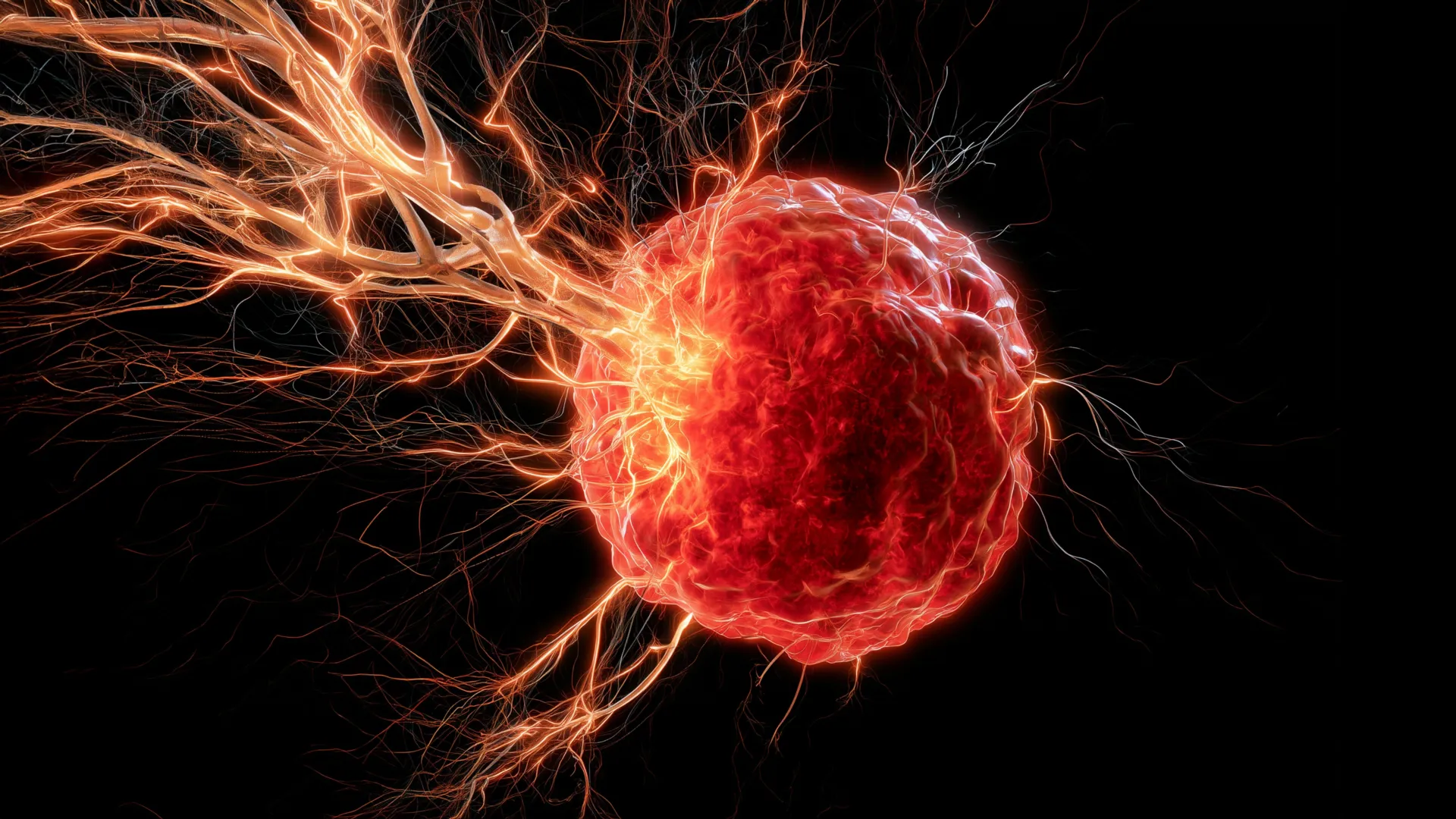
New research from the University of Oklahoma has revealed how triple-negative breast cancer can manipulate the immune system to attract nerves into tumors, creating an environment that may promote tumor growth and treatment resistance.
Scientists have long known that many solid tumors contain extensive networks of nerves. However, the process that brings these nerves into tumors has remained unclear. A new study published in Cell Death & Differentiation explains how this process may occur in triple-negative breast cancer, one of the most aggressive and difficult-to-treat forms of breast cancer.
Macrophages help recruit nerves to breast tumors
Researchers discovered that triple-negative breast tumors attract macrophages, immune cells that typically help fight infections and repair damaged tissue. Once inside the tumor, these macrophages release brain-derived neurotrophic factor, or BDNF.
BDNF is a protein best known for supporting the growth and survival of nerve cells in the brain. In breast cancer, however, tumors appear to use this same biological signal to encourage nearby nerves to grow toward and enter the tumor. The resulting nerve growth may contribute to breast cancer progression and resistance to treatment.
“Macrophages are an important source of neural recruitment to tumors. Macrophages normally play a positive role in the body, but in this breast cancer scenario they promote a negative role,” said Maureen Cox, Ph.D., assistant professor in the Department of Microbiology and Immunology at the OU School of Medicine and a research member at the OU Health Stephenson Cancer Center.
Blocking BDNF signaling slows tumor growth
The findings could lead to new treatment strategies for triple-negative breast cancer. Instead of focusing only on destroying cancer cells, future therapies may target the communication between macrophages and nerves that appears to support tumor growth.
Cox and her colleagues tested this approach in mice. After administering a drug that blocked BDNF signaling, the researchers observed less nerve growth inside the tumors. Tumor growth was also significantly reduced.
“It’s very promising that this drug, which is already on the market, can be used to target BDNF,” Cox said. “We believe that nerves have immunosuppressive properties, so if we can stop nerve growth in the first place, we may be able to boost the immune response and fight cancer.”
Patient data supports the breast cancer findings
The research team also analyzed data from patients with triple-negative breast cancer to determine whether the same biological process occurs in humans. Patients whose tumors contained high levels of both macrophages and BDNF had lower survival rates. This finding suggests that the mechanism identified in mice may also be relevant to people with triple-negative breast cancer.
Cox and her colleagues are now working to determine precisely how nerves help tumors grow. Previous research suggests that nerves may stimulate the formation of blood vessels, helping tumors receive oxygen and nutrients. Other studies indicate that cancer cells may travel along nerves as they spread, or metastasize, beyond the original tumor.
The researchers also plan to study whether the same treatment strategy could work against high-grade ovarian cancer, another aggressive disease with limited treatment options.
“Ultimately, we hope to turn anti-tumor immunity back on in cancer patients so that their own immune system can reject the tumor,” Cox said.
Research support
This research was supported by the NIH National Institute of General Medical Sciences through award numbers P20GM103447 and P20GM103639. The project also received support from the Oklahoma Tobacco Settlement Trust (TSET), the primary funder of the University of Oklahoma Stephenson Cancer Center and the TSET Health Promotion Research Center, as well as Oklahoma Shared Clinical and Translational Resources through an Institutional Development Award from the National Institute of General Medical Sciences (grant number U54GM104938).
Source: www.sciencedaily.com