


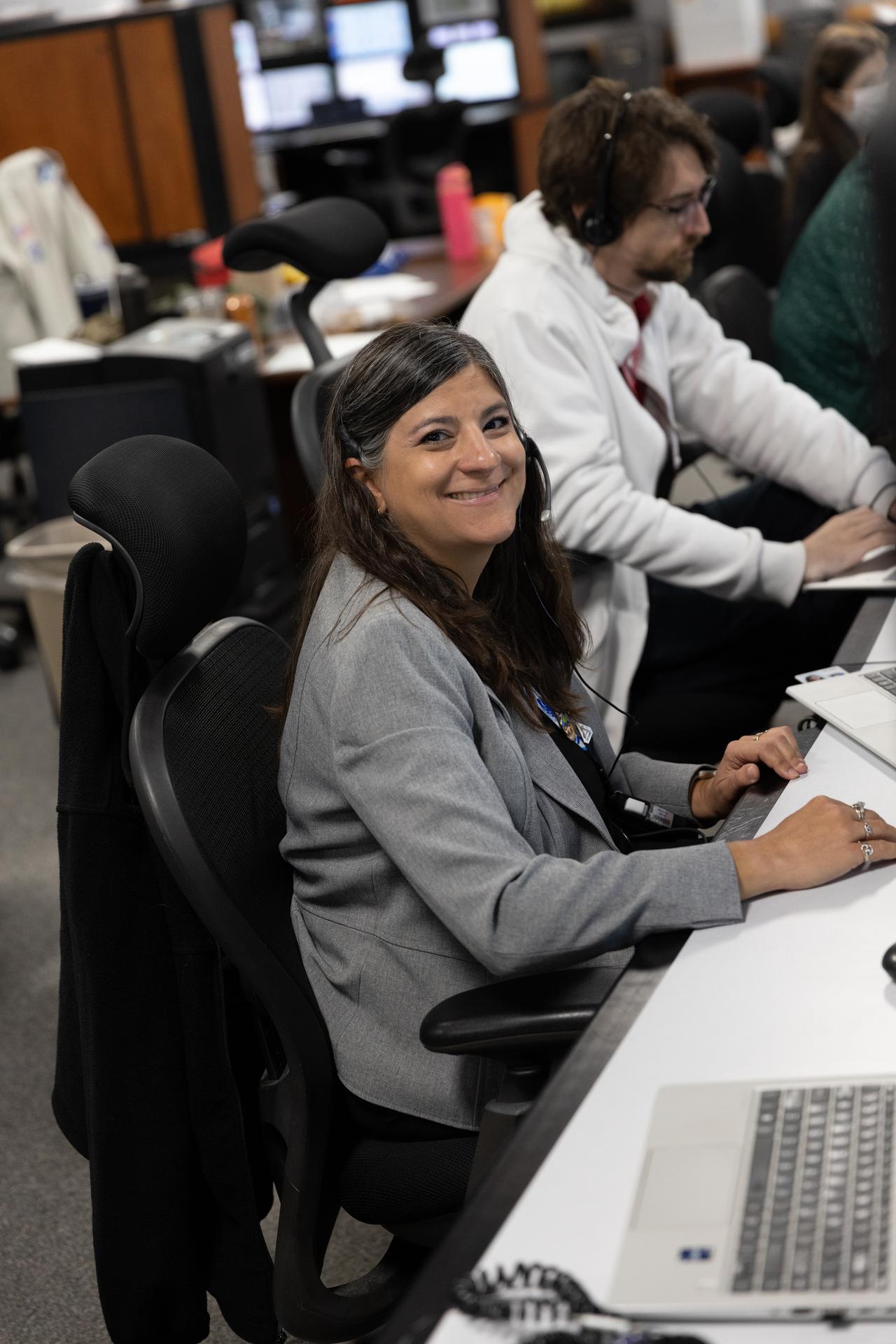
Lindsay Waite Turns Childhood NASA Dream Into Artemis Launch Team Career
As a young girl growing up in Worcester, Massachusetts, Lindsay Waite dreamed of working for NASA. Today, that dream is becoming a reality as she serves as a NASA test project engineer on the Artemis launch team. Her work supports NASA’s historic effort to return humans to the Moon after launching from Kennedy Space Center in Florida.
Waite’s interest in space began during a visit to Worcester Polytechnic Institute (WPI) in the late 1990s. While still in middle school, she met NASA space shuttle astronaut Michael López-Alegría and former WPI professor Albert Sacco Jr. She was inspired as they described their spaceflight experiences, including experiments involving cell growth in space. Waite took photographs, collected autographs and left with an even stronger passion for space exploration. At the time, she did not know they would be among the first of many astronauts she would meet.
Her desire to understand space, science and engineering eventually led Waite back to WPI. She studied a broad range of engineering disciplines and earned a Bachelor of Science in Mechanical Engineering with an emphasis in aerospace engineering. After graduation, she began pursuing her goal of contributing to the nation’s space program.
Waite first worked as a systems engineer on radar flight-test missions for a defense contractor. Although she excelled in the position, she soon realized that defense systems were not where her passion lay.
“This was an exciting program. It was rewarding to be part of a project that focused on protecting the country from enemy attack. But it wasn’t space,” Waite said.
Waite, whose husband is a retired U.S. Army sergeant first class, traveled with her family during his military service and continued to follow NASA missions from around the world. While raising their three sons, she also earned a master’s degree in space operations from the University of Colorado Colorado Springs. After 12 years away from the aerospace industry, Waite made the courageous decision to return to her original career goal: working for NASA.
Lindsay Waite
NASA test project engineer
Waite vividly remembers watching NASA astronauts Doug Hurley and Bob Behnken launch on NASA’s first commercial crew mission to the International Space Station in 2020. Her family watched together as she and her children played launch day by setting up a rocket-shaped tent in the garden. They cheered as the astronauts lifted off toward the workplace Waite had long hoped to join.
After moving to Florida in 2022, Waite continued pursuing opportunities with NASA. She worked as a systems engineer and program manager for a small satellite company in Cape Canaveral. Soon after settling in the Sunshine State, she and her family watched Artemis I launch. Waite woke early to see the historic mission send the Orion spacecraft around the Moon—a milestone that helped pave the way for future crewed Artemis missions.
Waite began working at Kennedy Space Center in 2024 as a contractor and served as a test project engineer supporting Artemis II. As technical problem solvers, test project engineers serve as a central connection point for launch and test operations. They coordinate solutions across multiple subsystems during the complex and fast-moving activities surrounding a rocket launch.
In preparation for the Artemis II launch, Waite qualified to work at the launch console during critical prelaunch and post-launch operations involving NASA’s Space Launch System (SLS) rocket and Orion spacecraft. She also watched from outside Kennedy’s launch control center as the four-person crew lifted off on its journey toward the Moon.
When NASA announced an initiative to bring key positions in-house, Waite seized the opportunity to fulfill her longtime goal. She applied for the position and became a NASA civil servant supporting the Artemis launch team as a test project engineer. With Artemis III ahead, she will be able to follow the launch operation from preparation through completion.
Waite is the only woman among the 14 test project engineers supporting the Artemis launch team. She said her colleagues have welcomed her and share her commitment to the mission.
“Everyone is so open and welcoming,” Waite said. “I’ve worked with teams before, but this is different. We’re all passionate about the mission, and we’re working together to get things done quickly and safely. That’s always our top priority. We’re moving forward.”
For Waite, the opportunity to work on NASA’s Artemis missions is the result of years of persistence, learning and determination. She continues to focus on achieving one goal at a time.
“The sky is not the limit. It’s wide open right now,” Waite said. “The universe has limits.”
Source: www.nasa.gov