


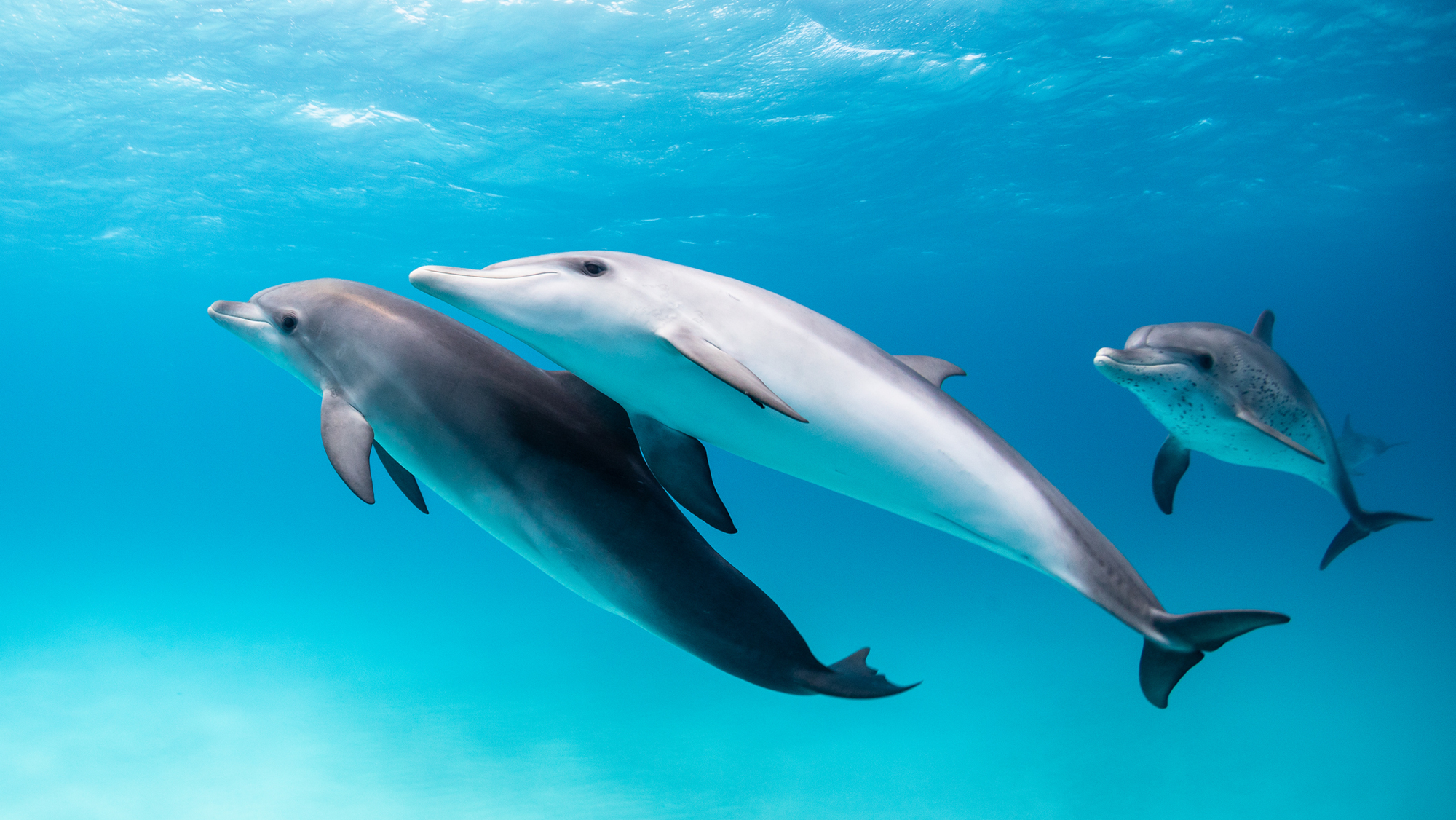
Do Animals Have Names? Scientists Find Evidence of Name-Like Calls
Every person has a name, and many people name their pets. But are names unique to humans, or do animals also use specific sounds to identify one another?
Research suggests that some highly social mammals and birds may use vocal labels that function much like names. Bottlenose dolphins show the strongest evidence so far, while studies of elephants, parrots and marmosets suggest that name-like communication may be more widespread than scientists once believed.
Do dolphins call each other by name?
In the 1960s, researchers discovered that young bottlenose dolphins (Tursiops) develop individually distinctive whistles known as signature whistles.
These whistles are not simply a reflection of each dolphin’s voice. Instead, they appear to have a distinctive sound pattern that can identify an individual dolphin. Researchers have tested this idea by playing recorded whistles through underwater speakers and observing how dolphins respond.
Studies indicate that dolphins can recognize a signature whistle even when it is produced by another dolphin—or reproduced electronically. Dolphins may also copy the signature whistles of other individuals to attract their attention, initiate contact or refer to them when they are out of sight.
“Just as humans use names, dolphins may use another dolphin’s signature whistle to initiate contact and recognize an individual,” researchers have suggested. The evidence is especially compelling because dolphins appear to respond to the whistle’s frequency and sound pattern, rather than simply to the caller’s voice.
Latest videos fromLive Science
Additional research has found that dolphins use these whistles within a complex social system. They may use individual vocal labels while maintaining contact with group members, recognizing one another and coordinating activities.
Can elephants use names?
Wild African elephants (Loxodonta africana) also appear to use individual-specific calls. In a 2023 preprint study, researchers used playback experiments to investigate whether elephants responded differently to calls associated with particular individuals.
The elephants produced low rumbling sounds that varied from one animal to another. When a recording associated with an individual was played, the elephant being addressed tended to approach the speaker more quickly and vocalize more often.
These results suggest that elephants may recognize and respond to individual vocal labels. However, the study has not yet undergone peer review, so scientists say the findings should be interpreted cautiously. It remains unclear whether elephant calls are true names or simply vocalizations linked to an animal’s voice, behavior or social position.
Sign up for our newsletter
(Image credit: Marilyn Perkins / Future)
Sign up for our weekly Life’s Little Mysteries newsletter to get the latest mysteries before they are posted online.
Do parrots give names to other animals?
Some parrots may also use learned vocal labels. Research on spectacled parrotlets (Forpus conspicillatus), a small parrot species native to parts of Central and South America, suggests that the birds use distinctive calls to identify members of their social group.
Studies of captive parrots provide additional clues. In a survey of approximately 800 parrot owners, about half reported that their birds used specific vocal sounds for individual people or animals. Some owners said their parrots used the correct names for family members, pets and even household visitors.
These observations are intriguing, but they do not prove that parrots understand names in exactly the same way humans do. Parrots are skilled vocal learners and can copy sounds they hear from people. A bird may learn when to produce a particular word or sound without understanding its meaning as a symbolic label.
Further research is needed to determine whether wild parrots use vocal labels consistently, whether other birds understand those labels and whether the sounds represent specific individuals in the birds’ minds.

Elephants in Kenya’s Samburu National Reserve produce low rumbles that vary from one individual to another.
(Image credit: Michael Pardo)
What about marmosets?
A recent study of marmosets found that these small, highly social monkeys may direct specific vocalizations toward particular individuals. The monkeys also appeared to learn some of these calls from family members.
However, not all researchers agree that the calls should be classified as names. In playback experiments, the vocalizations were correctly identified only some of the time. Critics have suggested that marmosets could be imitating one another’s calls rather than using symbolic labels.
This debate highlights an important challenge: animal communication can resemble human language without functioning in precisely the same way.
How do scientists define an animal name?
It is difficult to determine whether an animal sound is a name because humans typically define names as symbolic vocal labels attached to specific individuals. To apply that definition to animals, researchers need evidence that goes beyond an individual having a distinctive call.
One proposed framework includes at least three requirements:
- Individual reference: The sound consistently represents a specific animal.
- Symbolic meaning: The sound refers to the individual rather than merely copying that animal’s voice.
- Shared understanding: At least two animals associate the vocal label with the same individual.
By these standards, bottlenose dolphins currently provide the strongest evidence for name-like communication. More research is needed to determine whether elephants, parrots and marmosets meet all of the criteria.
Why would animals need names?
Name-like calls could be particularly useful for animals that live in large, complex societies. Individuals may separate from their groups, travel through dense habitats or need to coordinate with companions that are temporarily out of sight.
Species that appear to use individual vocal labels also tend to share two traits: they are highly social and capable of learning new sounds. These abilities may have evolved separately in different animal groups as a response to similar social pressures.
Studying animal names could also reveal more about animal intelligence. If an animal can create or recognize a vocal label for another individual, it may be forming an abstract mental representation of that animal.
“For humans, names are part of our personality and sense of self,” biologist Lauryn Benedict told Live Science. “If animals have names and respond to names, that suggests they may have a sense of self and of other individuals as distinct beings.”
Scientists remain cautious about claiming that animals use names exactly as humans do. Still, evidence from dolphins, elephants, parrots and marmosets suggests that name-like communication may be more common in the animal kingdom than previously thought.
Other social species—including baboons, giraffes and crows—also live in groups and possess sophisticated vocal-learning abilities. Although researchers have not yet demonstrated that these animals use names, they may be promising subjects for future studies.
How much do you know about the animal kingdom? Test your knowledge with our animal quiz!
Topics
Source: www.livescience.com