


Prime Editing Used Inside the Human Body for the First Time to Treat Wilson’s Disease
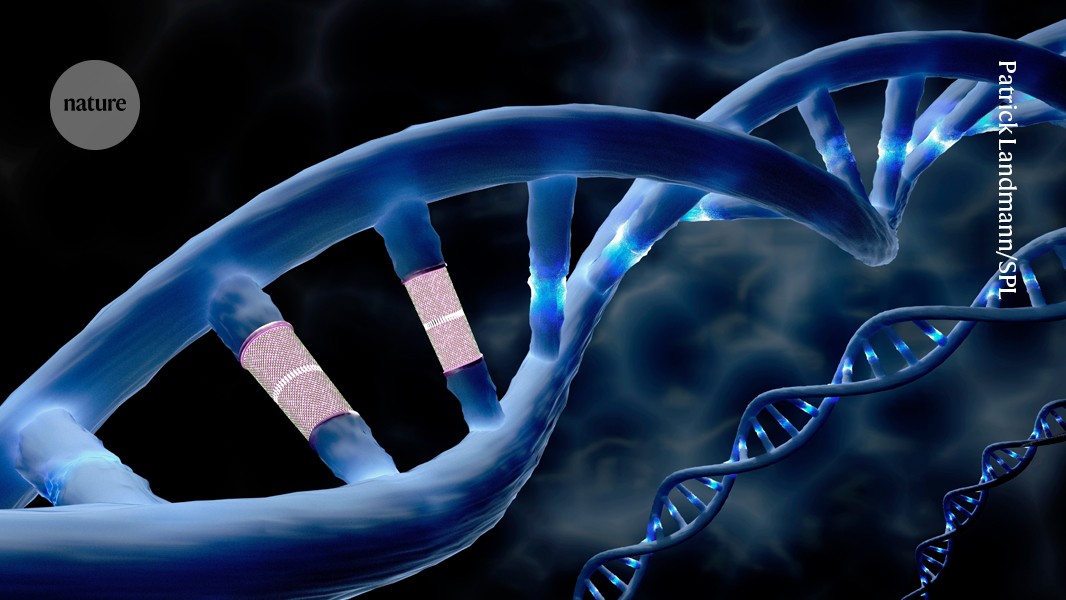
DNA can be minutely edited using a method called prime editing (illustration by the author).
Credit: Patrick Landmann/Science Photo Library
Scientists have used a powerful gene-editing technique to directly edit DNA inside a person’s body. It is the first known treatment of its kind.
The milestone treatment is part of a clinical trial using prime editing, a technology that can alter DNA with greater precision than the standard CRISPR-Cas9 method. In this case, prime editing was used to treat Wilson’s disease by rewriting the DNA of liver cells and correcting mutations that prevent the cells from removing excess copper.
Prime Medicine, a biotechnology company based in Cambridge, Massachusetts, announced that it had treated the first person earlier this month. The first study results are expected to be published next year.
Bigger than CRISPR? A guide to modern genome editors
“I never thought in my lifetime this would be applied to my rare disease,” said Rhonda Rowland, president of the Wilson Disease Association in Atlanta, Georgia. “It’s going to be a really exciting year.”
With the trial, Prime Medicine joins a number of companies aiming to manipulate cells directly inside the body, rather than using the standard approach of extracting a person’s cells, editing their DNA in a laboratory and reinjecting the modified cells. Editing DNA in vivo could make treatments faster and less expensive than creating personalized therapies from each person’s own cells.
However, in vivo approaches present their own challenges. “It depends on what kind of risk you’re willing to accept,” says Krishanu Saha, a biomedical engineer at the University of Wisconsin–Madison.
Why prime editing could help treat Wilson’s disease
Wilson’s disease is caused by mutations in a gene called ATP7B. The gene encodes a protein that transports excess copper out of the liver. If left untreated, copper buildup can cause liver and nerve damage, as well as neuropathy.
People with Wilson’s disease want a one-time treatment rather than the current complex regimen of copper-scavenging molecules and other drugs, Rowland said. In theory, gene editing could provide a permanent solution by correcting the defect in the ATP7B gene.
So far, the U.S. Food and Drug Administration (FDA) has approved only one gene-editing therapy, called Casgevy, for two inherited blood disorders. Casgevy relies on CRISPR-Cas9 gene editing, which is often used to disable genes rather than rewrite their sequences.

Strange CRISPR enzyme kills cancer cells by shredding their DNA
Another form of gene editing, called base editing, can rewrite individual DNA letters but cannot make the specific modifications needed to correct the most common ATP7B mutation. That leaves prime editing as a more complex and versatile system that can insert, delete and rewrite DNA segments.
In another clinical trial, Prime Medicine used its technology to treat two people with a rare immune disease by rewriting the DNA of each participant’s blood stem cells outside the body and then returning the modified cells to the body.
No gene-editing therapy has yet been approved for use in vivo. However, the FDA could approve an in vivo CRISPR-Cas9 therapy early next year for hereditary angioedema, a condition that causes severe swelling.
Source: www.nature.com