


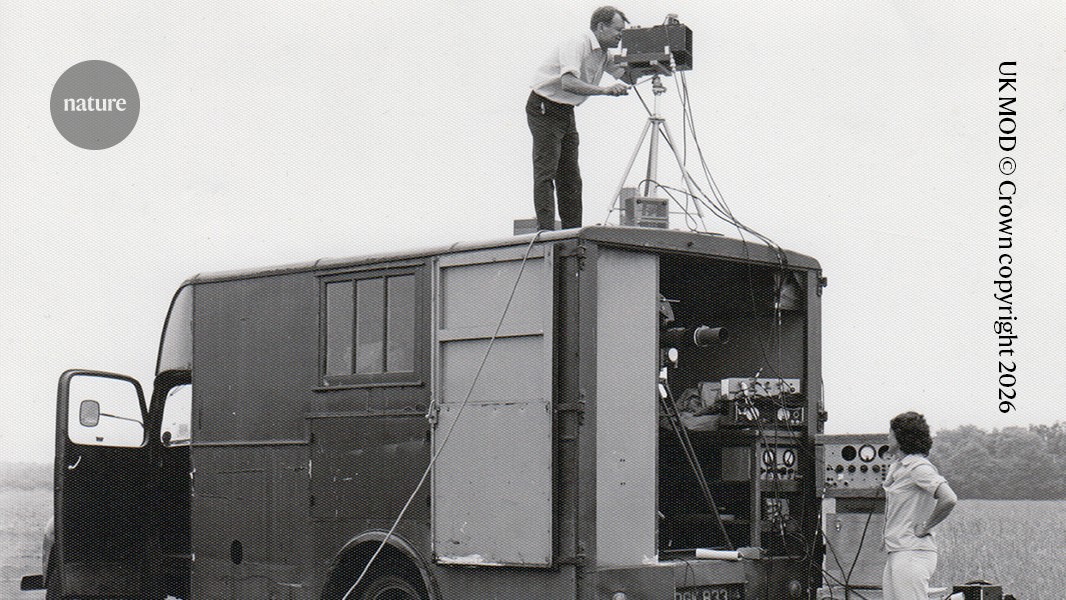
Shirley Jenkins flew test vehicles with colleagues in the Royal Aircraft Establishment Infrared Group during the 1970s.
Credit: UK MOD © Crown copyright 2026
In the early 1980s, a BBC film followed Susan James as she measured noise from a flying Westland Sea King helicopter. After the flight, James processed the data in the acoustics laboratory of the Royal Aircraft Establishment (RAE), a major research centre operated by the British Ministry of Defence.
James joined the RAE in 1979, aged 19. A few years later, James appeared in a British Broadcasting Corporation film designed to promote careers in the UK scientific civil service. In the programme, James described working at the RAE as “a good job with a bright future”.
At the time, the RAE was one of Europe’s largest government research centres, employing several thousand people at its Farnborough site. Its scientists and engineers conducted research, testing and analysis across aerodynamics, aircraft systems, acoustics and weapons technology.
Government scientists and engineers had demonstrated their value during the Second World War by leading advanced research programmes and providing scientific advice to policymakers. Their work helped establish the UK scientific civil service as an important career path for researchers and engineers.
By 1976, an estimated 5% of science and engineering graduates in the United Kingdom were entering the scientific civil service. Many followed career paths outside universities and commercial industry. The wider civil service employed tens of thousands of people, including a large community of scientists and engineers working in specialist research establishments.

Susan James works in the acoustics laboratory at the Royal Aircraft Establishment in the 1980s.
Credit: UK MOD © Crown copyright 2026
Most scientific civil servants worked in research institutes attached directly to government departments. Others were based at departmental headquarters in London, assigned to military research units or posted overseas as scientific advisers to embassies.
One of more than 70 departmental research centres operating in the 1980s was the Building Research Establishment (BRE) in Watford. The BRE specialised in building materials, construction methods and civil engineering, employing approximately 500 people. Anthony Bravery worked there as a timber specialist until retiring in 2011.
In 2019, as part of doctoral research, Bravery was interviewed about the career. Bravery and James were among 20 former government scientists interviewed about how organisational change and the privatisation of the RAE and BRE affected their working lives. The interviews, which lasted between 2.5 and 19.5 hours, are now held in the British Library’s Sound Archive.
These accounts offer a detailed view of life in the UK scientific civil service during the late twentieth century. The interviewees described their daily work, career ambitions, technical achievements and close relationships with colleagues. Together, their memories reveal both the opportunities and limitations of government-funded research.
Anthony Bravery

Credit: Bill Knight
People joined the scientific civil service for different reasons. Some were attracted by the reputation of government research centres, while others wanted to apply science in the public interest. David Dunford joined the RAE in 1975, aged 16, because he was interested in practical, hands-on work. The RAE later supported his PhD in materials engineering, which he completed in 1994. He went on to collaborate with international teams in industry and academia.
Space-weather researcher Paul Cannon joined the RAE in 1981. He recalls being attracted to an environment that allowed researchers to work “between the extremes of academia and industry”. Mike Westby, who joined the RAE’s Weapons Systems Division in 1988, similarly valued the opportunity to conduct research without pursuing a PhD. For Steve Rooks, who worked on and later led the Farnborough air-systems research team, the appeal was the “excitement of the work and the people”.
The interviews depict a workplace that encouraged technical creativity and freedom of ideas but was also shaped by the rigid structures of the civil service. That balance changed dramatically in 1982, when the Falklands conflict created an urgent demand for military technology. Cannon recalls that equipment had to be put on aircraft bound for the South Atlantic quickly, leaving little time for lengthy procurement negotiations with industrial suppliers.
Paul Cannon

Credit: Bill Knight
Some interviewees described clear career paths and long-term job security. They also recalled a bureaucracy in which grades, promotion systems and hierarchy could create frustration.
Carol Atkinson joined the BRE as a project manager in 1990 after working as a research chemist for the British electronics company GEC. She remembers widespread resentment about grades and perceived unfairness in promotion decisions: “I think grades and hierarchy bothered a lot of people.”
Although promotion did not depend on publishing research papers, many scientists still wanted their work to be recognised. Bravery recalls that the goal was not simply to receive a monthly salary but to publish research that would attract attention from scientists in countries such as Germany, France and Switzerland. International recognition was a powerful motivation for producing high-quality work.
Informal workplace traditions also helped maintain connections between colleagues. Coffee breaks and Friday pub lunches provided opportunities to discuss research, exchange ideas and keep track of projects.
David Dunford

Credit: Bill Knight
Women’s experiences in government research
Women working in UK research centres faced additional barriers before equal-opportunities legislation was introduced during the 1970s. Mothers in particular encountered restrictions that affected their careers, working hours and access to promotion.
Materials scientist Sarah Herbert joined the RAE in 1971 after completing her PhD at Victoria University, now part of the University of Manchester. She married while studying for her doctorate and later experienced the expectations placed on women scientists with families.
Sarah Herbert

Credit: Bill Knight
Shirley Jenkins joined the RAE in the early 1970s to work on the development of infrared technology for defence countermeasures. During a 50-year career, she flew approximately 1,000 hours in Canberra and Comet aircraft that had been modified for scientific research.
Jenkins and Herbert described the attitudes they encountered as women scientists and working mothers.
“They still didn’t take me seriously even though I had two kids and went straight back to work,” Jenkins said. “At the time, they didn’t feel they could trust me to be there and do my job.”
Herbert recalled that women were generally expected to leave work after starting a family. Childcare was limited, and employers often assumed that a woman with children would not remain in her career.
When Herbert’s manager agreed to let her work part-time to meet her caregiving responsibilities, the response was patronising. He “patted me on the head like I was a little dog”, she says.
Women returning to work after giving birth often found themselves moved into roles with less responsibility and lower status.
The Employment Protection Act 1975 established the principle of paid maternity leave, although it was not initially aimed at all women workers. By the end of the 1980s, employees at some research centres had access to on-site childcare and up to six months of maternity leave, James said.
How privatisation changed UK research centres
In 1979, Margaret Thatcher, a former industrial chemist, became prime minister of the United Kingdom. Her Conservative government introduced reforms intended to make the civil service more efficient and commercially focused.
Roger Courtney, director of the BRE from 1988 to 1990, described the political climate at the time: “You worked in a political context where public servants felt unloved. There’s no question about it — the private sector is good and the public sector is bad.”
Efficiency programmes reduced staffing and streamlined the infrastructure of government research. The BRE and RAE first became executive agencies, operating with greater independence from central government, before moving into the private sector. In 2001, the Defence Research Agency was divided between the privately owned QinetiQ and the government-run Defence Science and Technology Laboratory (Dstl).
Old equipment was removed, smaller sites were closed and staff numbers fell. Commercial targets and new management systems changed the workplace, making it more similar to an industrial research-and-development laboratory or technical services organisation.
For some employees, the reforms weakened the sense of belonging to a stable and supportive scientific community. For others, the changes dismantled outdated structures that had limited creativity and innovation.
Dunford explained that tight commercial deadlines created a different kind of pressure and changed how scientists approached their work.
Wendy Westby, an analytical chemist at the Farnborough research organisation, described the pressure to sell every hour of staff time to project managers. Even unexpected equipment failures could become a financial concern if they required unplanned work.
Jenkins questioned whether the new priorities always supported good science. “It became more important to do things on time and on budget, and less important whether we actually accomplished something,” she says.
James regretted losing the time needed to think deeply about research problems. In the new environment, James felt unable to carry out work with the same depth and robustness as before.
Source: www.nature.com