


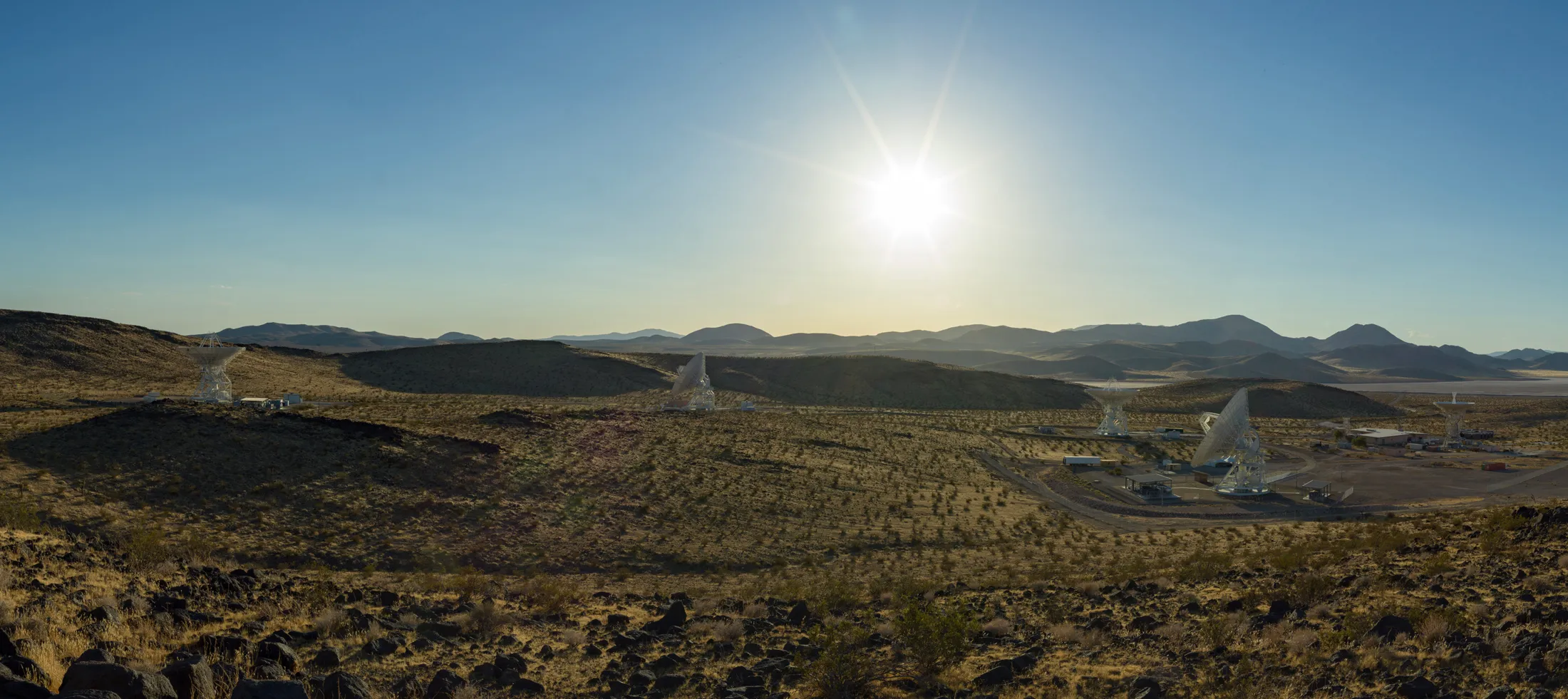
NASA has marked the completion of a new 34-meter (114-foot) radio antenna at the Goldstone Deep Space Communications Complex in California. Known as Deep Space Station 23 (DSS-23), the antenna expands the agency’s Deep Space Network (DSN), which provides critical communications and navigation support for more than 40 spacecraft exploring the Moon, Mars, the outer solar system, and interstellar space.
Located near Barstow, California, the Goldstone facility is managed by NASA’s Jet Propulsion Laboratory (JPL) in Southern California. Along with NASA’s facilities in Madrid, Spain, and Canberra, Australia, Goldstone forms one of the three worldwide complexes that make up the Deep Space Network.
NASA leaders, staff members, and senior officials gathered at the completed DSS-23 antenna for a ceremonial ribbon-cutting event. The antenna is the latest addition to NASA’s Deep Space Network Aperture Enhancement Project, an initiative launched in 2009 to modernize and expand the network with six new 34-meter multifrequency beam waveguide antennas.
These advanced antennas can operate across multiple radio frequencies, allowing them to support a wide range of NASA missions and spacecraft.
“By expanding the Deep Space Network, we are strengthening the communications infrastructure NASA needs for future bold missions, from exploring the Moon to exploring the depths of the solar system,” said James Kenyon, deputy administrator for the Research and Technology Mission Directorate at NASA Headquarters in Washington. “This new antenna will help us meet our national goals for space exploration and push boundaries that were once thought impossible.”
DSS-23 began tracking spacecraft and supporting mission communications on August 3, following a testing campaign conducted from May through July. Since entering service, the antenna has communicated with dozens of spacecraft, including NASA’s Mars Reconnaissance Orbiter, Psyche, Juno, Voyager 1, and other robotic missions exploring deep space.
“The addition of this next-generation antenna brings us closer to a fully modernized network that incorporates advanced technologies to ensure NASA’s leadership in deep space communications,” said JPL Director Dave Gallagher. “After more than 60 years of continuous operation supporting critical missions, these upgrades prepare the network for a new era of exploration. The team that designed, planned, and built DSS-23 should be proud.”
Construction of DSS-23 began with the antenna’s groundbreaking. After the 133-ton metal reflector framework was installed and bolted to the antenna pedestal in December 2024, engineers attached panels that reflect radio signals traveling between the antenna and spacecraft. Teams then carefully tuned and calibrated the system so it could operate with the rest of the Deep Space Network.
DSS-23 is now the fifth antenna at the Goldstone complex, joining three existing 34-meter antennas and one 70-meter (230-foot) antenna. It is also the fifth antenna completed under NASA’s Deep Space Network expansion project. The network includes antenna complexes in Goldstone, Madrid, and Canberra, Australia.
Multifrequency beam waveguide antennas route signals to a stable, temperature-controlled basement. This design keeps heavy and sensitive electronics out of the moving antenna structure, improving operational flexibility while making maintenance and future upgrades easier.
“The biggest challenge wasn’t actually building the antenna; it was converting a complex collection of mechanical, electrical, software, radio frequency, and infrastructure systems into a single mission-capable asset,” said Jermaine Aziz, project manager for the Deep Space Network Aperture Enhancement Project at JPL. “Supporting NASA’s deep space missions requires all subsystems to be integrated, calibrated, and verified to operate with exceptional accuracy and reliability.”
The Deep Space Network modernization project will be completed when the sixth enhancement-project antenna, Deep Space Station 33, becomes operational at NASA’s Canberra complex in 2029. At that point, the network will have 13 antennas measuring 34 meters in diameter.
Together, groups of 34-meter antennas provide communications backup comparable to a single 70-meter antenna at each DSN facility. This added redundancy is especially important because many of the network’s existing antennas have been operating nearly continuously for more than 50 years, making maintenance and repairs increasingly expensive.
JPL, managed by the California Institute of Technology for NASA, operates the Deep Space Network under the oversight of NASA’s Space Communications and Navigation (SCaN) program within the Research and Technology Mission Directorate. More than 100 NASA and non-NASA missions rely on NASA’s deep space and near-space communications networks, including missions supporting astronauts aboard the International Space Station, future Artemis lunar missions, Earth-observation programs, and spacecraft exploring the Moon, the solar system, and beyond.
For more information, visit NASA’s Deep Space Network resource.
Source: www.nasa.gov