


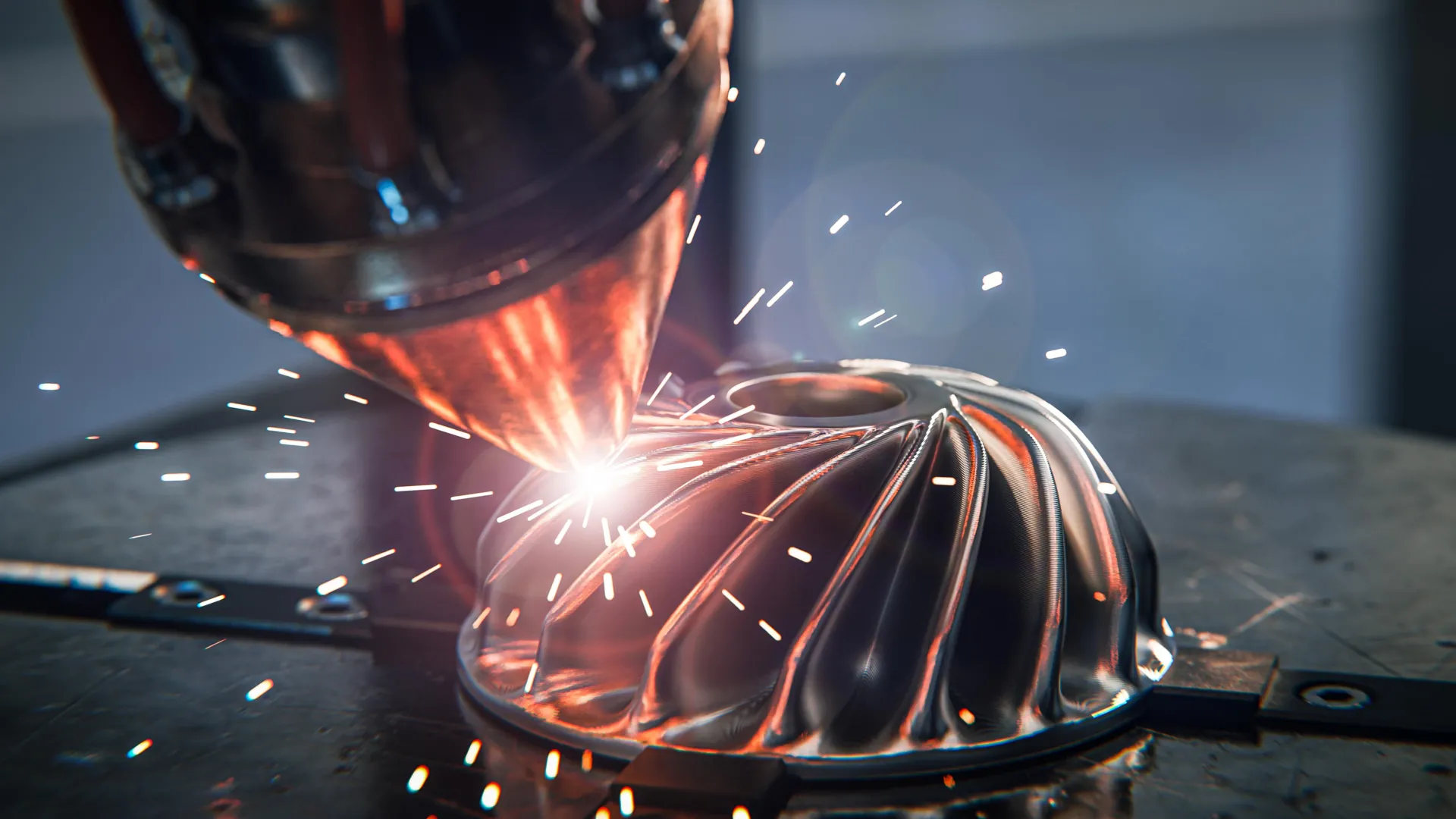
Researchers at Washington State University have developed an artificial intelligence (AI) method that makes 3D printing high-performance metal alloys faster, less expensive, and more efficient. The approach eliminates the need to manually test more than 100 million possible metal 3D-printing configurations.
The breakthrough could eventually make GRCop-42, a high-performance alloy widely used in aerospace, compatible with more common commercial 3D printers. The AI strategies developed by the research team may also support other scientific fields involving large numbers of costly experiments, including drug discovery.
Researchers from WSU’s School of Electrical Engineering and Computer Science and School of Mechanical and Materials Engineering presented the study at the AAAI Conference on Artificial Intelligence. The project also received the Innovative Deployed Application Award at the organization’s annual conference.
“Ninety percent of commercial printers can’t print this metal alloy. Since we were able to identify workable process parameters, we can now use those commercial printers and essentially democratize the 3D printing of this alloy,” said Jana Doppa, Huey Rogers Endowed Professor of Computer Science and Berry Distinguished Professor of Engineering, who led the study.
NASA-developed alloy designed for extreme heat
GRCop-42 is a copper, chromium, and niobium alloy developed by NASA for demanding environments where heat resistance and efficient thermal transfer are essential.
The alloy is used in aerospace systems, including liquid rocket engine combustion chambers, because it combines high thermal conductivity with strength at extreme temperatures. However, 3D printing GRCop-42 has traditionally been difficult and expensive because the process generally requires high laser power and substantial energy.
Previous efforts to 3D print GRCop-42 with the lower laser power available on many commercial machines were unsuccessful. Testing every possible combination of printing conditions is also impractical. Each experiment requires expensive materials, specialized equipment, and significant human effort. A single print can cost hundreds of dollars, while analyzing a completed sample can take several days.
“Sometimes when we printed certain configurations, the material melted,” said Aza Fadel, lead author of the study and a doctoral student in computer science. “It wasn’t really something you could print, and it wasn’t practical to spend the time and money testing all 100 million options. We used AI to efficiently select promising candidates from this enormous search space.”
AI searches more than 100 million 3D-printing possibilities
The researchers began with data from 37 printing configurations that had failed during earlier experiments conducted by the School of Mechanical and Materials Engineering.
Using those results, the team developed an AI model capable of estimating the likelihood that untested combinations of printing parameters would succeed. The model then recommended a small number of new configurations for researchers to test.
The AI-guided process balanced two priorities. Some experiments targeted configurations that appeared especially promising, while others explored uncertain areas of the search space that could provide new information and improve the model’s predictions.
Nathaniel Zuckschwerdt, Susmita Bose, and Amit Bandyopadhyay from the Department of Mechanical and Materials Engineering worked with the team to 3D print GRCop-42 using the AI-selected parameters and analyze the resulting samples. Aryan Deshwal of the University of Minnesota also contributed to the project.
“They returned results, even when the experiments failed, because every result improved our AI model,” Fadel said.
Lower laser power could expand access to metal 3D printing
Successfully 3D printing GRCop-42 with less laser power could provide several benefits. Lower power requirements may reduce energy consumption, limit wear on additive manufacturing equipment, and decrease the costs associated with processing and analyzing printed samples.
The development could also make GRCop-42 accessible to universities, small research laboratories, and businesses that lack specialized high-power metal 3D-printing systems.
The challenge was that the researchers knew successful configurations were extremely rare among the more than 100 million possible combinations of printing parameters.
“This is a very difficult case for AI,” Doppa said. “Each attempt essentially produces a binary signal: success or failure. The goal is to minimize the number of experiments and find the successful needle as quickly as possible.”
During three months of research, the team identified six successful configurations at different laser power levels while conducting only 40 experiments. For the first time, the researchers successfully 3D printed GRCop-42 using just 500 watts of laser power.
AI-powered tools could accelerate scientific discovery
The researchers say the same AI-guided experimental strategy could help identify successful processing conditions for other metal alloys and additive manufacturing systems.
More broadly, the method could help scientists solve problems in which successful results are rare, the number of possible experiments is enormous, and testing every option would be too expensive or time-consuming. Potential applications extend beyond manufacturing to other areas of scientific discovery where experiments require substantial materials, funding, or time.
“There is always uncertainty when implementing anything involving real people, materials, and physical costs,” Doppa said. “We didn’t know whether it would be successful, and there was always a risk. It was a very significant risk. I was very surprised that we were able to pull this off.”
Source: www.sciencedaily.com