


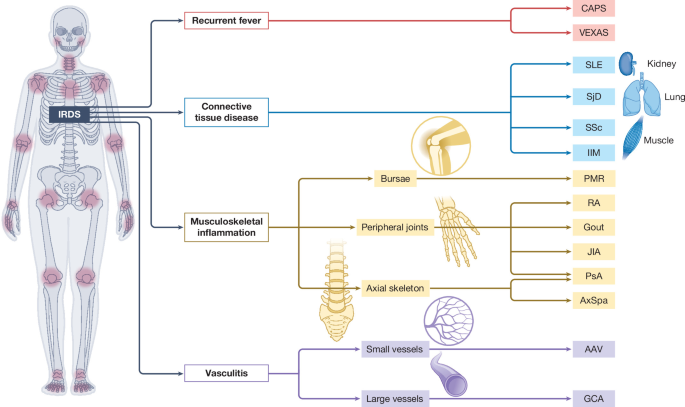
Research into rheumatic and autoimmune diseases is moving from broad clinical labels toward a more detailed understanding of the immune cells, genetic variants and tissue signals that drive disease in individual patients. The literature cited here traces that shift from cytokine-targeting drugs and biologic therapies to molecular phenotyping, immune-cell profiling, precision treatment and, increasingly, approaches intended to reset or selectively rebuild the immune system.
From inflammation control to precision treatment
Rheumatic diseases have long been associated with substantial illness and mortality. Epidemiological work has documented differences in incidence, prevalence, mortality and comorbidity across these conditions, while research into rheumatoid arthritis (RA) helped establish tumour necrosis factor (TNF) and other cytokines as therapeutic targets. The development of anti-TNF therapy and later biologic drugs transformed RA treatment, and Janus kinase (JAK)-targeting medicines added another mechanism-based approach.
Clinical trials helped establish the effectiveness of these strategies. A 2012 New England Journal of Medicine trial found benefits from tofacitinib monotherapy in RA, while another compared tofacitinib and adalimumab with placebo. However, suppressing inflammation is not the same as eliminating the underlying disease. Reviews have noted that remission may not represent a cure, and the RETRO study found frequent relapses when antirheumatic treatment was tapered or stopped, particularly among patients with ACPA-positive RA.
These findings have encouraged researchers to look beyond disease names and identify the biological mechanisms active in each patient. A 2023 study in Nature used single-cell RNA sequencing of synovial tissue to define inflammatory subtypes of RA. In the phase 4 R4RA trial, molecular analysis of synovial biopsies helped predict responses to rituximab or tocilizumab. More recent STRAP and STRAP-EU trials tested biopsy-driven treatment selection in biologic-naive patients, and a 2025 analysis of STRAP samples reported molecular signatures associated with responses to biologic therapies.
Genetics and autoantibodies reveal disease before symptoms
Genetic studies show that autoimmune disease usually results from interactions among inherited susceptibility, environmental exposure and immune regulation rather than from a single cause. Variants in genes including PTPN22, TNFAIP3, PADI4, DNASE1L3, CTLA4 and TLR7 have been linked to autoimmune or rheumatic disease. Fine-mapping studies have found that many disease-associated variants lie in enhancers active in immune cells, helping connect genetic risk to specific cellular functions.
Autoantibodies can also appear years before clinical disease. Anti-nuclear autoantibodies may precede systemic lupus erythematosus (SLE) by several years, while anticitrullinated protein antibodies can precede RA. These antibodies are not simply diagnostic markers: studies have linked their properties and activity to inflammation, tissue damage and clinical features such as interstitial lung disease. In RA, antibodies against citrullinated proteins can contribute to osteoclast activation and bone loss, although a subset of citrullinated-protein antibodies has also been associated with protection from disease.
Research into SLE has highlighted the importance of immune complexes, B cells and type I interferon. Nucleic-acid-containing immune complexes can activate plasmacytoid dendritic cells through Toll-like receptor 7 (TLR7), inducing interferon production. Genetic studies have identified hyperactive TLR7 variants as major drivers of some cases of human lupus, while variants in UNC93B1 can contribute to TLR7-dependent autoimmunity. These findings have helped motivate efforts to target interferon signalling, endosomal toll-like receptors and related pathways.
Immune-cell networks shape tissue damage and repair
Autoimmune inflammation is produced by interacting populations of immune and tissue-resident cells. In RA, expanded PD-1hiCXCR5−CD4+ peripheral helper T cells have been identified in inflamed synovial tissue, where they can support B-cell activity. Other studies have implicated macrophage subsets, synovial fibroblasts and osteoclasts. Some synovial macrophages are associated with remission, and resident macrophages can form an anti-inflammatory barrier that helps prevent spontaneous joint inflammation. By contrast, distinct fibroblast populations can promote inflammation and structural damage.
Similar tissue-specific mechanisms are being investigated across the rheumatic diseases. In spondyloarthritis, enthesitis—the inflammation of tendon and ligament attachment sites—is a characteristic feature, and studies have connected it to IL-23-responsive resident T cells. The IL-23 and IL-17 pathways also link inflammation in the skin, gut and joints and have become therapeutic targets in psoriasis, psoriatic arthritis and axial spondyloarthritis.
Autoinflammatory diseases differ from classic autoantibody-driven disorders but can overlap with them. Mutations affecting the NLRP3 inflammasome cause inherited periodic fever syndromes, and IL-1 blockade has shown clinical efficacy in cryopyrin-associated periodic syndrome. Acquired somatic mutations in UBA1 cause VEXAS syndrome, illustrating how mutations that arise during a person’s lifetime can produce severe adult-onset inflammation. Recent studies have also examined clonal haematopoiesis, mosaic loss of chromosome Y and age-related immune changes as possible contributors to distinct rheumatic disease phenotypes.
Therapeutic strategies are becoming more targeted
Therapy for SLE has expanded beyond conventional immunosuppression. Trials have supported the use of belimumab, which targets B-cell survival signals, and anifrolumab, an antibody against the type I interferon receptor. Deucravacitinib, a TYK2 inhibitor, has also been investigated in SLE. More intensive B-cell and plasma-cell depletion strategies include rituximab, obinutuzumab and daratumumab; a large 2025 trial reported efficacy and safety data for obinutuzumab in active lupus nephritis.
Cell-based therapies are being studied as a possible way to achieve deeper immune remissions. Early reports described CD19-targeted chimeric antigen receptor (CAR) T-cell therapy in refractory SLE, followed by case series reporting sustained, drug-free remission in some patients with autoimmune disease. Other reports have explored teclistamab, a BCMA-targeted T-cell engager, and CAR T-cell treatment in systemic sclerosis and ANCA-associated vasculitis. A 2026 phase 1/2 CASTLE basket trial examined CD19 CAR T cells in treatment-refractory autoimmune diseases, while a 2026 phase 1 trial investigated the approach in seropositive RA.
These approaches remain distinct from routine treatment and require careful evaluation of their risks, durability and effects on immune protection. Research is also exploring more selective options, including CAR T cells directed at disease-associated B cells, targeted depletion of particular T-cell receptor populations and small molecules that inhibit intracellular inflammatory pathways. The broader goal is an “immune reset”: suppressing disease-causing immune memory while preserving or restoring normal immune function.
Why disease classification is changing
The expanding body of work suggests that rheumatic diseases cannot always be understood as isolated, uniform entities. Patients who share a clinical diagnosis may have different genetic risks, immune-cell populations, tissue environments and dominant signalling pathways. Conversely, apparently different diseases may share mechanisms such as abnormal interferon activity, B-cell dysregulation, IL-23 signalling, defective clearance of apoptotic cells or inflammasome activation.
Studies using cohort-wide immunophenotyping, single-cell sequencing, molecular taxonomy and tissue biomarkers are therefore pushing rheumatology toward biologically defined subgroups. The challenge is to turn these research tools into reliable clinical tests that can guide treatment, predict relapse and identify patients before irreversible organ or joint damage occurs. The cited studies point toward a future in which treatment is selected not only by the name of a disease, but also by the specific immune programme active in each patient.
Selected sources
- Gabriel, S. E. & Michaud, K. “Epidemiological studies in incidence, prevalence, mortality, and comorbidity of the rheumatic diseases.” Arthritis Res. Ther. 11, 229 (2009). Article
- Feldmann, M. “Development of anti-TNF therapy for rheumatoid arthritis.” Nat. Rev. Immunol. 2, 364–371 (2002). Article
- Tanaka, Y., Luo, Y., O’Shea, J. J. & Nakayamada, S. “Janus kinase-targeting therapies in rheumatology: a mechanisms-based approach.” Nat. Rev. Rheumatol. 18, 133–145 (2022). Article
- Zhang, F. et al. “Deconstruction of rheumatoid arthritis synovium defines inflammatory subtypes.” Nature 623, 616–624 (2023). Article
- Rivellese, F. et al. “Rituximab versus tocilizumab in rheumatoid arthritis: synovial biopsy-based biomarker analysis of the phase 4 R4RA randomized trial.” Nat. Med. 28, 1256–1268 (2022). Article
- Furie, R. A. et al. “Efficacy and safety of obinutuzumab in active lupus nephritis.” N. Engl. J. Med. 392, 1471–1483 (2025). Article
- Müller, F. et al. “CD19 CAR T-cell therapy in autoimmune disease – a case series with Follow-up.” N. Engl. J. Med. 390, 687–700 (2024). Article
- Junt, T. et al. “Defining immune reset: achieving sustained remission in autoimmune diseases.” Nat. Rev. Immunol. 25, 528–541 (2025). Article
Source: www.nature.com